
Bulk Materials Handling and Storage Strategies for Dusty, High-Volume Plants





In a dusty, high-volume plant, the moment of truth is often not at the loading point or the dispatch gate. It happens in the less visible spaces: beneath a transfer chute, inside a reclaim tunnel, at the top of a stockpile, or around a bin that has stopped flowing as expected. Dust escapes, moisture changes, fines segregate, a belt mistracks, and a manageable operating issue can quickly become a quality deviation, a safety concern, or an unplanned interruption.
For quality-control and safety leaders, bulk materials handling and storage is therefore much more than a logistics function. It is a connected control system for material condition, worker exposure, equipment reliability, and production continuity. Whether a facility handles coal, ores, aggregates, cement raw meal, grain, minerals, fertilizers, or industrial powders, the same principle applies: material must remain contained, traceable, stable, and available from receipt through processing or shipment.
The best strategies do not begin with a single dust collector or a larger storage vessel. They begin by understanding how the material behaves across the complete flow path—and by treating every transfer, storage zone, and reclaim point as part of one operational environment.
Start with the material, not the equipment catalogue
Many handling projects become difficult because equipment selection starts before the plant has defined its material risks. “Bulk material” is not one category. A dry, free-flowing crushed mineral behaves very differently from damp coal fines, cohesive limestone powder, abrasive iron ore, or a fertilizer blend that absorbs moisture from the air.
Before changing conveyors, chutes, hoppers, or storage arrangements, establish a practical material profile. This should include particle-size distribution, bulk density, moisture range, dustiness, angle of repose, abrasiveness, flowability, tendency to segregate, and any sensitivity to degradation, heat, or contamination. For safety teams, combustible dust potential and exposure limits also belong in this profile. For QC teams, define what “out of specification” looks like: excessive moisture, foreign material, loss of blend uniformity, unacceptable fines generation, or cross-contamination between grades.
These characteristics influence nearly every later decision. They determine belt speed, chute geometry, liner selection, enclosure requirements, storage shape, feeder design, and the type of inspection needed. A solution that works well for coarse, dry aggregate may create ratholes and carryback when applied to a fine, cohesive powder.
It is equally important to record how the material changes in real operations. Laboratory data is useful, but conditions at a port terminal, mine, power plant, or processing site can shift with seasonal rain, supplier variation, shipment age, and ambient temperature. The material arriving at the intake point may not behave like the material described in the original design file.
Map the points where quality and safety risks overlap
Dust, spillage, and material loss are sometimes treated as housekeeping issues. In reality, they are signals that a process boundary has failed. The same uncontrolled transfer point can expose workers to airborne dust, contaminate neighboring product streams, accelerate idler and bearing wear, obscure walkways, and undermine inventory accuracy.
A useful review follows the material journey rather than the organization chart:
- Receiving: Is incoming material sampled correctly? Are unloading areas protected from wind and vehicle traffic? Can off-spec material be isolated without disrupting normal flow?
- Conveying and transfer: Where does material accelerate, change direction, impact a surface, or fall through open air? These are common sources of dust generation and degradation.
- Storage: Can rainwater, humidity, foreign material, or residual stock affect product condition? Does the stockpile or silo create segregation, compaction, or dead zones?
- Reclaim and feed: Is material withdrawn consistently, or does the process pull from only one area of the pile or vessel? Are bridging and blockages creating hazardous intervention tasks?
- Maintenance access: Can personnel inspect, clean, and repair equipment without entering high-risk zones or working around uncontrolled dust releases?
This flow-based assessment often reveals that an apparently local issue has an upstream cause. A dusty discharge point may result from an overloaded feeder. Belt carryback may originate in poor chute loading. Repeated bin blockages may be driven by moisture variation during storage rather than by the feeder alone.
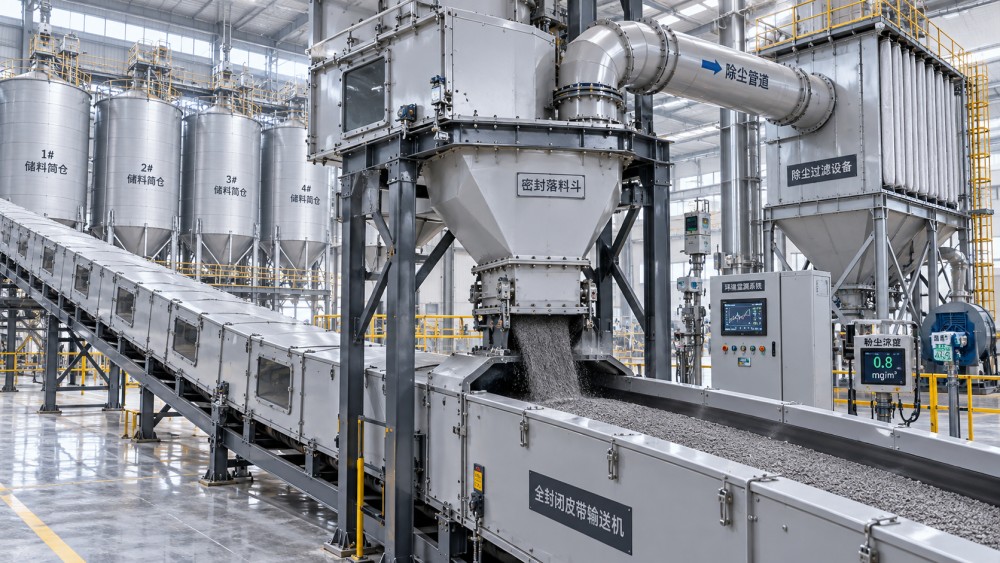
Design transfer points as containment zones
Transfer points deserve special attention because they combine impact, turbulence, material acceleration, and air displacement. In high-throughput systems, even a short uncontrolled drop can generate a dust cloud that travels well beyond the conveyor line.
Effective transfer design aims to keep material centered, controlled, and moving at a speed compatible with the receiving belt. Rather than allowing bulk solids to strike a chute wall and scatter, the chute should guide the stream in the direction of belt travel. This reduces belt wear, mistracking, impact damage, and the air movement that carries fine particles outward.
Containment is usually a layered arrangement, not one component. A fully enclosed loading zone, adequate skirt-board length, properly supported sealing, correctly selected impact support, and a stable belt path work together. If the belt sags between idlers or shifts laterally, even good sealing will struggle. Likewise, dust extraction installed on an open, poorly designed chute may collect some airborne material without addressing the source of the release.
For dusty plants, review the balance between enclosure and ventilation. Enclosures retain dust, but displaced air still needs a controlled route. Extraction systems should be designed around actual air volume, material loading conditions, and filter maintenance requirements. Over-extraction can pull valuable fines out of the product stream or create unwanted air currents; insufficient extraction allows pressure to force dust through gaps, access doors, and seals.
Simple operating observations are valuable here. If operators regularly see dust pulsing from a transfer hood, if skirts are continuously adjusted, or if cleanup crews revisit the same location every shift, the system is communicating that its containment design needs review.
Storage strategy is a quality-control decision
Storage is often viewed as a buffer between incoming and outgoing flow. In practice, it can be the place where product condition either remains stable or slowly deteriorates. The appropriate approach depends on the material, required inventory duration, environmental exposure, and blending needs.
Open stockpiles offer capacity and flexibility, particularly for ores, coal, aggregates, and other weather-tolerant materials. Yet they require disciplined controls. Wind can carry fines away from the pile and toward roads, structures, or adjacent products. Rain may increase moisture, create runoff, and affect downstream screening or combustion performance. Reclaim methods can also cause segregation if coarse and fine fractions settle or are removed unevenly.
Covered stockpiles, domes, sheds, silos, and enclosed warehouses provide better protection where moisture, contamination, or fugitive dust is critical. However, enclosure alone does not guarantee good storage integrity. Operators still need to manage pile formation, ventilation, condensation, drainage, access control, and residual material from previous campaigns.
For materials prone to self-heating, degradation, or compaction, storage time and inventory rotation should be actively managed. “First in, first out” is not merely an inventory phrase; it can be a practical safeguard against aged stock, changing moisture, or hidden quality variability. Where strict grade separation is needed, physical barriers, dedicated reclaim lines, documented cleanout procedures, and clear status labeling prevent the small cross-contamination events that later become difficult to explain.
Watch for segregation before it becomes a customer complaint
Segregation is especially easy to overlook in high-volume operations. When material is dropped from height, transported long distances, or piled repeatedly at one location, larger particles and fines may separate. The product may still look acceptable from the surface while its composition varies from one reclaim zone to another.
Controlled stacking patterns, multiple discharge points, telescopic loading equipment, and planned reclaim sequences can reduce this risk. Sampling plans should reflect the real storage and reclaim pattern, not just the convenient location near a conveyor. A representative sample taken at the wrong point can create false confidence.
Prevent blockages without normalizing hazardous intervention
Bridging, rat-holing, and compacted material in bins and hoppers are among the most persistent challenges in bulk materials handling and storage. They reduce throughput, distort feed consistency, and create pressure to “just clear it quickly.” That pressure is where safety discipline is most needed.
Manual entry into hoppers, silos, and chutes should never become a routine operational response. These spaces may involve engulfment, falling material, confined-space hazards, poor visibility, and unexpected equipment movement. The preferred strategy is to prevent no-flow conditions through appropriate hopper geometry, wall angles, liner selection, moisture control, and feeder design.
Where flow aids are required, they should suit the material rather than simply add vibration. Air cannons, vibrators, fluidizing systems, mechanical agitators, and acoustic devices each have operating limits. Used incorrectly, they can compact material, damage vessel walls, alter the product, or create new dust-release points. A recurring blockage should trigger a root-cause investigation that considers material variability, storage duration, vessel design, and operating sequence.
Build inspection into the operating rhythm
High-volume plants cannot rely on occasional visual checks alone. The objective is not to inspect everything constantly; it is to inspect the conditions that indicate loss of control. A well-designed routine combines operator observations, condition monitoring, sampling, housekeeping trends, and maintenance findings.
At minimum, teams should define clear checks for belt tracking, scraper performance, chute buildup, seal condition, filter differential pressure, spillage volume, dust accumulation, bearing temperature, abnormal vibration, and moisture-related changes in stored material. The information becomes more useful when it is recorded consistently. A note such as “dust high at transfer 4 during wet coal campaign” can help reveal a pattern that isolated alarms do not show.
Digital monitoring can strengthen this discipline, especially across large terminals and multi-line plants. Level sensors, belt scales, temperature probes, vibration monitoring, camera systems, and dust monitors provide earlier warning when paired with practical response rules. Data should support the people closest to the equipment, not bury them in dashboards. The key question is always: what action will this signal trigger, and who owns that action?
Choose improvements by risk reduction, not by visibility
Plants often prioritize the most visible problem area, which is understandable when dust is affecting an operator walkway or a customer visit. But the best investment sequence considers severity, frequency, exposure, production consequence, and likelihood of recurrence.
A transfer point that releases dust every shift may deserve priority over an occasional spill in a low-traffic area. A storage issue that changes product moisture may require faster action than a cosmetic enclosure upgrade. Similarly, a poorly accessible cleaning task can be a greater safety risk than the volume of material lost suggests.
For quality and safety managers, an improvement plan is stronger when each action is linked to a measurable control objective: reduce visible emissions at a transfer, maintain specified moisture range, eliminate manual clearing of a recurring blockage, reduce carryback at a discharge pulley, or improve traceability between received lots and reclaimed material. This creates a common language among operations, maintenance, engineering, and environmental teams.
Operational intelligence keeps the system connected
Bulk logistics does not operate in isolation. Mine output, rail unloading schedules, port vessel windows, plant consumption rates, and weather conditions all influence how material arrives, waits, moves, and is reclaimed. The same interconnected thinking seen in railway and terminal automation is increasingly relevant to bulk facilities: reliable flow depends on both robust mechanical design and timely operational insight.
For organizations tracking broader logistics and equipment developments, industry intelligence can help place local plant issues in context—from conveyor automation and remote inspection practices to dust-control expectations at bulk terminals and the changing reliability demands of high-volume transport networks. The purpose is not technology for its own sake. It is to make better decisions before a small handling weakness becomes a costly operational event.
Ultimately, effective bulk materials handling and storage protects more than throughput. It protects the integrity of the material, the confidence of the people who work around it, and the resilience of the supply chain that depends on it. When containment, storage discipline, maintenance access, and monitoring are treated as one system, dusty high-volume plants become easier to control—and far less dependent on last-minute intervention.
Related News
Related News
- 00
0000-00
What drives cargo handling automation pricing at container terminals? - 00
0000-00
Freight railway technology insights for reducing unplanned downtime - 00
0000-00
How rail logistics in the Middle East is reshaping freight corridor capacity - 00
0000-00
What railway rolling stock market analysis reveals about fleet demand - 00
0000-00
How axle load limits shape mainline railway freight capacity
Weekly Insights
Stay ahead with our curated technology reports delivered every Monday.