
Evaluating Skeletal Container Chassis Capacity for Loaded Boxes





A container chassis can appear suitable on paper and still be the wrong choice for a loaded box. A payload figure alone does not show how the container’s weight reaches the frame, whether the axle loads are acceptable, or whether the twist locks match the intended container positions. For purchasers, the useful question is not simply “How much can the trailer carry?” but “Can this trailer carry this load, in this position, throughout the intended operation?”
The answer depends on the combined limits of the container, chassis, running gear, coupling, tractor and route. Terminal-only use can change the applicable operating requirements, but it does not remove the need to assess structural capacity and safe load transfer. A procurement specification should distinguish those limits before comparing prices.
Define the load before comparing capacity ratings
Start with the maximum gross mass of the loaded container: the mass of the empty container plus its cargo and any packing or securing material inside. Do not confuse cargo mass with container gross mass. A chassis payload rating must accommodate the complete loaded box, not just the goods declared on a shipping document.
Next, establish the chassis tare mass and the gross vehicle or trailer mass rating stated by the manufacturer. The terminology on quotations can vary, so ask suppliers to define each figure and state what equipment is included in the tare. Spare wheels, landing gear, accessories and modifications can affect the available margin.
A practical preliminary check is:
- Loaded container gross mass: empty container plus cargo and internal securing materials.
- Chassis gross mass: loaded container gross mass plus actual chassis tare and any other equipment carried on the chassis.
- Allowable operating mass: the lowest relevant limit after considering the chassis, axles, tires, coupling, tractor and applicable route restrictions.
This is a screening method, not a substitute for a manufacturer’s load calculation or a legal assessment. The chassis gross mass is shared between the trailer axles and the tractor coupling; it should not be compared directly with the trailer axle rating as though all the weight rested on the trailer wheels.
Buyers reviewing a skeletal container chassis should request the payload rating together with a drawing showing the container positions for which it applies. A rating without an identified load position leaves an important question unanswered: whether the specified box can be carried within both structural and axle limits.
Check weight distribution, not just total weight
Two containers with the same gross mass can produce different axle loads. A box packed heavily toward one end shifts the combined center of gravity, while moving the container to another locking position changes how much load reaches the tractor and trailer axles. The tractor’s own weight and axle configuration matter as well.
Ask suppliers for an axle-load calculation using the intended tractor, container position and representative load distribution. The calculation should identify assumptions about the center of gravity, coupling height, wheelbase and unladen masses. If tractors vary across the fleet, evaluate the combinations that create the least margin rather than assuming one calculation covers every vehicle.
Where the cargo center of gravity is unknown or may move between shipments, ask what range of positions the chassis and vehicle combination can accommodate. A calculation based on a centered load is not evidence that an unevenly packed container will be acceptable. For operational verification, weigh the actual combination by axle or axle group where suitable weighing equipment is available, and compare the readings with the relevant vehicle ratings and route limits.
For illustration, if a loaded container has a gross mass of 28 tonnes and the chassis weighs 5 tonnes, the chassis and container together weigh 33 tonnes before adding the tractor. Those figures are hypothetical, not equipment ratings. They establish neither the individual axle loads nor the legality of the combination; the distribution calculation and applicable limits still control the decision.
Match the frame to the load path and duty cycle
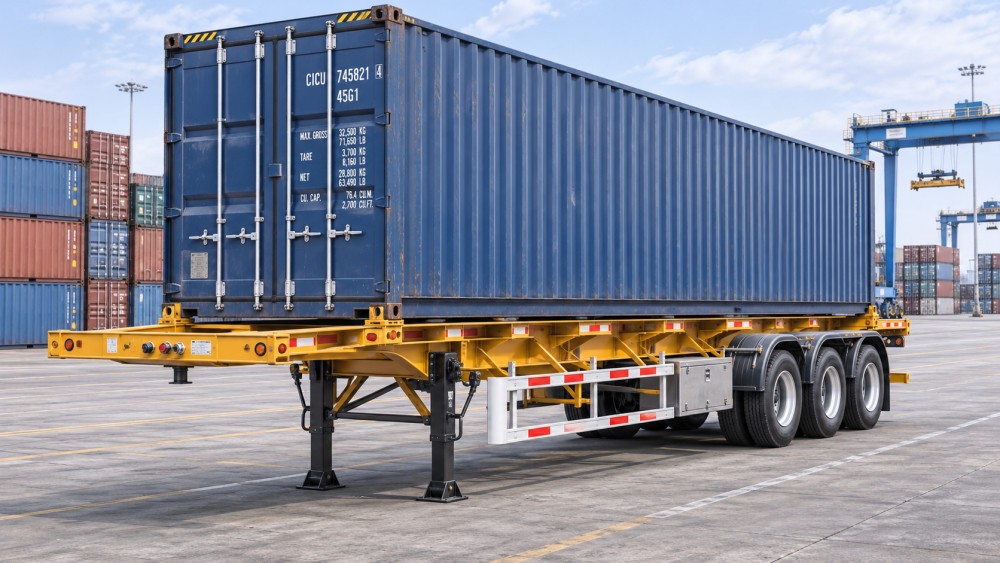
A skeletal frame carries container loads through defined support and locking locations rather than through a continuous deck. Buyers should examine where those locations connect to the main beams and crossmembers, and whether the supplier’s rated configuration matches the planned container length and position. A frame designed for one support arrangement should not be assumed suitable for another simply because the box can physically be placed on it.
Request a general arrangement drawing and a clear description of the load-bearing structure. Useful details include the locations of crossmembers, suspension attachments, kingpin structure, landing gear supports and twist-lock assemblies. Review any optional extensions or adjustable positions separately: their permitted loads may differ from the main frame’s rating.
Frame selection also depends on repeated operating conditions. Short terminal moves with frequent turns, coupling cycles and uneven pavement place demands on connections and suspension attachments. Longer road journeys introduce a different combination of distance, speed, braking and surface conditions. A chassis intended for both environments should be specified against both, rather than assessed only at its maximum static payload.
Steel grade or beam depth alone cannot establish durability. Geometry, connection details, weld quality, corrosion protection and the actual duty cycle all influence performance. Ask what inspection points the manufacturer recommends and whether replacement parts for stressed or wear-prone areas will be available over the planned service life.
Evaluate twist locks as part of the capacity decision
Twist locks locate and secure the container at its corner fittings. Their arrangement must match the container type and the intended carrying position, and operators need enough access to engage and verify them. A trailer may have several lock positions, but their presence does not automatically mean every combination is approved for every load.
Have the supplier identify the approved lock positions, the locking procedure and any limitations on container orientation or support. Check whether locks are fixed, retractable or adjustable, and how unintended movement is prevented during operation. For a mixed fleet, confirm compatibility with the containers actually handled, including any special equipment or unusual fittings.
During acceptance, use a representative container or an appropriate fit-check method agreed with the supplier. Verify alignment, engagement and release at each specified position. Inspect for damage, incomplete engagement and interference with adjacent components. The purpose is to confirm fit and function; a successful fit check does not prove the assembly’s structural load rating.
Container securing requirements depend on the jurisdiction and operation. In the United States, for example, Federal Motor Carrier Safety Regulations, 49 CFR 393.126, address the securement of intermodal containers transported on chassis and other vehicles. Buyers should check the applicable rules for their own routes and operating arrangements rather than assuming that a terminal practice satisfies road-transport requirements.
Separate terminal requirements from road requirements
A terminal tractor and a highway tractor may impose different coupling and operational requirements. Before requesting quotations, define whether the chassis will remain within a controlled site, travel on public roads, or do both. Include the expected coupling height range, turning space, ground conditions and whether the trailer will be parked loaded.
For road use, the specification must account for the requirements in each operating jurisdiction, including applicable axle and gross-mass limits, vehicle equipment and registration. As a U.S. reference, the Federal Highway Administration’s vehicle size and weight program explains federal limits on the Interstate System and the role of state administration. Other roads and jurisdictions can have different rules, so a manufacturer’s capacity plate is not by itself proof that a particular journey is legal.
For terminal-only operations, assess the site’s own rules, traffic patterns and handling equipment. Lower operating speeds do not eliminate the consequences of a poorly supported box, an overloaded tire or an incompatible coupling. If a chassis may later be transferred to road service, make that future use explicit before ordering; converting equipment after delivery may require more than adding visible road equipment.
Turn the operating requirement into a comparable quotation
A useful request for quotation describes the load and operating envelope rather than asking only for a nominal payload. Provide container types and lengths, maximum expected loaded gross masses, likely center-of-gravity variations, tractor details, road or terminal use, and the intended container positions. State whether the chassis must carry more than one container size and whether each configuration needs its own capacity declaration.
Ask each bidder to return the following information on a consistent basis:
- A rated capacity for each proposed container position, with assumptions and any restrictions stated.
- Chassis tare and gross rating, plus ratings for axles, tires, suspension, coupling and other relevant load-bearing components.
- A drawing identifying support points, twist-lock positions, principal dimensions and the intended tractor interface.
- An axle-load calculation for the specified tractor and load cases, including the assumed center of gravity.
- Documentation for inspection, maintenance, spare parts and any required identification plates or compliance evidence.
Compare the lowest usable margin, not merely the highest advertised payload. One proposal may have a higher structural rating but insufficient axle or tire capacity for the intended combination. Another may carry the load only in a position that is inconvenient for the terminal’s handling process. Clarify these differences before treating the prices as equivalent.
Plan acceptance and ongoing checks
Before delivery, agree on which documents and physical checks form acceptance. Reconcile identification plates and component markings with the purchase specification. Inspect accessible welds and protective coating for visible defects, check the operation of locks and landing gear, and confirm that tires and running-gear components match the ordered ratings. Any measurement or test intended to demonstrate capacity should have an agreed method and acceptance criteria; visual inspection alone cannot establish structural strength.
Record the as-delivered tare where practicable, especially if optional equipment was added after the quotation. Keep the load calculations, drawings and operating restrictions with the fleet records so dispatchers and maintenance staff can use the same assumptions as the purchasing team.
After entry into service, inspections should follow the manufacturer’s instructions and applicable local requirements, with attention to damage around locks, crossmembers, suspension attachments and the coupling area. If the operation changes to heavier boxes, different tractors or another container position, revisit the calculation before treating the original approval as valid.
Source references: Federal Motor Carrier Safety Administration, 49 CFR 393.126, “What are the rules for securing intermodal containers?”; Federal Highway Administration, “Vehicle Size and Weight” program and “Federal Size Regulations for Commercial Motor Vehicles.” These references describe U.S. requirements and guidance; purchasers should verify the rules applicable to their own operation.
Have questions about the global trade trends discussed here, or planning your expansion and supply chain strategy? Leave a message below and let the trade experts at TTC-Insight guide you.
We respect your privacy. Your information is strictly confidential.
Related News
Related News
- 00
0000-00
How public funding shapes the urban rail transit market - 00
0000-00
How do terminal operations systems coordinate crane scheduling? - 00
0000-00
Evaluating Skeletal Container Chassis Capacity for Loaded Boxes - 00
0000-00
How much outreach does a container terminal crane need? - 00
0000-00
Which rail safety technology standards apply to CBTC systems?
Weekly Insights
Stay ahead with our curated technology reports delivered every Monday.