
Bulk Material Handling Industry Trends Shaping Mining and Cement Projects





Bulk Material Handling Industry Trends Shaping Mining and Cement Projects
The bulk material handling industry is reshaping how mining and cement projects evaluate capacity, reliability, and lifecycle value. For years, capital decisions were often framed around a straightforward question: which conveyor, stacker, reclaimer, or loading system can deliver the required tonnage at the lowest initial cost? That question still matters, but it is no longer sufficient.
Mining operators are dealing with deeper pits, more variable ore characteristics, remote operating conditions, and increasingly complex links between mine, rail, port, and processing facilities. Cement producers face different material flows but many of the same pressures: quarry variability, fuel substitution, dust control, plant availability, energy consumption, and the need to keep kiln feed moving without interruption. In both sectors, a stoppage in one transfer point can become a production, shipping, and revenue problem well beyond that point.
The result is a more demanding market for equipment and system design. Buyers are no longer looking only at machine specifications. They are assessing whether an entire material flow can remain stable through peak demand, maintenance windows, weather exposure, changing feed conditions, and downstream logistics constraints.
Capacity is being evaluated as a system property
Nameplate capacity remains a familiar procurement metric, yet it can be misleading when considered in isolation. A belt conveyor may be sized for a specified tonnes-per-hour figure, but actual system output depends on the availability of feeders, transfer chutes, crushers, stockpiles, reclaimers, shiploaders, train loading arrangements, and control logic. It also depends on material behavior. Moisture, particle-size distribution, abrasion, stickiness, bulk density, and the presence of oversize material all influence real operating performance.
This is changing front-end project discussions. Instead of asking whether each item meets its individual duty, project teams increasingly examine bottlenecks across the material route. A conveyor that runs at full speed while a downstream transfer tower repeatedly plugs is not a high-capacity solution. A stockyard with large nominal storage but limited reclaim flexibility may also fail to protect a cement plant from quarry disruptions or a mine from rail delays.
For business evaluation teams, the useful question is not simply, “What is the design throughput?” It is, “Under what conditions can the system sustain required production, and what limits output first when conditions move away from design assumptions?” That distinction exposes where contingency, redundancy, surge capacity, and maintainability should be funded.
Reliability now includes the difficult parts of material flow
The market has become more alert to the fact that reliability is rarely determined by the main machine alone. Transfer points, belt cleaners, skirt systems, chutes, liners, take-up systems, idlers, and dust extraction interfaces may appear secondary during early budgeting, yet they often determine the operating burden after commissioning.
In mining, high abrasion can shorten the life of chutes and liners, while wet or clay-rich material may create carryback and blockage risks. In cement operations, fine materials and additives introduce their own dust, segregation, and flowability issues. Alternative fuels can make handling even more variable, particularly where material composition, size, and moisture are less consistent than traditional fossil fuels.
A growing design trend is therefore to treat material characterization as an operating input rather than a one-time engineering assumption. Bulk solids testing, representative samples, worst-case moisture assumptions, and realistic operating scenarios deserve attention early enough to affect layout and equipment selection. If these inputs are uncertain, a project should identify that uncertainty openly instead of hiding it behind a single conservative capacity number.
This also affects contract review. Performance guarantees need careful interpretation: what feed material is covered, what availability definition applies, which planned shutdowns are excluded, and how upstream or downstream interruptions are treated. Broad claims of “high reliability” are less useful than a transparent explanation of design duty, maintenance philosophy, critical spares, and access provisions.
Electrification and energy discipline are moving into core project economics
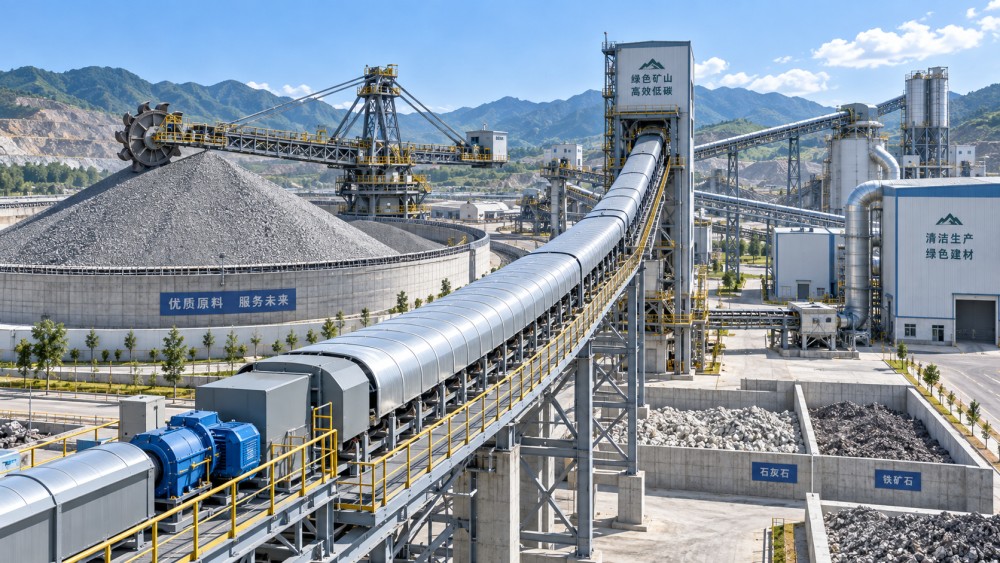
Energy has long been an operating cost, but it is increasingly influencing route selection and equipment architecture. Long-distance conveying, regenerative drive arrangements where site conditions allow, variable-speed drives, efficient motors, and improved control of start-up sequences are receiving more attention. The reason is practical: material handling systems often run for long periods, and small inefficiencies become meaningful over the life of a mine or plant.
That does not mean every project should pursue the most technically elaborate conveyor arrangement. A more complex drive system can introduce additional maintenance demands and specialist support requirements. The right balance depends on duty cycle, power availability, terrain, maintenance capability, and the cost of lost production. A remote mine with limited access to skilled service personnel may judge lifecycle risk differently from an integrated cement plant close to industrial support networks.
The wider decarbonization discussion is also affecting material flow choices. Where projects are comparing truck haulage, conveying, rail interfaces, and port stockyard systems, energy intensity and emissions exposure are becoming part of the business case. Those comparisons should remain project-specific. Terrain, distance, production profile, material characteristics, power source, and permitting conditions can all change the answer.
Automation is shifting from visibility to operational decisions
The next stage of automation in the bulk material handling industry is not simply adding sensors to established equipment. Most modern operations already recognize the value of condition monitoring, belt scales, level measurement, vibration data, temperature monitoring, and remote camera coverage. The larger opportunity lies in connecting those signals to operating decisions.
For example, an integrated control environment can help coordinate stockpile levels, reclaim priorities, train or vessel schedules, crusher feed, and conveyor loading. Predictive maintenance tools may identify patterns that justify inspection before a failure disrupts production. Machine vision can assist with detecting spillage, belt misalignment, or unsafe access conditions, although performance must be validated against site dust, lighting, weather, and communication reliability.
There is an important caution here. Data does not automatically produce better decisions. Many sites accumulate dashboards without resolving who owns the response, how alarms are prioritized, or whether maintenance planners can act on the information. Automation investments should be assessed against a clear operational problem: reducing unplanned stoppages, improving reclaim consistency, limiting personnel exposure, or synchronizing a logistics node with upstream production. If the decision pathway is unclear, the technology may add complexity rather than control.
Stockyards are becoming strategic buffers, not passive storage
Stockyards are gaining renewed strategic importance because supply chains are less predictable than many legacy layouts assumed. For mining projects, stockpile design can determine how well operations absorb disruptions in crushing, rail dispatch, port access, or shipping windows. For cement producers, material storage and blending arrangements affect the ability to manage limestone quality, additives, clinker, coal, petcoke, and alternative fuels.
The key issue is not just storage volume. It is usable storage under operating conditions. Dead zones, segregation, limited reclaim routes, excessive material degradation, and difficult cleanup can reduce the real buffer available to the operation. Stackers and reclaimers therefore need to be considered alongside stockpile geometry, blending requirements, material ageing, traffic patterns, and the consequences of a machine outage.
Where quality management is critical, reclaim strategy deserves commercial attention. A system designed mainly for maximum movement may not deliver the desired blend consistency. Conversely, a highly flexible blending arrangement may be difficult to justify if feed variability is limited and the plant has other control points. The decision requires a view of process consequences, not only mechanical capacity.
Modularity is valuable, but interfaces still decide delivery risk
Modular and prefabricated approaches are increasingly attractive, especially for remote mining sites and brownfield cement upgrades where shutdown time is constrained. Fabricating structures, transfer modules, electrical rooms, or skid-mounted drive packages off-site can reduce site labor exposure and simplify some installation activities. It may also make phased expansion more manageable.
However, modularity does not eliminate engineering risk. It moves part of the risk to interfaces: foundations, alignment, lifting plans, electrical integration, dust collection connections, control-system handover, and tolerances between packages. Brownfield work is particularly vulnerable because existing drawings may not fully reflect field conditions. A well-defined survey and interface register can be more valuable than an ambitious modularity claim.
Evaluation teams should also test whether proposed construction sequencing supports the plant’s real shutdown opportunities. The best equipment layout on paper may be impractical if key tie-ins require a longer outage than the site can tolerate.
Lifecycle support is becoming part of the asset decision
For long-life equipment, the availability of spares, service documentation, software support, and technical expertise can be as consequential as the initial purchase decision. Conveyor components may be standardized in some areas, but critical drives, controls, specialty gearboxes, safety systems, and proprietary machine elements often require a more deliberate support plan.
This is especially relevant when projects seek to adopt advanced automation. Operators should clarify ownership of operational data, cybersecurity responsibilities, remote-access arrangements, version control, and the conditions under which software can be updated. These topics are not administrative details; they influence maintainability over decades of operation.
A practical lifecycle review usually looks beyond spare-parts lists. It considers lead times for critical items, local repair capability, training requirements, inspection access, lifting arrangements, and the time needed to return a failed component to service. The most economical option at award can become expensive if it creates a narrow support channel for a production-critical asset.
What business evaluators should test before committing capital
The strongest projects connect engineering choices to operational consequences. Rather than scoring proposals only against price and nominal throughput, decision-makers can ask whether the design has addressed the scenarios most likely to disrupt material flow. A focused review should examine:
- the material properties and variability assumed in the design basis;
- the system bottleneck under normal, degraded, and maintenance conditions;
- the extent to which stockpile capacity is genuinely reclaimable and operationally useful;
- access for inspection, cleaning, liner replacement, belt maintenance, and emergency response;
- controls integration with crushers, rail loading, port equipment, or plant production planning;
- spares, digital support, cybersecurity, and local service arrangements across the intended asset life.
These checks are not designed to slow procurement. They help distinguish between a technically compliant package and a system that can remain productive when operating conditions become inconvenient—as they inevitably do.
A broader logistics view is becoming necessary
Bulk handling no longer sits neatly inside the boundary of a mine or cement plant. It is part of a wider high-volume transport chain that may include rail corridors, inland terminals, automated ports, and export stockyards. A delay at one node changes inventory requirements at another. Likewise, a rail maintenance window, a berth constraint, or a change in shipping cadence can expose weaknesses in on-site storage and reclaim capacity.
This cross-sector perspective is central to the work of TC-Insight, an international intelligence portal covering railway rolling stock, urban transit, high-speed EMU integration, container port cranes, and bulk logistics equipment. Its Strategic Intelligence Center follows how infrastructure planning, terminal automation, equipment reliability, and supply-chain efficiency interact. For mining and cement decision-makers, that wider view is useful because a handling system should be assessed not only as a plant utility, but as a physical link in a larger logistics network.
The immediate market direction is clear even if the correct technical response differs by site: more integrated planning, more attention to reliability at transfer points, more disciplined use of operational data, and a more realistic view of lifecycle support. Before selecting a concept, teams should confirm the design material, production profile, logistics constraints, maintenance model, and applicable local requirements. Those details determine whether a proposed system merely moves bulk solids—or protects the continuity of the business built around them.
Related News
Related News
- 00
0000-00
What should a rail transport provider guarantee in a metro project? - 00
0000-00
What drives cargo handling automation pricing at container terminals? - 00
0000-00
Freight railway technology insights for reducing unplanned downtime - 00
0000-00
How rail logistics in the Middle East is reshaping freight corridor capacity - 00
0000-00
What railway rolling stock market analysis reveals about fleet demand
Weekly Insights
Stay ahead with our curated technology reports delivered every Monday.