
Rebuilt Plastic Extruders: Quality, Reliability, and Inspection Priorities





Rebuilt Plastic Extruders: Quality, Reliability, and Inspection Priorities
Manufacturers facing tighter capital controls, volatile raw material markets, and pressure to keep lines running are looking more closely at rebuilt extrusion equipment. In many processing environments, replacing a machine with a brand-new system is not always the fastest or most economical decision. A rebuilt extruder may offer a practical route to restored production capacity, provided the machine has been properly evaluated. That makes pre-purchase inspection more than a technical formality. For operators, maintenance teams, quality staff, technical reviewers, and procurement departments, the real issue is whether the machine can deliver repeatable output without creating hidden cost, downtime, or compliance risk.
Plastic extrusion lines are expected to run with stable temperature control, predictable throughput, and consistent melt quality. When any of those conditions drift, the impact can spread quickly across production. Sheet thickness variation, surface defects, energy inefficiency, unplanned stoppages, and maintenance overload are common consequences of equipment instability. A rebuilt machine can still perform well in many settings, but only if buyers understand what has actually been rebuilt, what has only been cleaned or repainted, and which components will determine long-term reliability after installation.
This is especially relevant for processors working with PP, PE, ABS, and PS materials, where process control and mechanical condition directly influence output quality. In such applications, evaluating a machine only by age, appearance, or initial price can lead to poor decisions. A lower acquisition cost may be offset by screw wear, gearbox issues, unstable heating zones, control obsolescence, or weak documentation. Many buyers now treat rebuilt equipment as an engineering review project rather than a simple asset purchase, and that shift is generally justified.
Why the Evaluation Process Matters More Than the Label
The term “rebuilt” can cover a wide range of conditions. In one case, it may mean full disassembly, dimensional inspection, replacement of high-wear components, electrical review, control testing, and trial operation under load. In another, it may describe a machine that has undergone basic cleaning, cosmetic repair, and limited replacement of visibly damaged parts. For a buyer, the difference is substantial. The machine’s future performance depends less on the label and more on the scope and quality of the rebuilding work.
That is why technical due diligence needs to be structured. Procurement may focus on budget, lead time, and vendor support, while operators may care more about usability, setup consistency, and process responsiveness. Maintenance teams are usually concerned with spare part access, electrical condition, lubrication paths, and service history. Quality personnel will look for anything that could introduce contamination, dimensional instability, or repeatability issues. When these perspectives are brought together early, the inspection process tends to be more effective and the total ownership risk becomes easier to judge.
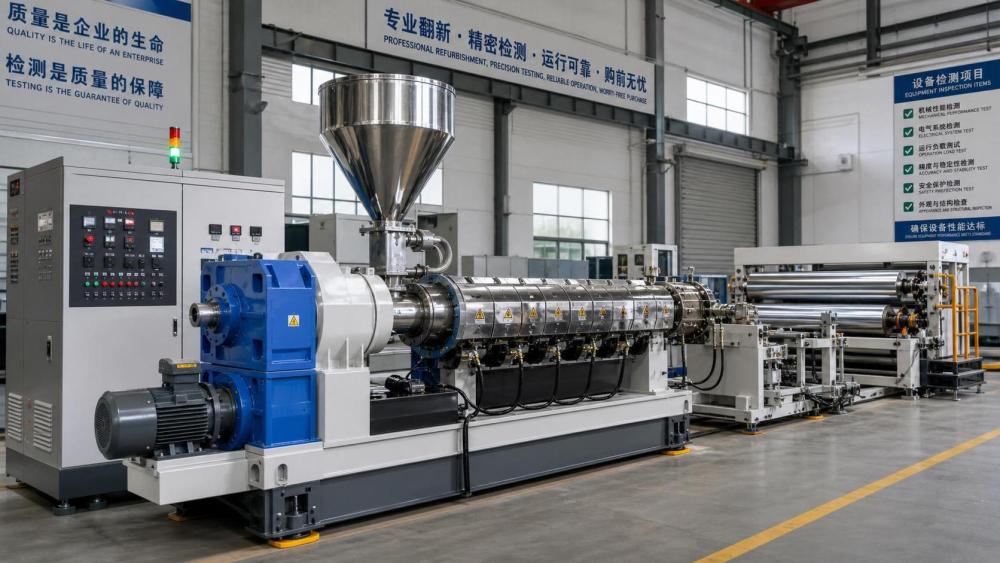
Core Inspection Priorities Before Purchase
A reliable evaluation starts with the machine’s critical mechanical systems. The screw and barrel should be reviewed for wear, scoring, corrosion, and rebuild tolerance. Excessive clearance between screw and barrel can reduce melting efficiency and output stability, especially in applications where material consistency is important. Buyers should also review whether the screw design still suits the intended resin mix and production target. A machine rebuilt for one product profile may not be ideal for another, even if the base equipment appears compatible.
The gearbox is another high-priority area. Noise, vibration, oil leakage, and unclear maintenance records may indicate future reliability issues. Since gearbox failure can stop a line immediately and create costly repair work, its inspection should never be superficial. Motor condition, coupling alignment, bearing status, and drive responsiveness also deserve attention. In many cases, energy performance and operating smoothness provide early clues about the quality of the rebuild.
Electrical and control systems often decide whether an older machine remains practical in a modern production environment. Buyers should check panel condition, wiring integrity, controller responsiveness, safety interlocks, sensor calibration, and heater zone stability. Obsolete control platforms may still function, but they can become difficult to support after installation. If replacement parts are scarce or technical documentation is weak, even a mechanically sound line may become difficult to maintain. For technical evaluators, this is one of the most important areas to investigate in detail.
Downstream sections also matter. In sheet extrusion lines, rollers, cooling sections, haul-off components, cutting systems, and related auxiliaries can affect product finish and throughput as much as the main extruder. Uneven roller surfaces, worn transmission components, or weak temperature regulation may not be obvious during a visual check, yet they can have a direct impact on product quality once production begins. A rebuilt line should be assessed as an integrated system rather than a collection of isolated parts.
Questions That Buyers Should Ask During Review
Several practical questions help move the evaluation from assumption to evidence. What components were replaced, repaired, machined, or upgraded? Were measurements recorded for key wear parts? Was the machine tested under production-like conditions, and if so, what operating parameters were observed? Are wiring diagrams, part lists, manuals, and maintenance notes available? Has the rebuild included safety-related checks such as emergency stops, guarding logic, and control response?
For procurement and plant management, another essential question is how much post-installation work the machine will still require. A machine that appears cost-effective at purchase may need substantial electrical adaptation, foundation work, utility matching, or control updates before it becomes productive. This is where rebuilt plastic extruders are best considered as part of a broader asset planning exercise, not simply a lower-cost substitute for new equipment. The more clearly integration requirements are understood in advance, the less likely the project is to experience delays or budget expansion after delivery.
Common Mistakes in Rebuilt Equipment Assessment
One common mistake is relying too heavily on appearance. Fresh paint, cleaned surfaces, and orderly presentation can improve confidence, but they do not confirm rebuild depth. Another mistake is reviewing only the extruder body while giving limited attention to feeders, drives, cooling units, die compatibility, and downstream handling. In actual production, weak performance often comes from supporting systems rather than the main machine alone.
A third error is failing to match the machine to the intended operating reality. A line may have acceptable output on paper, but it may still be unsuitable if the target plant requires frequent material changes, tight thickness tolerance, or limited maintenance staffing. Similarly, a technically capable system can become a burden if spare parts are difficult to source or if local teams are unfamiliar with its controls. Evaluation should therefore account for plant capability, not just machine specification.
A Practical Review Framework for Different Roles
Each stakeholder tends to notice different risk signals, and that is useful when managed systematically. Operators often identify usability problems early, including awkward adjustment points, poor visibility, slow response, or unstable start-up behavior. Maintenance personnel can usually judge whether lubrication access, electrical layout, and component condition support realistic service routines. Quality teams are more likely to focus on contamination risk, temperature consistency, and output repeatability. Procurement will typically compare price against expected life, support burden, and ramp-up cost.
A structured review can include the following priorities:
- Mechanical condition of screw, barrel, gearbox, bearings, and drive train
- Control integrity, heater performance, sensor feedback, and panel documentation
- Compatibility with target materials, die setup, throughput range, and downstream process flow
- Availability of service records, spare parts information, and installation requirements
- Evidence of testing, commissioning readiness, and safety function verification
When this review is completed jointly rather than in isolation, decision quality usually improves. It becomes easier to distinguish between a machine that is genuinely ready for productive use and one that may require further rebuilding after arrival.
How Rebuilt Extruders Fit Into Current Industrial Decision-Making
In many industrial sectors, buyers are balancing shorter delivery expectations against cost discipline and operational continuity. Rebuilt equipment fits this environment because it can reduce waiting time and preserve capital flexibility. That said, its value depends on disciplined inspection and realistic planning. A sound purchase decision is not based on whether a machine is new or rebuilt in abstract terms, but on whether it can meet the plant’s technical, quality, maintenance, and safety requirements with manageable risk.
For companies evaluating extrusion assets, the most effective approach is usually evidence-based. Review the rebuild scope, inspect the core wear systems, test control reliability, verify downstream condition, and judge the machine against the real production environment where it will operate. Rebuilt extruders can be a practical and reliable option, but only when quality and inspection priorities are treated as central to the purchase decision rather than secondary to price.
Related News
Related News
- 00
0000-00
How port machinery systems reduce container handling bottlenecks - 00
0000-00
How smart port logistics systems reduce container dwell time - 00
0000-00
How transport equipment intelligence analysis identifies bottlenecks - 00
0000-00
How rail technology advancements are reshaping signaling standards - 00
0000-00
What is driving growth in the global EMU market size?
Weekly Insights
Stay ahead with our curated technology reports delivered every Monday.