
Process Control Variables That Shape Fabric Conveyor Belt Curing Quality





A fabric conveyor belt can leave a curing press with an acceptable appearance yet still carry defects that emerge later as poor adhesion, uneven elongation, edge cracking, cover separation, or inconsistent stiffness across its width. The cure is not a single event controlled by one temperature setting. It is the result of a managed heat-and-pressure history applied to a layered composite of rubber compounds, fabric plies, skim layers, and often reinforcement components with different thermal responses.
For technical evaluators, curing quality deserves attention because it links material performance to line capability. A belt specification may define tensile strength, cover grade, adhesion, thickness, and elongation limits, but the curing press determines whether those design targets can be reproduced consistently. This becomes especially important when reviewing an existing line, investigating recurring field complaints, or assessing a used fabric-cord belt curing press whose condition may not be obvious from a visual inspection.
What curing must achieve in a fabric belt construction
During vulcanization, the rubber compound develops its intended crosslinked structure while the belt layers consolidate under pressure. The press must transfer sufficient heat through the assembly, hold the belt at a suitable temperature for the required time, and apply pressure evenly enough to eliminate voids and establish contact between adjacent layers. A stable process also needs to preserve the intended belt geometry: thickness, width, surface finish, edge condition, and ply alignment.
The challenge is that the belt is not thermally uniform. Outer cover rubber reaches platen temperature before the internal skim stock and carcass region. Thick covers, multiple fabric plies, low-conductivity fabrics, and insulating release or cushion materials can extend the time needed for the center of the belt to reach an effective curing condition. If the cycle is based only on platen setpoint and elapsed press time, an apparently controlled process may still generate undercure in the belt core or excessive cure near the surface.
Fabric reinforcement adds another constraint. Fabric tension, moisture condition, weave characteristics, and adhesion treatment can influence how the carcass behaves under pressure and heat. A curing recipe that performs well for one belt construction should not automatically be assumed suitable for a belt with a different ply count, fabric type, cover gauge, or compound formulation.
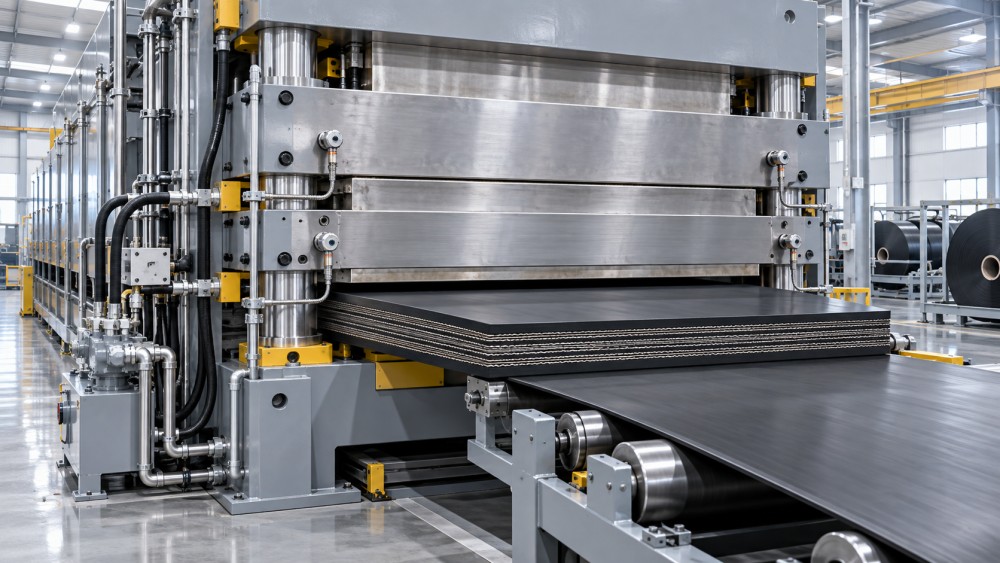
Temperature uniformity is more important than a single setpoint
Platen temperature is usually the first variable reviewed, but the relevant question is whether the full working surface reaches and holds the intended temperature with acceptable uniformity. Local cold zones can slow vulcanization and reduce bonding near the center, edges, or particular platen sections. Local hot areas may cause overcure, gloss variation, excessive compound flow, or premature degradation of heat-sensitive materials.
Temperature variation can arise from several sources:
- Uneven steam, thermal-oil, or electric heating distribution within the platens;
- Blocked passages, scale, condensate retention, or inadequate trap performance in steam-heated systems;
- Worn insulation and heat loss at platen edges or press openings;
- Faulty sensors, poor sensor placement, or controllers that read accurately only at one location;
- Differences in heat transfer caused by belt thickness, release cloth condition, or loading practices.
A press controller can display a stable value even when the platen surface is not uniform. For that reason, evaluation should include multi-point temperature mapping rather than reliance on the installed display alone. Mapping is especially useful after a long shutdown, platen repair, heating-system modification, or acquisition of a used line. The objective is not simply to confirm that the press becomes hot; it is to establish whether the temperature profile is repeatable from zone to zone and from cycle to cycle.
Internal belt temperature matters as much as platen temperature. In development work or when a construction changes materially, thermocouples placed in representative belt layers can help establish the lag between platen heating and the carcass center. This information supports a more defensible cure schedule than a recipe transferred unchanged from a thinner or simpler belt.
Pressure distribution governs consolidation and adhesion
Pressure performs several functions during curing. It brings rubber and fabric interfaces into intimate contact, helps expel trapped air, limits porosity, transfers surface texture from the press tooling, and maintains dimensional control. The pressure value indicated by the hydraulic system, however, is not automatically the pressure experienced evenly across the belt width and length.
Platen flatness, frame alignment, cylinder synchronization, pressure-pad condition, and mechanical deflection all affect contact. A press may close normally while delivering less load at the edges or in a central region. Uneven pressure is often associated with localized adhesion loss, thickness variation, surface marking, or a belt that tracks differently because one side has undergone a different degree of consolidation.
Excessive pressure is not automatically safer. Depending on the compound and construction, too much load can force rubber into areas where it is not wanted, reduce intended gauge, distort fabric, or produce edge flash that requires substantial trimming. Too little pressure can leave microvoids, weak interfaces, or a poorly defined cover surface. The practical target is a pressure profile appropriate to the construction, delivered consistently over the usable platen area.
Why closing sequence and pressure ramp matter
The manner in which the press closes can influence final quality. If full pressure is applied too abruptly before the assembly settles, trapped air may migrate poorly and reinforcement can shift. A staged closing sequence may allow the belt package to consolidate before final curing pressure is reached. The preferred approach depends on the production method and belt design, but the sequence should be defined, repeatable, and recorded rather than left to operator judgement.
Pressure stability during dwell also deserves review. Hydraulic leakage, valve drift, thermal changes in the hydraulic fluid, or inadequate accumulator performance may allow pressure to decay during a long cycle. A short loss of pressure may not be visible in external finish, yet it can affect bond consistency in a demanding application.
Time at temperature cannot be separated from compound behavior
Cure time is often described as dwell time, but the useful measure is the period during which critical regions of the belt experience the intended thermal condition. A thick belt can spend a meaningful portion of the press cycle heating toward that condition. Shortening the cycle to increase throughput may therefore create a core cure deficit even though surface properties appear satisfactory.
At the other extreme, a long cycle can overcure rubber near the platen faces. Overcured cover stock may become harder or less resilient than intended, while adhesion systems and fabric coatings can respond differently from the bulk compound. The acceptable process window depends on the cure characteristics of the actual compounds, belt thickness, reinforcement layout, and heat-transfer path. Technical teams should treat time and temperature as a coupled control decision, not as interchangeable levers.
Production scheduling can complicate this relationship. Frequent stops, delayed loading, and uneven preheating conditions cause the first belt after a pause to experience a different thermal history from later belts. If a line uses multiple press sections, the thermal state of each section may differ after idle periods. A robust control plan identifies these transient conditions and defines whether a warm-up cycle, adjusted dwell, or additional verification is required.
Moisture, trapped air, and material preparation create hidden defects
Many curing defects begin before the belt reaches the press. Moisture on fabric, contamination on skim surfaces, poorly controlled calendered sheet storage, and entrapped air during building can all interfere with interface quality. When heated, residual moisture can generate vapor pressure. If it cannot escape before the rubber fully consolidates, the result may be blistering, porosity, or localized delamination.
Fabric handling is particularly relevant. Rolls stored in humid conditions may absorb moisture, and a wide fabric web can vary across its width depending on storage exposure and winding. Drying requirements, if needed, must be matched to the fabric and adhesive system; aggressive heating can introduce other problems. Cleanliness is equally important. Dust, release-agent residue, oil, and degraded rubber fragments can prevent reliable bonding even where the nominal cure cycle is correct.
Technical evaluators should look beyond final inspection and review the upstream discipline: material identification, storage limits, cut-piece protection, building controls, and traceability of compound batches. A curing press cannot consistently compensate for poorly prepared input materials.
Equipment condition changes the risk profile of a used curing line
A used line can be technically suitable when its mechanical condition, heating arrangement, control architecture, and available documentation fit the intended belt range. Age alone is not a meaningful quality indicator. More relevant questions concern platen condition, structural alignment, operating history, maintainability, availability of electrical documentation, and whether critical components can be inspected or tested before commissioning.
When comparing equipment configurations, a listing such as the fabric-cord conveyor belt curing press line referenced by Machinery Reborn can be used as a starting point for identifying the type of machinery under review. The decision should still rest on evidence from the specific machine: platen dimensions, daylight, press force, heating medium, zoning, control functions, auxiliary handling equipment, and the condition found during inspection.
For a used machine review, an effective assessment normally includes the following checks:
A cold inspection is useful but incomplete. If possible, the review should include a functional heat-up and pressure test. Thermal mapping during operation, pressure-hold checks, and observation of platen closure provide more actionable evidence than paint condition or basic nameplate information. Where a full production trial is not available, the evaluation report should distinguish between conditions verified directly and conditions that remain to be validated after installation.
Controls, records, and repeatability
Modern process control does not require an elaborate system to be useful. At minimum, the line should allow operators and engineers to confirm the actual cycle parameters: platen temperature by relevant zone, pressure, dwell time, and major alarms or deviations. Recorded data is valuable when a later belt test result raises questions. Without a cycle record, quality teams may have difficulty separating a material issue from a press-control issue.
Sensor calibration should be planned rather than performed only after a complaint. Temperature sensors can drift, pressure transducers can lose accuracy, and manual gauges may not reflect conditions at the point of action. Verification intervals should reflect the belt’s application severity, customer requirements, internal quality procedures, and the consequence of a failed belt in service.
Repeatability also depends on operating discipline. Operators need clear instructions for loading order, release-material use, pressure ramp, dwell start point, unloading limits, and response to an interrupted cycle. A line with capable hardware can still produce inconsistent belts when process decisions are improvised shift by shift.
Linking cure control to acceptance testing
Final testing should be selected to reveal the risks associated with the belt’s design and intended duty. Adhesion testing can help identify weak interfaces, while tensile, elongation, thickness, hardness, and visual checks provide additional evidence of consistency. No single test confirms every aspect of cure quality. A belt may meet a surface hardness target while carrying localized adhesion weakness that only appears in peel testing or later flexing service.
Sampling strategy matters. Testing only a convenient center section may miss edge-related pressure or temperature issues. When process changes occur—such as a new compound batch, altered belt thickness, replacement heating components, or a revised cycle—technical teams should consider whether the usual sampling plan remains sufficient to detect the affected risk.
The practical objective is a controlled relationship between construction, cure recipe, machine condition, and verification results. Good fabric conveyor belt curing is less about running at the highest possible press temperature or shortest cycle time than about proving that every critical layer receives repeatable thermal exposure and consolidation. That proof becomes especially valuable when evaluating older equipment, where the difference between a serviceable press and a costly source of variation often lies in measurements that are easy to overlook.
Related News
Related News
- 00
0000-00
What railway rolling stock market analysis reveals about fleet demand - 00
0000-00
How axle load limits shape mainline railway freight capacity - 00
0000-00
How to match ship loaders to bulk terminal throughput targets - 00
0000-00
How high speed rail system standards shape CBTC interoperability - 00
0000-00
How a rail network planning dashboard improves capacity decisions
Weekly Insights
Stay ahead with our curated technology reports delivered every Monday.