How to Select Bulk Material Transport Systems for Long-Distance Plant Transfer





How to Select Bulk Material Transport Systems for Long-Distance Plant Transfer
Selecting bulk material transport systems for long-distance plant transfer requires more than comparing rated capacity, belt width, or initial purchase cost. A system that looks efficient on a layout drawing can become a persistent operating constraint if it does not match the material’s behavior, the route’s topography, the plant’s production rhythm, and the maintenance resources available after commissioning.
For technical evaluators, the real question is rarely “Which conveyor is best?” It is “Which transport architecture can move this material, across this route, at this duty cycle, with an acceptable level of operational and lifecycle risk?” The answer may involve a conventional belt conveyor, pipe conveyor, enclosed belt arrangement, overland conveyor, pneumatic system, rail-based transfer, truck haulage, or a combination of these methods. The right choice depends on the points where process engineering, mechanical design, controls, civil works, and operating discipline meet.
Long-distance transfer deserves special attention because small assumptions compound over distance. A minor error in material testing, a poorly defined transfer point, or an inaccessible drive station may be manageable on a short plant conveyor. Over several kilometres, it can influence energy demand, belt wear, dust exposure, downtime, and the cost of every future intervention.
Start with the Material, Not the Conveyor Catalogue
Material characteristics should establish the selection boundary before equipment options are compared. Bulk solids that appear similar in a production report may handle very differently in service. Ore, coal, clinker, grain, biomass, fertilizers, aggregates, mineral concentrates, and industrial residues each create distinct challenges involving abrasion, moisture, particle-size distribution, cohesiveness, temperature, corrosion, dust generation, or segregation.
A capacity figure is not enough. Evaluators should request representative information on bulk density, maximum lump size, fines content, moisture range, angle of repose, flowability, abrasiveness, and whether the material can freeze, degrade, compact, or self-heat. Where material conditions vary by season, source, or upstream process, the design basis should include that variability rather than only an ideal sample.
For example, a material with a modest average moisture content may still create carryback and chute blockage when delivered in wetter batches. Highly abrasive material can shift the decision toward more robust liners, controlled loading, and serviceable transfer stations. Fine, dusty material may justify enclosed conveying even where an open overland route appears less expensive at first glance. The transport system is only as reliable as its ability to handle the difficult material condition, not merely the normal one.
Define the Duty Profile and the Consequence of Interruption
A long-distance route should be designed around the plant’s actual operating pattern. Continuous process plants often need steady feed and limited tolerance for interruptions. Batch operations may accept intermittent transfer if storage buffers are adequate. A terminal may face short, intense loading windows followed by low utilisation. These are different design problems even when annual tonnage appears similar.
Technical teams should distinguish between nominal throughput, maximum instantaneous throughput, expected operating hours, peak demand, and required recovery capacity after a stoppage. If a downstream crusher, kiln, shiploader, stockyard, or rail loading station cannot tolerate starvation, redundancy and buffer capacity become part of the transport decision. Conversely, specifying duplicate equipment without a clear production consequence can add complexity without delivering useful availability.
Ask a practical question: if the main transport line stops for several hours, what happens next? The answer may reveal a need for surge storage, bypass capability, a parallel route, modular drive arrangements, or simply stronger maintenance planning. Availability is not a label that comes with a machine. It comes from a whole system: components, spares, access, diagnostics, operator response, and the ability to isolate faults without shutting down every upstream and downstream asset.
Treat Route Engineering as a Core Selection Variable
The route often decides whether one form of long-distance transfer is genuinely suitable. Elevation changes, horizontal curves, crossing points, geology, public boundaries, waterways, roads, rail corridors, and future plant expansions all influence the practical configuration. A seemingly straightforward conveyor alignment may require extensive civil structures, complex permitting, or maintenance access roads that change the project economics.
For belt-based bulk material transport systems, gradient and route profile have a direct effect on tension, drive requirements, braking logic, and energy behaviour. Downhill conveying can create regenerative opportunities, but it also requires careful control of stopping conditions and runback risk. Long uphill sections increase installed power and may affect whether a single drive station, distributed drives, or intermediate boosting is appropriate. Those questions should be addressed through route-specific engineering rather than broad rules of thumb.
Curved or constrained routes may point toward pipe conveyors or other enclosed systems, particularly where dust containment, land use, or crossing density matters. Yet tighter routing flexibility should be weighed against belt complexity, inspection requirements, and replacement planning. In some sites, truck or rail transfer remains justified where terrain, temporary mine development, or route uncertainty makes fixed infrastructure difficult to defend.
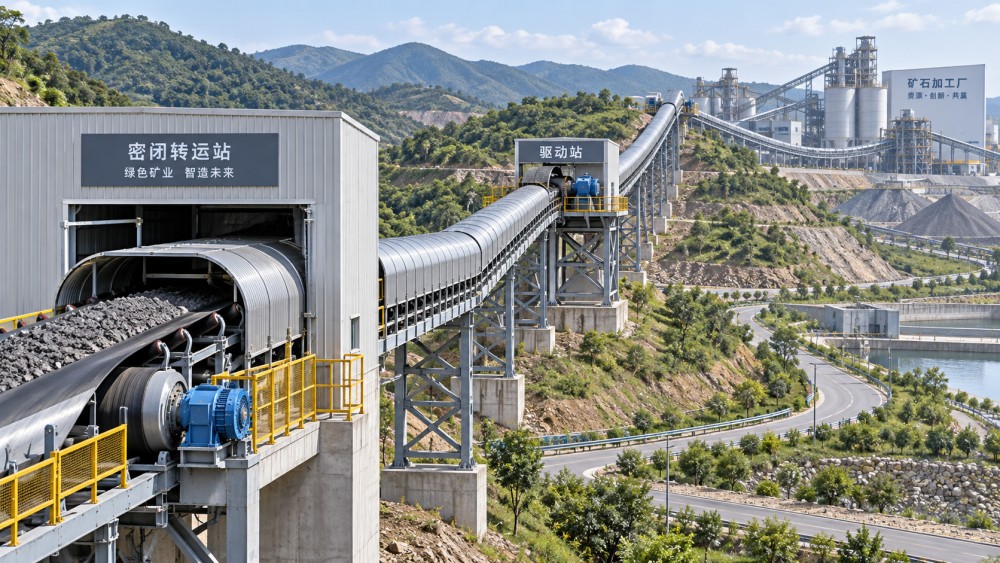
The route assessment should also include maintainability. Can personnel safely reach idlers, pulleys, take-up systems, transfer towers, and emergency devices? Are there locations where a belt change would be unusually difficult? Is drainage adequate around structures and electrical equipment? These questions may feel secondary during early option screening, but inaccessible assets are expensive assets over time.
Compare Transport Concepts by Operating Fit
A useful comparison does not rank technologies in the abstract. It tests each one against the project’s operating constraints.
Hybrid arrangements are common in real facilities. A truck fleet may bring material from an evolving extraction area to a fixed crushing station; a conveyor then carries it to a processing plant or export terminal. Rail may be the logical line-haul method between distant nodes, while conveyors handle continuous transfer within each node. The transition points deserve the same scrutiny as the main transport line because they often set the actual system capacity.
Look Beyond Installed Power When Assessing Energy
Energy evaluation should include the system’s full operating envelope. Drive sizing is essential, but so are startup behaviour, idling periods, loaded versus unloaded operation, regenerative conditions, and the control strategy used to manage speed. Variable-speed drives can offer operational flexibility in some applications, though their value depends on the production profile and the wider electrical system.
Avoid treating energy efficiency as a separate sustainability exercise. It is an operating issue. Poor loading can increase belt resistance and spillage. Misalignment creates drag and accelerates component wear. A poorly tuned sequence can run empty equipment longer than necessary. In long-distance conveying, these losses become persistent rather than occasional.
The technical specification should therefore request transparent assumptions for resistance, loading condition, route elevation, starting method, and control philosophy. A vendor’s performance model may be appropriate, but the project team needs enough visibility to compare alternatives on a consistent basis. This is especially important where designs use different throughput assumptions or exclude auxiliary loads from their operating estimate.
Transfer Points Are Where Good Designs Can Fail
Long-distance systems are frequently judged by their main conveyor, while day-to-day operating problems originate at loading and discharge points. Poor material trajectory, uncontrolled impact, inadequate skirt sealing, weak dust extraction, or insufficient chute access can lead to spillage, belt damage, plug-ups, and excessive housekeeping requirements.
Transfer design should be evaluated as a material-flow problem, not simply a steelwork package. The incoming stream should be centred and stabilised before it reaches the receiving belt. Drop height, velocity, impact energy, liner arrangement, and access for replacement all matter. Where dust is a concern, containment, air movement, and cleaning provisions should be considered together. Adding more seals after commissioning is rarely as effective as designing the transfer correctly from the outset.
This is also where test data and process knowledge matter most. Chutes for dry, free-flowing material may perform poorly with wet fines or mixed-size feed. If the project includes several material sources, the evaluator should confirm which condition governs the chute geometry and wear allowance.
Specify Automation That Improves Decisions, Not Just Visibility
Automation for bulk handling should support safe operation, early fault recognition, and coordinated production flow. Basic interlocks, pull-wire switches, belt drift monitoring, speed sensing, and emergency-stop arrangements are fundamental, but the system also benefits from clear operating logic: startup sequencing, controlled shutdown, blocked-chute response, and restart conditions after an alarm.
Condition monitoring can be valuable for drives, bearings, belt condition, and critical structures when it is tied to a workable maintenance process. Gathering more signals does not automatically reduce downtime. Teams need alarm priorities, diagnostic ownership, and defined actions when readings move outside expected conditions. Remote visibility is useful, but a remote dashboard cannot compensate for inaccessible equipment or a weak spare-parts strategy.
TC-Insight follows this wider connection between equipment controls and logistics performance across bulk terminals, rail networks, and automated port operations. The same principle applies in each setting: automation is most useful when it turns equipment status into a timely operating decision, rather than simply generating more data for the control room.
Evaluate Lifecycle Risk Before Finalising the Preferred Option
Capital cost remains important, but it should be assessed alongside wear components, belt replacement logistics, drive and gearbox support, electrical spares, inspection burden, cleaning requirements, and specialist skills. A lower initial price can be misleading if it depends on components with uncertain local support or a maintenance approach the site cannot sustain.
A disciplined evaluation usually asks suppliers to state what is included in the performance boundary, identify critical assumptions, and describe maintenance tasks at realistic intervals without implying certainty where field conditions are unknown. It should also clarify interfaces: civil foundations, power supply, controls integration, fire protection where required, dust collection, communication networks, and upstream or downstream equipment. Unclear interfaces often become schedule and reliability risks later.
The Global Transit-Core Hub’s Strategic Intelligence Center examines long-cycle transport assets through the same lens. Whether the asset is a traction system, port crane, or bulk conveyor route, value depends on how engineering choices hold up under operational variability, maintenance constraints, and changing logistics demand.
A Practical Basis for a Defensible Decision
Before selecting a preferred concept, assemble a decision record that captures the material design envelope, route survey, capacity profile, availability requirement, utilities, environmental constraints, maintenance model, interfaces, and future expansion assumptions. Score options against these conditions, but do not let a weighted matrix hide unresolved engineering questions. If a concept depends on uncertain geotechnical conditions, untested material behaviour, or an unconfirmed power connection, that uncertainty should remain visible in the decision.
The most suitable bulk material transport systems are not necessarily the most sophisticated or the lowest-cost systems at tender stage. They are the systems whose mechanical design, controls, route arrangement, and service strategy match the plant’s real operating conditions. For long-distance transfer, that alignment is what turns nominal capacity into dependable material flow.
Related News
Related News
- 00
0000-00
What drives cargo handling automation pricing at container terminals? - 00
0000-00
Freight railway technology insights for reducing unplanned downtime - 00
0000-00
How rail logistics in the Middle East is reshaping freight corridor capacity - 00
0000-00
What railway rolling stock market analysis reveals about fleet demand - 00
0000-00
How axle load limits shape mainline railway freight capacity
Weekly Insights
Stay ahead with our curated technology reports delivered every Monday.