
Bulk Material Handling Conveyor Design: Key Rules for Capacity and Spillage





Bulk Material Handling Conveyor Design: Key Rules for Capacity and Spillage
A bulk conveyor rarely fails because one calculation was entirely wrong. More often, it is compromised by several reasonable-looking assumptions that do not work together: a nominal belt capacity is treated as usable capacity, the transfer chute is designed around a clean material stream, or a high belt speed is selected before anyone has agreed how the loading zone will be sealed and maintained.
For mines, coal terminals, quarries, and port stockyards, bulk material handling conveyor design is therefore not just a matter of selecting belt width, idler spacing, drive power, and pulley diameters. It is a system decision. The conveyor must accept real feed conditions, carry material without excessive loss, survive wear, remain accessible for maintenance, and recover safely when upstream equipment sends a non-ideal load. A design that looks efficient in a capacity spreadsheet can become expensive very quickly if spillage, dust, carryback, and belt damage are treated as secondary issues.
This is especially relevant in high-volume logistics networks, where an interruption at a rail loading station, ship loader, reclaim route, or crusher discharge can affect far more than one conveyor line. From the perspective of TC-Insight’s wider focus on rail freight, port machinery, and continuous bulk logistics, the conveyor is one of the quietest but most consequential links between extraction, storage, transport, and export.
Capacity Starts With the Material, Not the Belt Width
The starting point for conveyor capacity is the required mass flow, usually expressed in tonnes per hour. But that figure alone is not enough to select a conveyor. The conversion from mass flow to volumetric flow depends on bulk density, and bulk density can vary with moisture, particle-size distribution, compaction, and the source of the material. Coal from a stockpile, for example, may not behave like coal discharged directly from a crusher. Ore containing fines and moisture can move very differently after rain than it does during dry commissioning.
At a basic level, conveyor capacity is related to the loaded cross-sectional area of material on the belt, belt speed, and bulk density. In practice, the loaded area is affected by belt width, troughing angle, surcharge angle, edge clearance, and whether the material actually settles into the assumed profile. Standard methods, including those referenced in CEMA guidance, ISO 5048, and DIN 22101-based design practice, can support the calculation. They do not remove the need to validate the input assumptions.
One recurring mistake is to use a maximum theoretical belt loading as the operating target. Technical evaluators should separate at least three conditions:
- normal operating throughput;
- short-duration peak or surge throughput; and
- the capacity needed to clear an upstream upset without creating a downstream blockage.
The distinction matters because a transfer station does not respond instantly to a surge. Material can accumulate in a chute, rebound from liners, or arrive off-centre after passing through a feeder. If the conveyor only performs cleanly at an ideal loading rate, it has little operating margin.
Belt speed is a trade-off, not a universal efficiency lever
Increasing belt speed can raise capacity without increasing belt width, which is attractive where space is restricted. It can also reduce the number of conveyors or transfer points needed in a route. Yet speed amplifies other design demands. Faster belts make it harder to keep the material stream stable, increase the consequence of poor chute alignment, and can worsen dust generation at impact and discharge zones.
A higher-speed conveyor may be appropriate for a controlled, relatively uniform material stream. It is less forgiving when handling sticky fines, irregular lump sizes, or material with changing moisture. The right question is not “How fast can the belt run?” but “At what speed can this material be loaded, centred, cleaned, and inspected reliably?”
Belt width should also be considered in relation to lump size. Large or occasional oversize pieces need enough room to travel without crowding belt edges or striking skirting. When the belt is too narrow for the material envelope, the problem tends to show up first as edge damage, unstable loading, and blocked chutes rather than as a simple capacity shortfall.
Transfer Points Decide Whether Spillage Is Designed Out or Managed Forever
Most persistent conveyor spillage originates at transfer points. This is where material changes direction, drops from one belt to another, passes through a feeder, or enters a receiving belt with a different speed and trajectory. It is also where the design team often discovers too late that the discharge path was based on a simplified drawing rather than the actual stream of material.
Good transfer design aims to place the material centrally on the receiving belt, in the direction of belt travel, and at a velocity that the belt can accept without excessive turbulence. This sounds straightforward, but it requires proper attention to the head pulley trajectory, material cohesion, chute geometry, liner wear, and the changing shape of the material stream. A chute that works with dry coarse material may flood or plug when fines become wet.
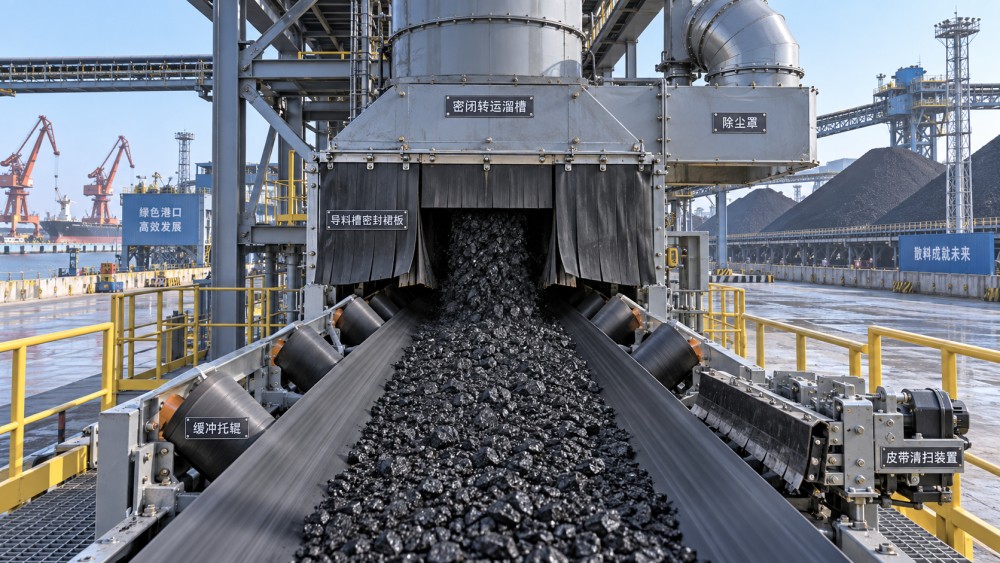
The loading zone should be treated as a controlled containment area rather than an open gap covered by skirt rubber. Skirting has a sealing role, but it should not be expected to force a badly directed material stream into place. If material strikes the skirt directly, operators may tighten the seal to stop leakage. That can increase belt friction, accelerate skirt wear, and create a new source of belt-edge damage.
Support beneath the belt is equally important. In a poorly supported loading zone, the belt deflects between idlers as material lands. That movement opens and closes the sealing interface, allowing fines to escape. Impact beds, impact idlers, or other support arrangements may be considered depending on lump size, drop height, loading rate, and maintenance strategy. The choice should follow the duty; it should not be made simply because one transfer point has been copied from another project.
Do not design a chute around a “typical” material condition
Bulk materials are rarely typical for long. Their behavior changes with weather, blend ratios, crusher settings, reclaiming methods, and stockpile residence time. Technical reviews should ask for the material conditions that are most likely to cause trouble: maximum moisture, highest fines content, largest expected lump, lowest and highest bulk density, abrasion level, temperature where relevant, and any tendency to degrade, cake, or self-heat.
This does not mean designing every chute for an extreme that will never occur. It means identifying which excursions are credible and operationally significant. If a wet-season condition is routine, it belongs in the design basis. If an unusual oversize event can be stopped upstream by screening or interlocking, that may be a more sensible control than enlarging every downstream conveyor.
Containment, Dust Control, and Carryback Need Different Answers
Spillage is often discussed as one problem, but its causes differ. A lump falling from an overloaded belt is not solved in the same way as dust escaping from a transfer enclosure. Fine material that adheres to the belt after discharge is a carryback problem, while material thrown beyond the receiving belt is usually a trajectory or impact issue. Treating all of them as “housekeeping” hides the root cause.
Dust control begins by reducing air movement and material disturbance inside the transfer. Chute geometry, controlled loading, adequate enclosure length, and a stable belt profile do more than external extraction alone. Where dust collection systems are used, their airflow must be coordinated with the transfer enclosure. Excessive negative pressure can pull air—and fine material—through small gaps, while insufficient control allows fugitive dust to migrate into walkways and equipment areas.
Carryback deserves early attention because it becomes a distributed maintenance burden. Primary and secondary belt cleaners, return ploughs, and properly located collection points can reduce it, but cleaning performance depends on belt condition, pulley wrap, blade pressure, material properties, and access for adjustment. A scraper that cannot be inspected safely will eventually be ignored, regardless of how well it performed when new.
Water is another complication. Suppression may help control dust in suitable applications, but it can alter bulk flow, aggravate adhesion, and change chute blockage risk. In cold environments, it raises additional questions about freezing. The decision cannot be separated from the material handling process as a whole.
Tracking and Structural Alignment Are Not Minor Mechanical Details
Belts usually mistrack because the system is telling them to. Uneven loading, misaligned pulleys and idlers, a distorted structure, buildup on pulleys, damaged belt edges, or a belt splice that does not run square can all push the belt away from centre. Training devices can be useful, but they should not be used to compensate for fundamental alignment errors.
In technical evaluation, it is worth looking beyond the conveyor frame drawing. Check the expected erection tolerances, survey requirements, access to adjustment points, and the sequence for aligning the belt under load. A conveyor can be geometrically correct when empty and still mistrack once the loading chute shifts the mass of material to one side.
Return-side housekeeping also affects tracking. Material buildup on return rollers or pulleys creates a changing running surface, which can steer the belt unpredictably. This is why effective cleaning and a sensible return-side arrangement are part of tracking control, not separate maintenance topics.
Design for Inspection Before Selecting the Final Arrangement
A conveyor route should be reviewed from the maintainer’s position, not only from the process flow diagram. Can personnel inspect chute liners, skirt seals, cleaners, take-up components, pulleys, and belt edges without entering a hazardous area or removing major guards? Is there space to remove worn components? Are emergency pull-wire switches, guards, walkways, and access platforms arranged in accordance with the applicable site rules and local requirements?
Long-cycle assets benefit from condition monitoring, but instrumentation should be selected for the actual failure modes. Belt drift switches, speed monitoring, pull-wire systems, blocked-chute detection, bearing temperature monitoring, and vibration monitoring can all be relevant. Their value depends on correct placement, maintainable wiring, alarm logic, and a clear response procedure. A sensor that trips frequently because its threshold is poorly set may eventually be bypassed; that is worse than having no confidence in the signal from the start.
This is where bulk handling begins to resemble other high-volume transport systems. Railway traction, automated terminal cranes, and conveyor networks all depend on the same discipline: reliable hardware, useful operating data, and a maintenance plan that recognizes how equipment behaves in the field rather than how it appears in a specification.
A Practical Review Sequence for Technical Evaluation
Before approving a bulk material handling conveyor design, it is useful to test the package in the order the system will experience it. Start with the incoming material and feed variability. Then verify required throughput, surge conditions, belt loading, and speed. Review the discharge trajectory and transfer chute before moving to skirting, dust collection, and belt cleaning. Only after those elements are credible should the team regard tracking devices and cleanup provisions as supporting controls rather than primary solutions.
The design basis should make assumptions visible. If density, moisture, particle size, belt tension, or duty cycle are still provisional, that should be recorded rather than buried in a calculation file. Standards such as CEMA, ISO, DIN, and applicable site specifications provide important frameworks, but project conditions determine how conservatively their guidance needs to be applied.
The best conveyor systems are not necessarily the ones with the highest nominal capacity or the most elaborate accessories. They are the systems where capacity, loading geometry, containment, cleaning, structural alignment, and maintenance access have been resolved as one operating problem. When those decisions are made early, the conveyor has a much better chance of moving bulk material continuously instead of moving it from the belt to the floor.
Related News
Related News
- 00
0000-00
When do port automation solutions in Europe justify the investment? - 00
0000-00
What should a rail transport provider guarantee in a metro project? - 00
0000-00
What drives cargo handling automation pricing at container terminals? - 00
0000-00
Freight railway technology insights for reducing unplanned downtime - 00
0000-00
How rail logistics in the Middle East is reshaping freight corridor capacity
Weekly Insights
Stay ahead with our curated technology reports delivered every Monday.