
Which Cargo Handling System Is Best for Dusty Bulk Materials?





For dusty bulk materials moved continuously at high volume, an enclosed belt conveyor with engineered transfer points and local dust extraction is often the strongest starting option. Pneumatic conveying can be a better fit for fine, dry powders that need a sealed route, particularly where pipes simplify a difficult layout. At a ship berth, the choice also depends on how cargo leaves the hold: a mechanical or pneumatic continuous ship unloader may improve containment, but its downstream conveying system must maintain that protection.
The best choice depends on the material and the handling route. Dry cement, abrasive mineral fines, damp coal, and combustible grain dust create different operating problems. A useful comparison therefore starts with four questions: how the cargo behaves, where dust escapes, what sustained duty the terminal requires, and what it costs to keep the complete system working.
Which system should operators consider first?
An enclosed belt conveyor deserves early consideration for a fixed route carrying large quantities of bulk solids, especially when conveying distance makes energy consumption important. It transports material without suspending the entire cargo stream in air. For materials compatible with belt handling, that can offer a favorable balance of capacity, energy use, and equipment wear.
The enclosure alone does not establish dust performance. Loading zones, discharge chutes, belt cleaning, and connections to storage or loading equipment need equal attention. A well-designed belt route can contain dust effectively; a covered belt with poorly controlled transfers can still create substantial emissions.
Pneumatic conveying deserves closer attention when the cargo is a suitable powder and containment is a leading requirement. It can connect receiving equipment, silos, and process destinations through a closed pipe network. The tradeoff is the energy needed to move air and material, together with wear, filtration, and possible changes to particle quality.
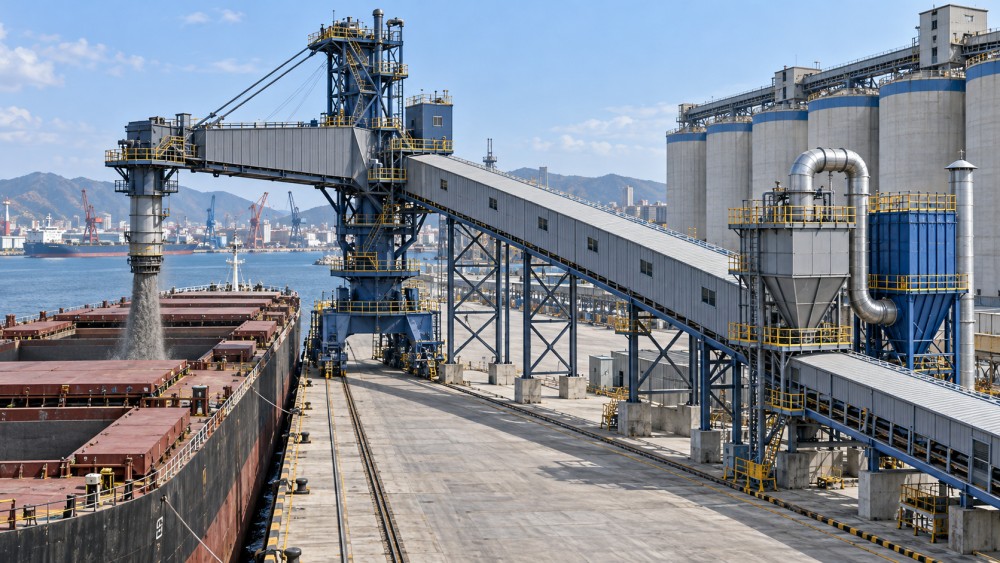
For vessel unloading, continuous ship unloaders address a different part of the decision. “Continuous” describes the unloading method, not a single conveying technology. The machine may use mechanical pickup and conveying, or pneumatic suction. Comparing a belt conveyor with a continuous ship unloader as if they were interchangeable can obscure the equipment actually needed.
When is an enclosed belt conveyor the better choice?
Enclosed belts are attractive where cargo must travel along a defined corridor at a sustained rate. They can accommodate bulk materials whose particle size distribution or abrasiveness would make pneumatic transport difficult or costly. They also allow designers to control the material trajectory at transfers, reducing unnecessary agitation and impact.
Dust performance depends heavily on what happens when material lands on or leaves the belt. A long free fall can break fragile particles and entrain air. If that air escapes through gaps in a chute or skirt, it carries fine particles into the workplace. Increasing extraction without correcting the material trajectory may leave the underlying problem unresolved.
A stronger design combines controlled chute geometry, suitable loading-zone seals, adequate space for disturbed air to slow down, and extraction where needed. The belt should receive material in a stable stream, with loading conditions that limit spillage and excessive turbulence. These details deserve attention alongside nominal conveyor capacity.
The return side also matters. Material adhering to the belt can fall from rollers and accumulate beneath the conveyor. Belt cleaners, accessible collection points, and practical housekeeping arrangements help control this secondary dust source. An enclosure that prevents inspection or makes cleaning difficult can turn small accumulations into recurring shutdown work.
Pipe conveyors can provide another enclosed mechanical option where the route requires curves or where containing the load between transfers is particularly valuable. They still need carefully designed loading and discharge transitions, and their suitability depends on belt behavior, material characteristics, route geometry, and maintenance capability.
For damp or cohesive cargo, mechanical conveying may remain practical, but sticking and buildup can become the main limitation. Enclosed equipment should therefore be assessed for cleanability and blockage recovery as well as dust containment.
When does pneumatic conveying justify its tradeoffs?
Pneumatic conveying is a credible option for suitable fine powders when a sealed route and flexible pipe layout have high value. Cement and some dry mineral powders are candidates, subject to their flow behavior, abrasiveness, moisture content, and required conveying rate. The decision should rest on representative material characteristics rather than a cargo name alone.
Vacuum conveying can help contain emissions because leakage along the suction section tends to draw air inward. That advantage ends where the material enters equipment operating under different pressure conditions. Receivers, filters, discharge valves, and downstream storage connections still need effective seals and appropriate venting.
Positive-pressure systems can also provide enclosed transport, but a leaking connection can release dust outward. Their suitability depends on system integrity, operating pressure, and how leaks are detected and repaired. Neither pressure arrangement removes the need to manage displaced air at the receiving destination.
The distinction between dilute-phase and dense-phase conveying also affects the comparison. Dilute-phase transport generally uses higher gas velocities, which can increase erosion and particle breakage for some cargos. Dense-phase transport can reduce velocity for suitable materials, but stable operation depends on the powder’s properties and the system design. It should not be assumed that every dusty powder will move reliably in dense phase.
Energy use needs scrutiny where throughput, conveying distance, or elevation is substantial. Pneumatic systems must supply the air movement and pressure difference needed for transport. Their containment advantages may justify that demand, but the comparison should include filtration, compressed-air or blower requirements, and performance across the expected operating range.
Moisture is another deciding factor. A powder that flows well when dry may cake in a pipe, receiver, or filter when exposed to moisture. Abrasive material can wear bends and valves, while fragile particles may produce additional fines during transport. Material trials can help establish whether these risks are manageable.
What changes when the cargo is unloaded from a ship?
At the berth, operators need to evaluate the unloading chain from hold to storage. A contained downstream conveyor cannot prevent dust released by an open grab, and a contained unloader cannot prevent emissions from an exposed discharge into the terminal conveyor.
Mechanical continuous ship unloaders can suit sustained bulk flows where the pickup mechanism is compatible with the cargo and vessel geometry. Their dust performance depends on containment around pickup, internal transfers, and discharge. Pneumatic unloaders can offer effective suction pickup for suitable powders, but air handling, filtration, energy demand, and material wear remain part of the decision.
Rated unloading capacity provides only part of the operating picture. Access around hold structures, vessel movement, cargo compaction, repositioning, and final hold cleanup can affect sustained output. Procurement comparisons should distinguish the rate achieved under favorable pickup conditions from the performance expected across a complete vessel discharge.
Grab unloading may remain attractive where cargo variety and vessel flexibility are important. For dusty cargo, an enclosed receiving hopper with appropriate extraction and controlled discharge can reduce emissions at the receiving point. Dust released during grab travel or opening still requires separate consideration. The value of upgrading the hopper therefore depends on where the terminal’s emissions actually originate.
Which material properties can overturn the initial choice?
Dustiness is only one property. The same material can behave differently after changes in moisture, particle size distribution, storage time, or compaction during transport. A specification based solely on average bulk density and required tonnes per hour leaves important uncertainties unresolved.
- Fine-particle content and particle strength: Existing fines influence dust release, while fragile particles can generate more fines at impacts or during high-velocity transport.
- Moisture and cohesion: Sticky material can build up in chutes, on belts, or inside pneumatic equipment. Seasonal variation may matter as much as the typical condition.
- Abrasiveness: Wear at bends, chutes, liners, valves, and seals affects both maintenance cost and the ability to maintain containment.
- Combustibility and health hazards: These determine the protective measures needed around conveying, extraction, collection, and maintenance activities.
Combustible dust requires particular care because enclosure can create confined locations where dust clouds form. Depending on the assessed hazard and applicable requirements, protection may include ignition control, suitable electrical equipment, explosion isolation, venting, or suppression. A sealed system should never be treated as proof that explosion risk has been resolved.
For cargo containing hazardous respirable particles, visible cleanliness is an incomplete measure of performance. Fine particles may remain airborne without an obvious plume. Exposure assessment and suitable monitoring should inform the design and verification of containment.
Water sprays also need a material-specific decision. They can reduce airborne dust where the cargo tolerates added moisture. For moisture-sensitive powders, however, water may cause caking, change product quality, or interfere with subsequent use. Extraction and controlled material flow may be more appropriate in those circumstances.
How should buyers compare lifecycle cost and dust performance?
Compare complete systems with the same starting point, destination, cargo conditions, and operating duty. A quotation for a conveyor without receiving equipment, transfer extraction, or destination filtration cannot be meaningfully compared with a pneumatic package that includes those functions.
The cost comparison should include energy at realistic operating loads, wear parts, filter servicing, cleaning labor, inspection access, and expected interruptions. For pneumatic transport, bends, air supply, and filtration can be significant cost drivers. For mechanical transport, belts, cleaners, chute liners, seals, and buildup removal deserve similar attention.
Dust-control performance also depends on maintenance. Filters need servicing, seals deteriorate, and extraction can lose effectiveness when airflow changes. Access for inspection and repair should be evaluated before purchase. Equipment that is difficult to maintain may gradually operate below its intended containment standard.
Ask suppliers to connect performance commitments to defined conditions: cargo properties, throughput range, route configuration, filter condition, and the locations where emissions will be assessed. “Dust-free” is too vague to support an equipment decision. A useful acceptance plan distinguishes visible emissions, workplace exposure, and environmental requirements according to the site’s obligations.
Where the cargo is variable or difficult to convey, representative trials should answer specific uncertainties. These might include plugging under higher moisture, particle degradation, bend wear, achievable conveying rate, or dust release at discharge. A successful trial with a favorable sample does not establish performance across the terminal’s full cargo range.
For a fixed, high-volume route, start by testing the case for enclosed mechanical conveying. For a suitable dry powder requiring sealed transport through a complex layout, test the case for pneumatic conveying. At a berth, select the unloading method together with its receiving and storage connections. The strongest proposal will explain how it handles the difficult cargo condition, the final part of vessel discharge, and the maintenance intervention that puts containment under strain.
Have questions about the global trade trends discussed here, or planning your expansion and supply chain strategy? Leave a message below and let the trade experts at TTC-Insight guide you.
We respect your privacy. Your information is strictly confidential.
Related News
Related News
- 00
0000-00
How public funding shapes the urban rail transit market - 00
0000-00
How do terminal operations systems coordinate crane scheduling? - 00
0000-00
Evaluating Skeletal Container Chassis Capacity for Loaded Boxes - 00
0000-00
How much outreach does a container terminal crane need? - 00
0000-00
Which rail safety technology standards apply to CBTC systems?
Weekly Insights
Stay ahead with our curated technology reports delivered every Monday.