
What Defines an Efficient Stacking Yard for Variable Bulk Material Throughput?





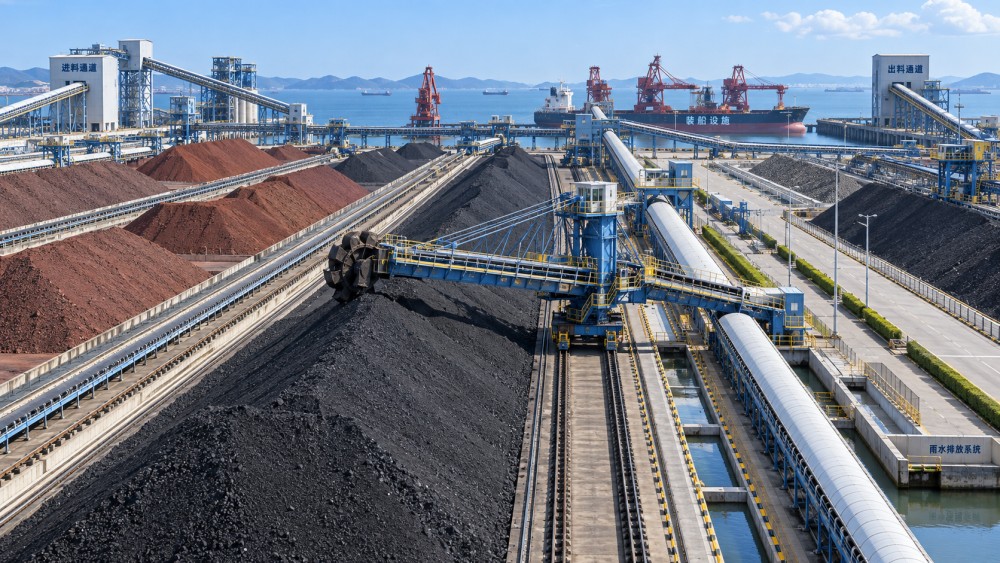
An efficient stacking yard is not defined by how much material it can hold at its physical maximum. It is defined by its ability to receive, place, protect, recover, and dispatch material at the required rate when inbound and outbound flows change. A yard that appears spacious can still become the limiting point in a mine, coal terminal, power-plant supply chain, or industrial port if reclaiming cannot follow vessel loading, plant consumption, or rail dispatch demand.
For variable bulk material throughput, the central challenge is managing imbalance. Material may arrive in concentrated rail consists, truck convoys, or high-output conveyor streams, while leaving in a different pattern: a continuous plant feed, a single high-rate shiploader, intermittent train loading, or customer orders with grade-specific requirements. The stacking yard must absorb those differences without creating excessive rehandling, material degradation, contamination, or equipment conflicts.
Throughput is a system outcome, not an equipment nameplate
Stackers, reclaimers, conveyors, hoppers, feeders, and shiploaders are often rated in tonnes per hour. Those ratings are useful, but they do not establish the usable throughput of the yard. The effective rate is constrained by the slowest available path at a given moment: receiving conveyor capacity, transfer chute performance, travel speed of the stacker, reclaimer digging conditions, feeder drawdown limits, downstream conveyor availability, or the time needed to switch between stockpiles.
A yard may have a reclaimer with a high nominal capacity but still fail to meet dispatch requirements because the material is stored too far from the active reclaim face, because another machine blocks the rail path, or because the selected stockpile contains the wrong quality range. Similarly, a high-capacity stacker does little to improve receiving performance if the upstream unloading station cannot provide a stable material stream.
This is why efficient yard design begins with flow scenarios rather than a single annual tonnage figure. Relevant scenarios include peak inbound receipt, peak outbound dispatch, simultaneous receiving and reclaiming, maintenance periods with one route unavailable, weather-related operating constraints, and grade-change events. The question is not simply “How much can the yard process?” but “Which combinations of movements must occur at the same time, and what prevents them from occurring?”
Storage capacity and working capacity are different
Gross storage capacity is the theoretical volume of all stockpiles combined. Working capacity is the portion that can be used without compromising access, quality control, safety clearances, drainage, or the ability to reclaim the required product. For operations handling multiple grades of coal, ore, biomass, limestone, fertilizers, or mineral concentrates, working capacity can be substantially lower than the physical footprint suggests.
Several portions of a yard are not freely interchangeable:
- Material reserved for a specific customer, vessel, process line, or quality specification.
- Safety stock held to protect a continuous downstream process from supply interruption.
- Material that is temporarily inaccessible because of equipment position, maintenance isolation, or an active stacking operation.
- Low-level material that cannot be economically reclaimed without dozer assistance, recovery equipment, or elevated contamination risk.
- Areas required as empty space for incoming material, grade separation, stockpile rotation, or emergency diversion.
A useful stacking yard therefore maintains deliberate operating space. Running permanently near its physical storage limit can reduce flexibility precisely when throughput variability is highest. The visible symptom is often increased rehandling: material is moved not because it adds value, but because a stockpile must be cleared to create room for another arrival. Rehandling consumes machine time, raises operating cost, can increase fines generation, and complicates inventory accuracy.
Layout must separate flows before it optimizes distances
Short conveyor routes and compact machine travel distances matter, but the more important layout question is whether incompatible flows are forced through the same corridor. Receiving, stacking, reclaiming, sampling, blending, and dispatch each create traffic demands. If all functions converge at one transfer tower, one rail track, or one machine aisle, a small disruption can propagate through the whole operation.
An efficient layout usually provides choices: more than one route into the yard, more than one reclaim route where continuity is critical, and enough separation for stacking and reclaiming to proceed without frequent mutual interruption. The level of redundancy should reflect the cost of lost throughput. A mine supplying a batch process has different tolerance for an outage than a terminal loading a vessel within a contracted berth window or a power station dependent on uninterrupted fuel feed.
Stockpile geometry also influences practical efficiency. Long, narrow piles may support better segregation and more controlled reclaim sequencing, but require greater machine travel. Wider or higher piles can improve land utilization, yet may make selective reclaiming more difficult and increase the consequence of a single equipment blockage. There is no universally optimal shape; the appropriate geometry depends on material behavior, reclaim method, grade management needs, available land, machine configuration, and safety requirements.
Material behavior determines whether a layout works in practice
Bulk materials do not behave like uniform inventory units. Particle size distribution, moisture, bulk density, abrasion, angle of repose, dustiness, tendency to segregate, spontaneous-heating risk, and flowability all affect stacking and reclaiming. A yard designed around conveyor capacity alone can underperform when actual material characteristics alter pile formation or reclaim resistance.
Fine and coarse fractions may segregate during stacking, especially where material falls from height or travels along the slope of a pile. If the delivered product must meet narrow quality or size limits, the stacking method matters. Chevron, windrow, and cone-shell stacking patterns create different distributions within the pile. Their suitability depends on whether the operational priority is homogenization, segregation avoidance, selective recovery, or simple high-rate placement.
Moisture introduces another set of constraints. Wet material may adhere to chutes, form build-up at transfer points, or create reclaim difficulties. In cold climates, freezing can reduce feeder performance and make pile recovery uneven. Some materials require careful temperature monitoring, controlled pile height, rotation discipline, or restrictions on how fresh and aged material are combined. These are not peripheral environmental issues; they directly affect usable inventory and the reliability of outbound flow.
Stacking and reclaiming strategy should match the variability profile
Where inbound material is relatively uniform and outbound demand is steady, a simpler stack-and-reclaim pattern may be sufficient. Variable throughput changes the requirement. The yard needs to absorb short-term surges without losing the ability to retrieve the right material at the right rate.
For example, a terminal receiving material from trains may experience sharp inbound peaks followed by quieter periods. Its stacking system needs enough capacity and available space to clear unloading operations promptly. If vessel loading begins while train unloading continues, the reclaim path must remain independent enough to avoid a direct conflict. In contrast, a processing plant with a fluctuating feed rate may place greater value on blending consistency and rapid switching between stockpiles than on maximum shiploading rate.
Equipment selection follows from this operating logic. A radial stacker may be appropriate where land is available and stockpile segregation needs are modest. A rail-mounted stacker-reclaimer can provide structured stockpile formation and controlled reclaiming in larger installations. Bucket-wheel reclaimers support continuous high-volume recovery but depend on suitable pile geometry and reliable downstream conveying. Bridge reclaimers, portal reclaimers, and loader-based operations each offer different combinations of selectivity, mobility, capital intensity, and dependence on manual intervention.
The key issue is not whether one machine type is “better.” It is whether the equipment can maintain required flow under the expected combinations of material, pile condition, and operating sequence. A machine optimized for continuous reclaiming may be poorly suited to frequent grade changes. A highly flexible mobile fleet can handle irregular work but may struggle to provide consistent high-rate feed with precise inventory control.
Reclaim efficiency is often the real measure of yard performance
Stacking is generally easier to accelerate than reclaiming. Incoming material can often be diverted, spread, or placed into available areas. Reclaiming must deliver material in the required sequence, at the required quality, to a specific downstream destination. It is also more exposed to pile condition, equipment access, and the consequences of poor stockpile discipline.
Reclaim efficiency depends on the availability of an accessible reclaim face, the ability to maintain a steady feed to downstream conveyors, and the time needed to shift from one pile or grade to another. Frequent starts, stops, and low-rate operation may create more wear and instability than the average throughput figure indicates. Transfer chutes, belt scales, feeders, and surge bins need to be assessed as part of the reclaim system rather than as isolated components.
Dead stock deserves particular attention. Every yard has a practical limit below which material cannot be recovered efficiently by the main reclaimer. If this quantity is not explicitly accounted for, inventory reports can overstate usable material. Recovery arrangements for residual stock—such as mobile equipment, reclaim tunnels, dozer support, or scavenger systems—should be considered in the operating model, especially where material value, quality preservation, or environmental control is important.
Inventory accuracy is operational infrastructure
A stacking yard cannot be run efficiently if the location, quantity, age, and quality of material are uncertain. Inventory is not merely a finance record. It determines whether dispatch commitments can be met, whether blending plans are achievable, and whether material can be reclaimed without unnecessary movement.
Reliable inventory control combines belt-scale data, shipment records, stockpile boundaries, material movement records, and periodic physical measurement. Depending on the site, pile volumes may be estimated through survey methods, laser scanning, drone-based mapping, or fixed scanning systems. Each method has limitations. Volume estimates require appropriate bulk-density assumptions, while belt data may be affected by calibration, moisture changes, spillage, or diverted flow. The operational value lies in reconciling these sources rather than treating any single number as unquestionable.
Quality tracking is equally important where multiple grades are handled. A stockpile label should represent more than its product name. It may need to include source, time of placement, expected quality range, contamination constraints, moisture condition, and planned reclaim sequence. Without this discipline, blending decisions become reactive and stockpiles gradually lose their intended function.
Automation improves coordination when operating rules are already clear
Automation can strengthen yard performance through machine positioning, conveyor interlocks, stockpile visualization, collision prevention, condition monitoring, and schedule execution. It is particularly valuable where the number of routes and operating states exceeds what can be managed reliably through manual coordination alone.
However, automation does not correct an unclear material-handling strategy. If grade ownership is ambiguous, if stockpile locations change without discipline, or if operational priorities are routinely overridden without recording the consequence, a digital control system will reproduce the same uncertainty more quickly. The prerequisite is a defined set of rules: where each material can be placed, which reclaim routes are permitted, what stockpile must be protected, and how conflicts are resolved when receiving and dispatch demands compete.
For variable throughput, scheduling logic should recognize constraints rather than merely sequence tasks. It should account for the time needed to travel equipment, clear conveyors, change routes, complete sampling, establish a stable reclaim feed, and return a system to service after a trip. A plan based only on hourly tonnage can look feasible while ignoring the transition time that consumes much of the available operating window.
Environmental controls protect both compliance and capacity
Dust suppression, enclosure, transfer-point sealing, drainage, runoff management, and fire-prevention measures are often treated as separate compliance systems. In reality, they influence throughput. Dust accumulation can impair equipment and create housekeeping interruptions. Poor drainage can destabilize traffic areas, increase moisture variability, or carry material into unsuitable locations. Inadequate fire controls can restrict pile configuration or require operational limits that reduce usable storage.
Environmental design must therefore be aligned with the material and the handling pattern. Water-based dust suppression may be effective for some products but unsuitable where added moisture affects product quality or downstream processing. Enclosures can reduce emissions but may introduce access and maintenance requirements. The objective is not the maximum number of control devices; it is a control approach that remains effective during peak receiving, reclaiming, wind exposure, and maintenance activity.
What an efficient yard looks like under changing demand
The strongest indicator of efficiency is not a clean layout drawing or an impressive equipment rating. It is operational resilience: the yard can receive an unplanned arrival, continue serving an outbound commitment, preserve material identity, and recover from an equipment interruption without turning every disruption into a system-wide bottleneck.
That resilience comes from matched capacities, accessible working stock, clear flow separation, material-aware pile management, dependable reclaim routes, and accurate control of inventory and quality. A stacking yard becomes efficient when it is designed as a dynamic buffer between uncertain supply and time-sensitive demand—not as a passive area where bulk material waits.
Related News
Related News
- 00
0000-00
How high speed rail system standards shape CBTC interoperability - 00
0000-00
How a rail network planning dashboard improves capacity decisions - 00
0000-00
Comparing bulk handling solutions by throughput reliability - 00
0000-00
What determines port crane intelligence pricing for terminal upgrades? - 00
0000-00
Rail equipment intelligence in Southeast Asia is reshaping fleet investment
Weekly Insights
Stay ahead with our curated technology reports delivered every Monday.