
Is Rail Cheaper Than Truck for Long-Distance Bulk Freight?





Is Rail Cheaper Than Truck for Long-Distance Bulk Freight?
For a finance approver, “is rail cheaper than truck” is rarely a simple rate comparison. A rail quotation may look attractive on a cost-per-ton basis, while the truck option appears easier to deploy and less exposed to terminal constraints. Neither view is complete. The real decision sits in the gap between line-haul price and total landed cost: loading and unloading, first- and last-mile movements, inventory held in transit, demurrage exposure, network reliability, contract flexibility, and the cost of disruption when material does not arrive when the plant needs it.
For long-distance bulk freight—aggregates, grain, minerals, coal, cementitious materials, scrap, fertilizer, forest products, or industrial inputs—rail is often structurally less expensive once volume is large, flows are repeatable, and both ends of the lane can handle rail efficiently. “Often” matters. A low rail rate can be erased by poorly designed transloading, irregular car supply, weak terminal capacity, or a destination that is still fundamentally truck-dependent.
The practical question is not whether rail beats truck in general. It is whether a particular origin-to-destination lane has enough density, infrastructure, and operational discipline for rail’s scale advantage to outweigh its fixed handling burden.
Why rail usually gains ground as distance and volume rise
Rail’s basic economic advantage comes from consolidation. One train can move a very large freight load with a comparatively small operating crew and lower energy use per unit moved than a large number of individual road vehicles. That is especially relevant for commodities that are low in value relative to their weight and do not need daily, door-to-door delivery.
On a stable lane, rail also spreads certain costs across a much larger tonnage base. Locomotive power, crews, train-path access, wagon circulation, and dispatching do not scale in the same way as the driver, tractor, trailer, fuel, toll, and maintenance costs attached to each truck movement. When a shipper can load unit trains, block trains, or a dependable sequence of railcars, the economics can become compelling.
Truck freight retains an advantage in flexibility. It can collect directly from a quarry, factory, farm, warehouse, or port gate and deliver to a customer without a rail siding, stockyard, or unloading plant. It can also react more quickly to uneven order patterns. Those benefits have a value, even if they are not obvious in a per-ton freight comparison.
A useful rule of thumb is this: rail tends to improve as the shipment becomes heavier, farther, and more predictable. Truck tends to improve as the shipment becomes smaller, more variable, more time-sensitive, or more geographically dispersed.
The cost comparison that approval teams should actually make
Approving a modal shift on quoted transport rates alone is one of the most common errors in bulk logistics. The right comparison is delivered cost per usable ton, measured over a realistic operating period—not a single well-performing month.
The denominator deserves attention as well. A cost per shipped ton can be misleading where moisture changes, spillage occurs, contamination must be removed, or a receiving plant rejects part of the load. Finance teams should model cost per accepted ton or per production-ready ton where quality exposure is material.
Terminal economics are where apparently cheap rail can become expensive
Rail performs best when the physical system has been designed around it. A mine with a loader, loop track, wagon maintenance discipline, and a dedicated discharge point is a very different proposition from a business that must shuttle material by truck to a public terminal, wait for railcar placement, and transfer again into road vehicles at the far end.
Bulk terminals are not interchangeable. Some handle a narrow commodity range efficiently but struggle with product segregation, high moisture content, abrasive materials, or rapid changeovers. Others have enough machinery but not enough stockpile space. At ports, rail can connect directly to ship loaders or bulk yards, yet berth windows, crane availability, and yard congestion may still dictate the real cost of the movement.
This is why a site visit matters before capital is approved. The rail siding may exist on a layout drawing, but the commercial answer depends on details: turnout condition, train length, unloading speed, weighbridge logic, stockyard circulation, dust suppression, drainage, maintenance access, and whether loading can continue during routine equipment downtime.
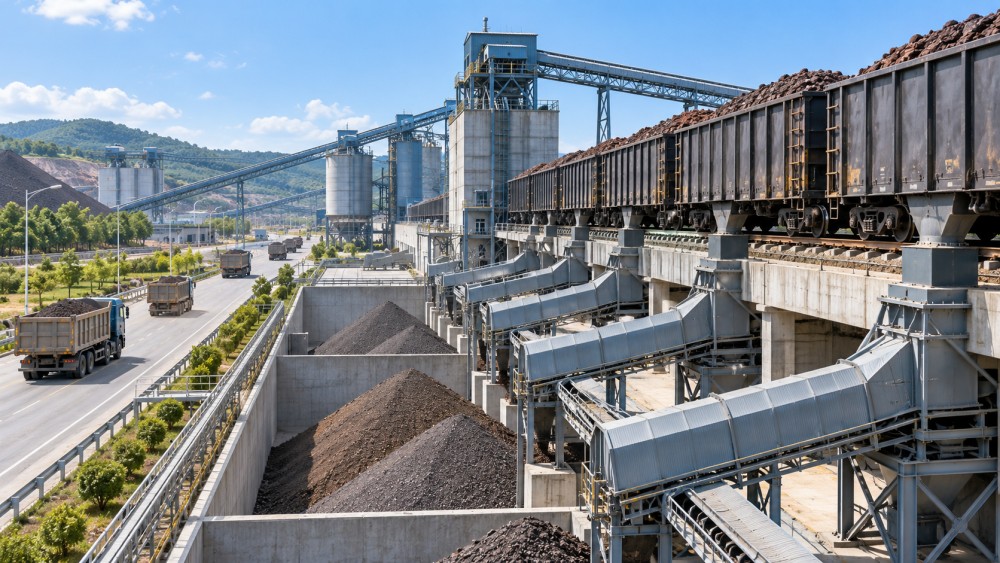
A conveyor, rotary car dumper, hopper system, automatic stacker, or remote-operated yard process can reduce handling friction, but it also creates fixed cost and operational dependency. For a low-volume or seasonal flow, a simpler truck-based arrangement may be financially safer even if it looks less elegant. Asset-heavy terminals need utilization; without it, the “cheap” rail lane is carrying too much idle infrastructure.
Transit time is less important than transit-time variability
Truck is generally easier to schedule tightly from dispatch to delivery. Rail can offer reliable service on established corridors, but its cycle includes wagon availability, train assembly, interchange activity where networks meet, terminal appointment discipline, and destination discharge capacity. A nominal rail transit time is therefore not enough for planning purposes.
What finance teams need is a realistic view of variability. If a manufacturing site consumes a bulk input continuously, a delay of several days may trigger premium road haulage, emergency spot purchases, reduced output, or a shutdown. Those costs should not be treated as remote exceptions if they recur in ordinary operations. They belong in the base-case model.
The strongest rail programs separate planned rail volume from resilience volume. Rail carries the stable base load. Trucks cover short-notice replenishment, customer-specific drops, and recovery after disruption. This is not a failure to commit to rail; it is often the more financially credible design. A network that relies on one mode for every tonne may look efficient until the first terminal outage or weather event tests it.
When trucking remains commercially justified
Long distance alone does not automatically make rail the lower-cost answer. Trucking may remain justified when annual volume is too low to support trainload or wagonload commitments, when origins are scattered, when delivery points change frequently, or when the customer cannot accept large inventory drops.
It can also be the better choice where a rail route requires two expensive transfers, where destination rail access is constrained, or where a commodity must be kept exceptionally clean and separate. Materials with short delivery windows or irregular sales demand can create a hidden penalty under rail’s batch-oriented operating model. The cost of carrying inventory, paying storage, and managing material aging can exceed an apparent freight saving.
There is another practical issue: contractual commitment. Rail providers and terminal operators may require minimum volumes, loading windows, car-cycle assumptions, or take-or-pay structures. Those arrangements can make sense for an established flow, but they should not be approved using a demand forecast that has not been stress-tested. A truck contract is often easier to resize when markets soften.
Build the business case around scenarios, not one forecast
A sound transport-cost model normally starts with three operating scenarios: expected volume, a lower-volume case, and a disruption case. The lower-volume case tests whether terminal and rail commitments remain tolerable if demand underperforms. The disruption case should reflect a plausible problem: delayed wagon placement, an unloading equipment outage, road restrictions, a port backlog, or a weather-related interruption. The point is not to predict every event. It is to avoid presenting a fragile plan as a guaranteed saving.
Use a full-lane view: origin loading, pre-carriage, rail freight, interchange where relevant, destination unloading, post-carriage, inventory cost, handling loss, administration, and contingency road capacity. Keep capital expenditure separate from operating cost at first, then bring it into the decision through utilization, depreciation policy, financing cost, and the expected life of the terminal asset. This prevents a one-year rate comparison from masking a long-term infrastructure commitment.
Fuel and energy exposure should also be visible rather than buried inside carrier rates. Trucking is usually more directly exposed to road fuel volatility; rail contracts may have their own fuel or energy adjustment mechanisms. The exact impact depends on the market and contract language, so it needs legal and procurement review rather than an assumption that one mode is automatically protected.
Questions worth resolving before signing
Before approving a long-distance bulk rail program, ask for evidence on a few uncomfortable points. Can the origin and destination load and unload at the required rate? Who pays if wagons are delayed because the site is not ready? What volume is genuinely committed, not merely forecast? How much buffer stock is needed to protect production? Is there a truck recovery plan, and has its cost been included? Are railcars suitable for the material’s density, moisture, abrasiveness, or contamination risk?
Also ask whether the proposed arrangement can be measured cleanly. A monthly dashboard should track delivered cost, railcar cycle time, terminal dwell, on-time placement, handling losses, demurrage or detention, emergency truck movements, and inventory days. Without those measures, a rail program can retain its attractive original business case long after operating reality has changed.
The decision is really about network design
For long-distance, high-volume, repeatable bulk movements, rail is frequently cheaper than truck on a total transport basis—but only when the lane supports rail’s operating model. The strongest savings typically come from matching dense flows with capable loading and discharge assets, not from negotiating a lower headline rail rate.
For finance approval, the most defensible answer is often a blended one: rail for predictable trunk movements and trucking for collection, distribution, and operational recovery. That approach recognizes that transportation cost is shaped by rolling stock, terminals, material-handling equipment, and supply-chain control as much as by distance. Intelligence on rail-network capacity, port automation, wagon utilization, and bulk terminal performance—areas closely observed by TC-Insight—can help turn that broad principle into a lane-specific investment decision.
Related News
Related News
- 00
0000-00
How bogie condition monitoring can reduce rolling stock downtime - 00
0000-00
How passenger capacity shapes rail equipment selection for metro - 00
0000-00
Traction Converter Core Components: Roles in Locomotive Power Conversion - 00
0000-00
What makes a rail transit integration supplier fit a CBTC project? - 00
0000-00
How to assess rail automation systems software for CBTC integration
Weekly Insights
Stay ahead with our curated technology reports delivered every Monday.