When Should Shippers Combine Road Transport and Rail Transport?





Combining road transport and rail transport makes commercial sense when the long-haul portion of a shipment is large enough, regular enough, and predictable enough for rail to offset the extra handling required at each end. The usual winning pattern is not “road versus rail,” but road for collection and final delivery, with rail carrying the distance where line-haul cost, capacity pressure, emissions, or driver availability become material business risks.
The decision should not be based on a quoted freight rate alone. A rail leg adds terminal transfers, cut-off times, equipment availability requirements, and dependence on train schedules. Those factors can be worthwhile when they replace a long, exposed road movement with a more stable corridor service. They are not worthwhile when the shipment needs continuous routing flexibility, very short lead times, or frequent last-minute changes.
Use rail for the line-haul, not for every kilometre
Road transport remains the default mode for dispersed origins and destinations because it provides door-to-door access. Rail becomes relevant where freight can be consolidated at an origin terminal, moved over a sufficiently long trunk route, and distributed from a destination terminal without excessive detours.
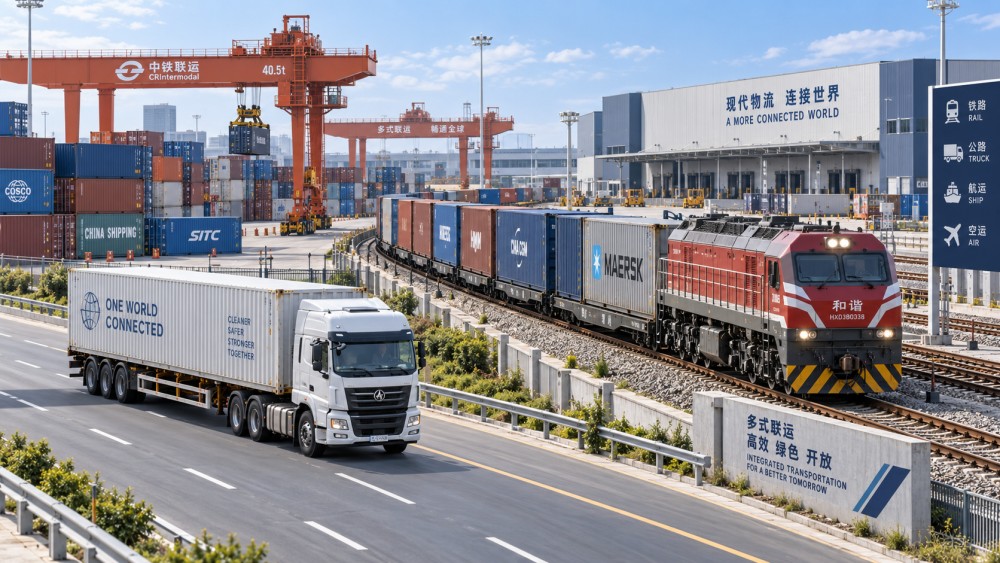
This is why road-rail combinations are most practical on corridor-based flows: factory clusters to inland ports, distribution centres to regional consumption hubs, mines or bulk terminals to industrial plants, and import gateways to inland logistics zones. In each case, road transport serves the first and last mile while rail handles the distance-intensive middle section.
The central question is not whether a shipment can move by rail. Nearly any shipment can be put onto rail if enough handling is accepted. The useful question is whether the rail segment removes more cost and risk than the transfers introduce.
A shipper should examine the real route, rather than the straight-line distance between origin and destination. A rail terminal located far from the loading point may add substantial pre-haul mileage. The same problem can occur at destination if the consignee is outside the rail service area. A nominal rail movement can therefore become a largely road-based trip with two additional lifts and more coordination points.
Where terminals are close to both production and delivery locations, the position changes. A road-rail-road movement can reduce the number of long-distance truck kilometres while preserving the local flexibility that rail alone cannot offer.
Distance matters, but lane density matters more
Longer distance generally improves the case for rail because terminal handling represents a smaller share of total transport cost. Yet distance by itself is an incomplete test. A long route with irregular loads, uneven seasonal demand, or low equipment availability may still be better served by road. Conversely, a medium-distance lane with frequent, consolidated flows and reliable rail departures can be a strong intermodal candidate.
Rail works best where there is enough volume to protect a repeatable operating plan. That does not necessarily require a dedicated train. It can mean recurring container, swap-body, trailer, palletised, or bulk flows that can be booked into a scheduled intermodal service. What matters is that freight reaches the terminal in volumes and timing compatible with the rail operator’s departure pattern.
For decision purposes, shipments can be assessed through four practical questions:
- Can cargo be accumulated without disrupting customer service or production schedules?
- Is there a dependable rail service on the required corridor, rather than only theoretical network access?
- Can the origin and destination drayage legs remain short and operationally manageable?
- Will the lane generate repeat volume, or can it be combined with other compatible flows?
A single urgent consignment is rarely an ideal reason to redesign a transport network around rail. A recurring lane with predictable weekly or daily demand is different. It allows bookings, equipment positioning, terminal appointments, and inventory planning to be managed as a system rather than as isolated shipments.
Combine modes when road capacity is the real constraint
Road transport can appear operationally simple until capacity becomes constrained. Driver shortages, hours-of-service limits, congestion, border delays, seasonal restrictions, and fluctuating access to equipment can make a truck-only plan difficult to scale. Rail does not eliminate these constraints, but it can reduce exposure to them on the longest and most resource-intensive segment of the route.
This is particularly relevant for freight that would otherwise require repeated long-haul truck movements over the same corridor. Shifting the trunk movement to rail may allow the road fleet or contracted carriers to focus on local collection and delivery, where their flexibility has the greatest value. The result is not necessarily the lowest cost on every shipment; it is often a more resilient capacity model during periods when long-haul trucking is difficult to secure.
Capacity resilience should be measured against the operational consequences of failure. If a missed delivery can halt a production line, cause a vessel connection to be lost, or trigger costly inventory shortages, the cheapest transport quote is not necessarily the best option. A scheduled rail product with clear cut-offs and established terminal processes may offer greater planning discipline than ad hoc spot-market road capacity.
That said, rail schedules introduce their own rigidity. Missing a terminal cut-off may delay the cargo until the next departure. A multimodal solution is therefore most credible when collection times, warehouse release processes, customs documentation, and loading windows are designed around the rail timetable. Treating rail as a truck with tracks is a common source of service failure.
Cargo characteristics determine whether handling is acceptable
Road-rail transport is well suited to cargo that tolerates planned terminal handling and can be loaded into standardised transport units. Containerised imports and exports, palletised industrial goods, consumer products moving to distribution centres, building materials, agricultural products, and many bulk commodities can fit this model. The required equipment and handling method differ, but the logic is the same: freight must be safely transferred between modes without creating disproportionate damage, delay, or compliance risk.
High-value cargo is not automatically unsuitable for rail. The relevant issue is whether the handover points have acceptable security controls, chain-of-custody visibility, sealing procedures, and claims responsibility. A shipment that is secure in a sealed container may be operationally easier to move intermodally than loose cargo that requires repeated handling.
Fragile goods, temperature-sensitive products, hazardous materials, oversized units, and cargo with strict delivery appointments require more detailed assessment. They may still move by rail, but only if compatible wagons, containers, terminal capabilities, monitoring systems, and regulatory procedures are available across the entire route. The weak point is often not the railway movement itself, but an incompatible terminal, unavailable specialised equipment, or an incomplete handover process.
For bulk logistics, rail becomes especially relevant when cargo volume is high and origins or destinations connect directly, or nearly directly, to rail infrastructure. However, bulk shippers should look beyond the cost per tonne. Loading and unloading rates, stockpile capacity, wagon cycle times, weighbridge processes, dust control, moisture exposure, and plant receiving capacity can determine whether rail assets turn efficiently. A low rail tariff cannot compensate for slow terminal operations that leave wagons or material idle.
Do not compare transport rates; compare landed logistics performance
A road-only quote is usually straightforward: pickup, line-haul, and delivery are visible in one price. A combined road and rail quote may separate drayage, terminal lifts, rail carriage, equipment hire, storage, demurrage-related exposure, customs processing, and surcharges. Comparing only the rail line-haul price against a truck rate will produce the wrong decision.
The relevant comparison is total logistics cost for the required service level. This includes transport expenditure, inventory carrying effects, terminal dwell, risk of missed delivery windows, damage exposure, internal planning effort, and contingency costs when disruptions occur. Transit time must be assessed as both average duration and variability. A route that is one day longer but arrives within a narrow and dependable delivery window may be more useful than a nominally faster route with highly variable arrival performance.
It is also important to distinguish between transit time and order cycle time. Rail may take a fixed number of hours or days in motion, but the full process begins when freight is ready for pickup and ends when it is available for unloading at destination. Cut-off times, weekend operations, terminal opening hours, customs clearance, and delivery appointment availability can materially change the actual order cycle.
Businesses with inventory buffers may absorb this structure easily. Businesses operating on just-in-time replenishment need to verify whether the rail service’s timetable and recovery options meet their service commitments. In some cases, the best model is not to transfer every shipment to rail, but to reserve rail for planned replenishment while retaining road capacity for exceptions, urgent orders, and demand spikes.
Carbon goals are meaningful only when the route is operationally sound
Rail is often considered when a company seeks to reduce the emissions associated with long-distance freight. That objective is valid, but it should be translated into an operational design rather than treated as a stand-alone reason for modal shift. Extra road detours to remote terminals, low equipment utilisation, empty repositioning, or avoidable dwell can reduce the expected benefit of a rail option.
A credible approach measures the full route: road collection, terminal activity, rail movement, destination drayage, and any empty equipment movements required by the chosen loading method. The calculation method should be consistent across options, particularly where emissions reporting is linked to customer disclosures, internal targets, or procurement requirements.
Carbon performance can strengthen the business case when the lane already meets service, capacity, and cost requirements. It is less persuasive when used to justify a network that creates recurring delivery exceptions or excessive inventory. Sustainable freight planning is most durable when the lower-emission mode also has an identifiable operational role in the supply chain.
Cross-border rail requires a stricter feasibility test
International movements can benefit from road-rail combinations, especially where major ports, inland terminals, and industrial corridors are connected by established services. Yet border crossings add layers of risk that do not disappear simply because the main leg is by rail. Customs status, transit documentation, security procedures, sanctions screening where relevant, terminal release rules, and responsibility for delays must be clear before volume is committed.
Interoperability also matters. Rail systems may differ in gauge, traction power, loading profile, wagon acceptance, operating language, and border procedures. Some corridors manage these differences through established processes; others require transshipment, bogie exchange, locomotive changes, or long border dwell. A nominally direct rail route may therefore contain operational discontinuities that materially affect reliability.
For containerised international freight, the ability to maintain visibility across road carriers, terminals, rail operators, customs brokers, and ocean connections is often more important than the availability of a rail service itself. Event data should identify when a unit was collected, gated into the terminal, loaded to rail, discharged, released, and delivered. Without these milestones, supply-chain teams may learn about disruptions too late to protect production or customer commitments.
Where the multimodal model usually fails
The most common error is shifting freight to rail before redesigning the surrounding process. Rail is then expected to absorb late warehouse releases, uncertain forecasts, incomplete shipping instructions, and changing delivery appointments. It cannot do so with the same flexibility as a truck dispatched directly from a loading bay.
Another failure point is choosing a lane based on average cost savings while ignoring exception management. The proposed service should be tested against missed cut-offs, terminal congestion, equipment shortages, train cancellation, delayed discharge, and urgent customer orders. The question is not whether disruptions are possible; all modes experience them. The question is whether responsibilities, alternative transport options, and communication triggers are defined before they occur.
It is also risky to assume that rail automatically reduces damage or claims exposure. Rail may provide a stable line-haul environment, but every transfer creates a handling event. Loading quality, lashing, packaging strength, seals, unit condition inspections, and documented handovers remain essential.
A sound trigger for combining road and rail
Road transport and rail transport should be combined when a business has a repeatable long-haul lane, access to practical terminals, freight that can tolerate controlled transfers, and a service design aligned with production and delivery cycles. The case becomes stronger when road capacity is volatile, emissions performance matters, or long-distance trucking represents a concentration of cost and operational risk.
It is less appropriate where volumes are sporadic, delivery commitments are highly urgent, terminal drayage is excessive, cargo requires specialised handling that the network cannot support, or the commercial model depends on frequent last-minute routing changes.
The most effective multimodal networks do not attempt to replace road transport. They assign each mode the work it performs best: road for reach and responsiveness, rail for consolidated corridor movement. When that division matches the actual flow of goods, rather than an assumed transport preference, the combined model can improve predictability, protect capacity, and make long-haul logistics easier to manage.
Related News
Related News
- 00
0000-00
How to assess wheel wear during freight rolling stock maintenance - 00
0000-00
Can digital freight logistics lower costs by reducing empty miles? - 00
0000-00
How bogie condition monitoring can reduce rolling stock downtime - 00
0000-00
How passenger capacity shapes rail equipment selection for metro - 00
0000-00
Total Cost of Ownership for Automated Port Cranes: What to Include
Weekly Insights
Stay ahead with our curated technology reports delivered every Monday.