
Where Lower-Emissions Logistics Delivers Measurable Savings in Bulk Supply Chains





The strongest savings from lower-emissions logistics occur where a supply chain moves large, predictable volumes through constrained assets: long-haul freight corridors, port interfaces, stockyards, and continuous bulk handling systems. In these environments, emissions reduction is not an abstract environmental benefit. It is often the operational result of using less fuel and electricity per tonne moved, reducing equipment idle time, avoiding unnecessary handling, and improving asset availability.
The commercial case weakens when companies treat lower emissions as a separate procurement category. A battery vehicle, electrified crane, rail service, automation platform, or conveyor upgrade should not be assessed mainly by its headline emissions profile. The relevant question is whether it reduces the total cost of reliably moving each tonne through a specific network. For bulk supply chains, that calculation depends less on the individual machine and more on the flow it serves.
Lower emissions deliver savings when they remove waste from high-volume movement
Bulk logistics has an inherent advantage: large volumes make small efficiency gains economically material. A reduction in fuel consumption, empty positioning, loading delay, rehandling, or unplanned downtime can be multiplied across repeated movements of ore, grain, coal, aggregates, cement raw materials, fertilizers, or containerized commodities.
That does not mean every decarbonization investment produces a favorable return. The same technology can have very different economics at two sites because utilization, electricity availability, route length, cargo density, loading discipline, and operating hours differ. The most valuable opportunities tend to share three characteristics:
- Volumes are sufficiently stable to justify fixed infrastructure, contracted capacity, or specialized equipment.
- Energy-intensive movements are repeated often enough for efficiency improvements to accumulate.
- Current operations contain visible friction: diesel idling, truck queueing, partial loads, equipment waiting, double handling, or avoidable maintenance disruption.
Where those conditions are absent, an investment may still support compliance or customer requirements, but its direct cost case should be treated separately from its emissions narrative.
Rail corridors: the clearest savings case is not simply modal shift
Moving dense bulk cargo from road to rail can reduce energy use per tonne-kilometre where rail loading, terminal access, and route design are suitable. Yet the financial value does not arise automatically from choosing rail. It comes from building a movement system that keeps trainsets, locomotives, crews, loading points, and receiving facilities productive.
A rail corridor is most likely to generate measurable savings when origin and destination volumes are concentrated, rail access is available at both ends, and cargo can move in full trainloads or reliably consolidated blocks. Under these conditions, rail may reduce diesel exposure, lower road congestion costs, reduce driver dependence, and limit the number of separate vehicle movements required to transport the same tonnage.
The avoided-cost side is often more important than the nominal freight-rate comparison. Road-based operations may conceal costs in demurrage, loading-yard congestion, tire consumption, road damage, safety exposure, security arrangements, and variable driver availability. Rail introduces different constraints—network capacity, wagon cycle time, loading consistency, siding capability, and service reliability—but these can be managed when the freight flow is regular and operational control is strong.
The central procurement error is comparing a rail quotation against a truck rate without examining the full cycle. The effective transport cost should include origin handling, wagon or container availability, terminal dwell, destination discharge, inventory held in transit, switching or last-mile movements, and the commercial consequences of missed delivery windows. A lower-emissions rail option can become more expensive if poor terminal design causes wagons to wait for loading or discharge.
Electrified rail offers a further emissions advantage where traction power is available, but the investment logic remains operational. The question is whether electrification, network access, and traffic density create lower lifecycle energy and maintenance costs than the alternatives. For dedicated heavy-haul routes with sustained throughput, this can be a meaningful structural advantage. For irregular movements requiring multiple transfers and long road feeder legs, the benefit may be diluted.
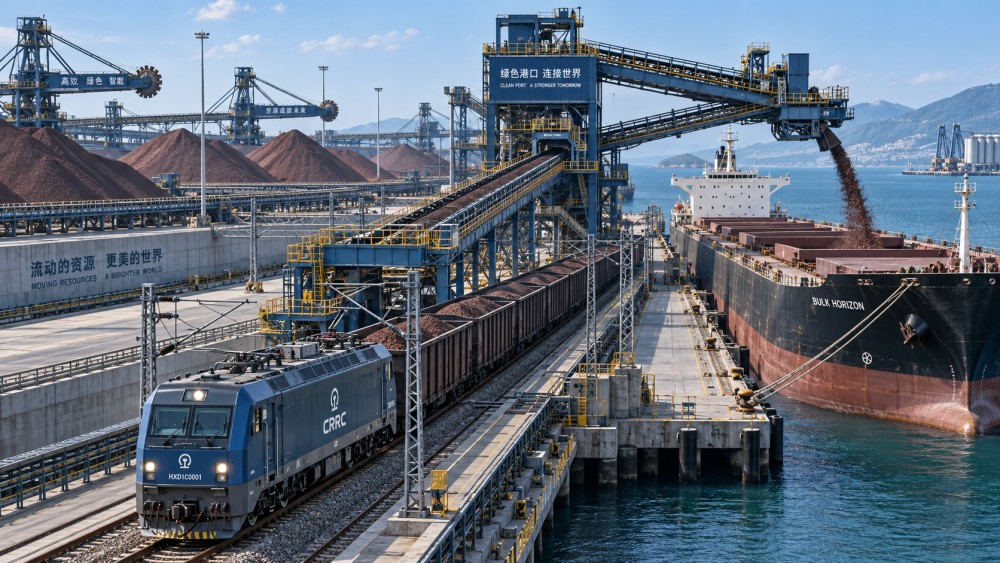
Ports and intermodal terminals: idle time is often the most expensive emission source
At ports, inland terminals, and container transfer points, the link between emissions and cost is frequently found in waiting rather than travel. Yard trucks, reach stackers, rubber-tyred gantry cranes, straddle carriers, locomotives, and auxiliary equipment consume energy when serving poorly synchronized flows. A vessel delay, an uneven gate pattern, an unplanned stack reshuffle, or a disconnected appointment system can create both emissions and direct operating cost without moving any cargo closer to its destination.
Lower-emissions terminal investments therefore deliver the best returns when they improve the quality of operating decisions. Automation, remote operation, terminal operating system upgrades, energy management, and electrified equipment can reduce fuel or electricity use, but their value depends on whether they also reduce unproductive moves.
For example, electrifying a crane fleet may lower local diesel consumption and maintenance needs, yet the business case changes materially if electrical infrastructure is undersized, charging windows interfere with peak operations, or grid-demand charges are not understood. Similarly, automated stacking can reduce unnecessary travel and improve stack planning, but it may not solve a bottleneck created by customs release delays, berth scheduling, rail-slot shortages, or insufficient outbound transport capacity.
Before approving terminal equipment, the buyer should identify the dominant source of dwell and rehandling. A useful distinction is between equipment-limited delay and flow-limited delay. Equipment-limited delay may justify fleet modernization, automation, or electrification. Flow-limited delay requires changes in scheduling, gate rules, data exchange, documentation, or commercial coordination between carriers, terminal operators, and cargo owners. Buying cleaner equipment to solve a documentation bottleneck is an expensive mismatch.
Continuous bulk material handling: energy intensity must be assessed across the whole transfer chain
Conveyors, ship loaders, reclaimers, stackers, feeders, crushers, and transfer stations are frequently viewed as fixed industrial assets rather than logistics assets. In bulk supply chains, that distinction is unhelpful. Their operating profile determines how quickly cargo can leave a mine, plant, rail yard, warehouse, or berth, and how much energy is consumed before the material reaches its next transport mode.
Continuous handling systems can produce significant savings when they replace repeated mobile-equipment movements, reduce material loss, and maintain stable throughput. Their advantage is strongest when the material stream is sufficiently continuous and the layout minimizes transfer points. Every transfer point adds power demand, wear exposure, dust-control requirements, spillage risk, cleanup work, and potential interruption.
However, a conveyor-based design should not be assumed to be lower cost merely because it uses electricity rather than diesel. The decision depends on throughput profile, route geometry, material characteristics, duty cycle, power reliability, maintenance access, and the cost of stoppage. An oversized conveyor operating far below design capacity may have a weak energy profile. A poorly engineered transfer tower can create belt mistracking, blockage, carryback, and accelerated component wear. These failures raise both maintenance cost and emissions because recovery frequently involves mobile equipment and lost production time.
For capital decisions, the relevant comparison is not “diesel handling versus electric handling.” It is the lifecycle cost of the complete route from stockpile or process plant to railcar, barge, vessel, or warehouse. That comparison should include auxiliary systems such as dust suppression, lighting, drainage, belt cleaning, condition monitoring, and standby power. These items may appear secondary in an equipment budget but can materially affect availability and energy use over the asset life.
Energy savings matter, but availability often determines the real return
Many lower-emissions projects are justified through projected fuel or electricity savings. That is necessary but incomplete. In high-volume logistics, availability can be more valuable than an incremental reduction in unit energy consumption. A machine that consumes less energy but causes repeated service interruptions may increase total logistics cost through delayed loading, missed vessel windows, railcar detention, overtime labor, inventory disruption, and emergency trucking.
This is especially relevant when replacing established diesel fleets with battery-electric equipment or moving from manual to automated operations. The technical assessment must cover operating range, charging or power-delivery design, ambient conditions, maintenance capability, spare-parts strategy, software support, and recovery procedures for failure modes. The goal is not to prove that a technology can operate under ideal conditions; it is to establish whether it can sustain the required duty cycle without shifting cost into downtime.
Maintenance economics also differ by asset type. Electrified drivetrains may reduce some engine-related maintenance tasks, while adding dependence on power electronics, batteries, cooling systems, charging hardware, or specialist diagnostics. Automated terminals can improve repeatability but increase reliance on sensors, communications networks, control systems, cybersecurity practices, and disciplined exception handling. Savings should be evaluated against the maintenance model that will actually exist after commissioning, not the model used for conventional equipment.
Carbon cost exposure is real, but should not carry the entire investment case
Carbon-related obligations and customer reporting requirements can change the economics of logistics decisions, particularly in supply chains serving markets with emissions disclosure, procurement standards, or carbon-pricing mechanisms. Yet carbon cost should be treated as one variable in a robust case, not the sole source of value.
Its financial relevance depends on contractual structure. A transport provider may bear fuel cost while the cargo owner bears reporting obligations. A terminal operator may invest in electrification while customers capture most of the emissions benefit. A shipper may need lower-emissions transport to retain market access but lack the contractual leverage to secure capacity at a reasonable cost. These allocation issues must be resolved before capital is committed.
The more defensible approach is to model emissions and cost together at the activity level: tonnes moved, distance travelled, handling moves, equipment hours, energy consumed, and dwell time. This produces a traceable baseline and avoids claiming reductions that are simply transferred elsewhere in the chain. For example, shifting a terminal vehicle from diesel to electricity reduces local fuel use, but the full benefit depends on how electricity is sourced and whether the new operating model reduces total equipment hours.
What a credible procurement model should measure
A useful lower-emissions logistics business case is built around operational units rather than generic sustainability claims. The following measures are more decision-relevant than a single headline emissions figure:
The baseline period needs to reflect normal operating variation. Seasonal commodity patterns, weather disruption, vessel bunching, maintenance shutdowns, and changes in product mix can all affect energy use and throughput. A comparison based on a short, unusually efficient, or unusually disrupted period can produce a misleading investment case.
Where savings are commonly overstated
The first overstatement is assuming that lower emissions always mean lower total cost. Cleaner energy can cost more at the point of use, and new infrastructure may require substantial civil works, grid reinforcement, commissioning time, or specialist support. The cost advantage must be demonstrated over the operating life, not inferred from the technology label.
The second is ignoring network constraints. A lower-emissions mode may perform well on one leg while adding delays or extra handling elsewhere. Bulk supply chains are often constrained by the least flexible node: a rail loading loop, berth window, stockpile capacity, discharge rate, customs process, or last-mile connection. Improvements that do not relieve the binding constraint may generate less value than expected.
The third is treating procurement as a one-time equipment decision. Long-life logistics assets depend on service agreements, software support, energy supply, spare parts, operator training, control-system integration, and clear performance responsibilities. These operating dependencies should be specified with the same rigor as equipment capacity and purchase price.
A practical investment threshold
Lower-emissions logistics warrants priority where it simultaneously reduces energy intensity, eliminates a recurring operational bottleneck, and can be measured through reliable operating data. Rail-linked bulk flows, high-utilization terminal equipment, and continuous handling routes are often the most promising starting points because their volumes make waste visible and savings repeatable.
Projects should be deferred or redesigned when the expected benefit depends mainly on a favorable emissions claim while throughput, power access, maintenance support, or network coordination remain uncertain. The durable savings are not created by purchasing a greener asset in isolation. They come from designing a logistics system in which less energy, less waiting, less rehandling, and less unplanned recovery work are required to move the same commercial volume.
Related News
Related News
- 00
0000-00
How axle load limits shape mainline railway freight capacity - 00
0000-00
How to match ship loaders to bulk terminal throughput targets - 00
0000-00
How high speed rail system standards shape CBTC interoperability - 00
0000-00
How a rail network planning dashboard improves capacity decisions - 00
0000-00
Comparing bulk handling solutions by throughput reliability
Weekly Insights
Stay ahead with our curated technology reports delivered every Monday.