
How Long Does Logistics Technology Integration Usually Take?





How long does logistics technology integration usually take? In transport-intensive operations, the honest answer is: longer than a software demonstration, but often shorter than the organization fears—provided the work is phased correctly. A contained integration may take a few weeks. A terminal-wide automation program, rail control modernization, or cross-network supply-chain platform can unfold over many months or longer.
For railway operators, urban transit authorities, container ports, and bulk-handling terminals, the calendar is rarely governed by one factor. The real schedule emerges from the condition of legacy systems, the quality of operational data, safety and cybersecurity requirements, vendor coordination, available maintenance windows, and the willingness to redesign established work practices.
The question is not simply “When will the platform go live?” It is also: when can dispatchers trust the alerts, when can maintenance teams rely on the asset records, and when can an operational decision be made without switching between spreadsheets, radio calls, and disconnected control screens?
The practical timeline: from focused connection to enterprise transformation
Logistics technology integration covers very different types of work. Connecting a warehouse management system to a transport platform is not comparable to linking automated stacking cranes, terminal operating systems, gate systems, remote-control stations, and carrier data feeds. Likewise, integrating a condition-monitoring platform into a locomotive maintenance environment is fundamentally different from replacing the signaling interface of a high-frequency urban rail line.
A useful way to estimate duration is to compare the scope of operational change, not just the number of applications involved.
These ranges are planning references, not guarantees. A well-prepared port can complete a seemingly complex data integration faster than a smaller facility with undocumented equipment interfaces. In the same way, a rail operator may have modern onboard systems yet still face a slow program because maintenance records, asset IDs, and depot procedures have evolved separately over decades.
Why “installation time” is usually the wrong measure
Technology suppliers may be able to deploy a software component quickly. But logistics integration is not finished when the software is installed. It becomes operational only when information flows accurately, exceptions are handled by the right people, and the new workflow can withstand peak demand, equipment faults, and communications disruptions.
Consider an automated container terminal. A dashboard showing crane cycle time can be configured relatively quickly. Connecting that data to the terminal operating system, equipment control layer, maintenance system, yard planning logic, and remote operator workstations takes more care. Each handoff needs agreed event definitions: when is a move considered complete, what constitutes an equipment delay, and which system owns the final operational record?
In bulk material handling, the comparable challenge may be the relationship between conveyor sensors, stockyard reclaimers, process control systems, and enterprise maintenance planning. The physical equipment continues moving while the integration team validates signals, alarm thresholds, and fail-safe behavior. A rushed cutover may create more uncertainty than the old disconnected process.
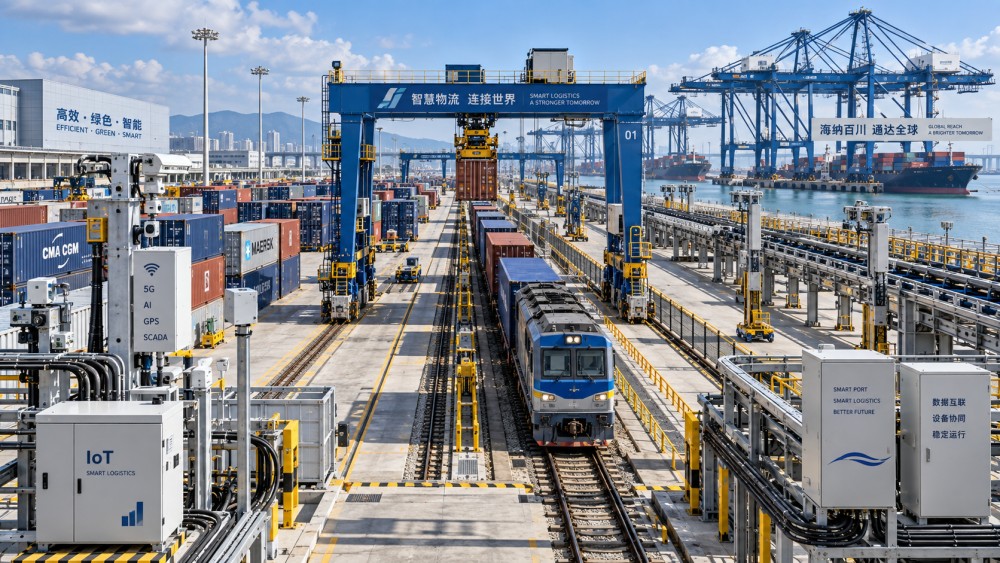
Four factors that change the timeline more than expected
1. The age and openness of the existing estate
Legacy does not automatically mean unusable. Many older rail, crane, and conveyor systems remain dependable precisely because they were designed for long asset lives. The challenge is that their communication protocols, controllers, and maintenance documentation may not have been designed for modern interoperability.
If interfaces are well documented and data can be accessed safely, integration may proceed through gateways or middleware. If a team must first discover how a controller behaves, reconcile inconsistent equipment naming, or determine whether a signal is trustworthy, the discovery phase can become the largest part of the project.
2. Data readiness
Integration projects often reveal that an organization has plenty of data but little shared meaning. One system may identify a rail vehicle by fleet number, another by unit number, and a third by a component serial reference. A port may record a container handoff differently in its gate, yard, and crane systems. Until these identities and events are reconciled, a polished interface can still produce unreliable decisions.
Data cleansing is not administrative housekeeping. It is operational design. Teams need to agree on master data, timestamps, exception codes, units of measure, and retention rules before automation can be trusted.
3. The cost of downtime
A distribution center may schedule a weekend cutover. A metropolitan rail line during peak commuting hours, or a bulk terminal loading a vessel against a narrow berth window, has much less flexibility. High-volume transport assets need staged testing, parallel running, rollback plans, and carefully selected maintenance windows.
That requirement can extend the program, but it is not wasted time. In critical transport environments, the safest integration is usually the one introduced in controlled increments rather than through a dramatic “big bang” launch.
4. Change management at the control room and on the ground
Operators and maintainers are often asked to absorb the most visible changes. A new rail dispatching interface, automated exception alert, crane remote-control workflow, or predictive-maintenance task list can alter how people prioritize work. If their knowledge is brought in only at final acceptance, teams may discover practical flaws late in the program.
Early involvement tends to shorten the path to usable adoption. It also improves the design: the people closest to a terminal, depot, or control room know where a nominally simple workflow meets real-world weather, shift handovers, traffic surges, and equipment constraints.
Comparing common integration paths
Organizations looking for a faster timeline often consider three broad approaches. Each has a place, and none is universally best.
Point-to-point integration can be the right answer when a port needs timely visibility between a specific equipment system and maintenance application, or when a freight operator needs to connect a new sensor feed to an existing asset platform. But a patchwork of quick fixes can create a fragile architecture if every new use case requires another custom connection.
A middleware or integration-layer approach usually takes longer at the beginning because it demands common data models, security rules, and interface governance. Its benefit is cumulative: future connections may become easier, and operational data can be reused across planning, maintenance, energy management, and performance analysis.
Full replacement should not be chosen merely because existing systems look old. It is more appropriate when the current technology cannot meet safety, supportability, cybersecurity, or business-process requirements. The timeline can be substantial because migration is not just technical; historical data, training, contractual processes, and operational contingency procedures all need attention.
A realistic phased plan for rail, port, and bulk logistics operations
The most resilient programs begin with a narrow operational question. Rather than announcing a broad ambition to “digitize the terminal” or “connect the rail network,” define a measurable use case: reduce unplanned traction-system maintenance events, improve the accuracy of crane availability, shorten the time required to identify a delayed wagon, or coordinate stockyard equipment status with shipment schedules.
The first phase is discovery and design. This is where teams inventory systems, map interfaces, identify safety boundaries, review cybersecurity requirements, and determine who owns each critical data object. Depending on complexity, this may take several weeks or several months. Skipping it can make later progress appear fast—until testing exposes assumptions no one documented.
Next comes a pilot or limited deployment. A single depot, one berth, one yard zone, a selected fleet class, or a defined conveyor route provides a manageable environment. The goal is not simply to prove that data can move. It is to confirm that alarms are meaningful, response responsibilities are clear, and the integration works under normal operating pressure.
Only then should the program move into staged rollout. This stage often takes the longest because it must respect local variation. One rail depot may have different maintenance practices from another; one terminal may operate with a distinct equipment mix or shift pattern. Standardization matters, but forcing identical processes where operating conditions differ can undermine adoption.
Finally, stabilization should be planned as a distinct period rather than treated as an afterthought. Interfaces need monitoring, exception rules may need tuning, and users need a clear route to report problems. The project is truly complete when routine support ownership has transferred successfully and performance is no longer dependent on a temporary implementation team.
What can shorten the integration without cutting corners?
The quickest safe route is usually preparation. Start with an interface inventory and identify systems that are truly operationally critical. Establish a small decision group with representatives from operations, engineering, IT, cybersecurity, and maintenance. Give that group authority to resolve data definitions and workflow ownership before issues become technical rework.
Use standard interfaces where they are available, but do not assume a standard protocol solves every problem. The meaning, timing, and quality of the data still need validation. Build testing around actual scenarios: a crane fault during a vessel window, a delayed train entering a congested corridor, a failed sensor on a conveyor, or a control-room handover at shift change.
It also helps to separate “must-have for safe operation” from “valuable optimization.” A first release may only need reliable status visibility and a defined exception workflow. Advanced optimization, digital-twin modeling, energy analytics, or AI-supported planning can follow once the underlying data chain is stable.
Questions to ask before committing to a date
Before accepting an implementation schedule, decision-makers should ask: Which interfaces already exist and which must be built? Is the source data complete enough to support the intended workflow? Can testing occur in a non-production environment? What downtime or maintenance windows are realistically available? Who signs off on safety, security, and operational readiness? And what is the fallback procedure if a cutover does not perform as expected?
A credible plan will answer these questions plainly. It will distinguish between configuration, integration, commissioning, and user adoption rather than presenting them as one undifferentiated timeline.
The answer depends on the operational horizon
So, how long does logistics technology integration usually take? A simple connection can be delivered within weeks. A meaningful operational integration commonly requires several months. A multi-site transformation across rail assets, automated ports, or bulk logistics infrastructure should be treated as a long-term program, often measured in phases over a year or more.
The better question is whether each phase creates dependable operational value without putting uptime at risk. In high-volume transportation, integration is not a race to connect systems for its own sake. It is the careful work of connecting equipment intelligence, automation logic, and human decisions so that every movement—from a traction converter’s health signal to a crane’s next task—supports a more visible, resilient flow of goods and passengers.
TC-Insight continues to examine how these timelines are changing as rail networks, urban transit systems, ports, and bulk terminals adopt more connected operating models. The technology matters, but the integration discipline behind it remains what determines whether digital ambition becomes reliable day-to-day performance.
Related News
Related News
- 00
0000-00
How axle load limits shape mainline railway freight capacity - 00
0000-00
How to match ship loaders to bulk terminal throughput targets - 00
0000-00
How high speed rail system standards shape CBTC interoperability - 00
0000-00
How a rail network planning dashboard improves capacity decisions - 00
0000-00
Comparing bulk handling solutions by throughput reliability
Weekly Insights
Stay ahead with our curated technology reports delivered every Monday.