
How Much Does Terminal Operations Software Implementation Cost?





Terminal operations software implementation can range from a focused deployment with a limited operating scope to a multi-system transformation involving berth planning, yard control, gate processes, equipment dispatch, maintenance data, billing interfaces, and remote crane functions. The software license is only one budget line. The larger cost usually comes from adapting operational rules, connecting reliable data sources, testing live exceptions, and preparing people and equipment to work under the new control logic.
A useful budget should therefore separate the cost of obtaining the application from the cost of making it dependable in a specific terminal. A container terminal with existing digital work instructions has a very different implementation profile from a bulk facility that relies on radio calls, spreadsheets, paper tickets, and equipment-specific control systems. Likewise, adding software to improve vessel planning differs substantially from replacing the core system that determines every container move, truck transaction, and equipment assignment.
Where the implementation budget goes
Most terminal operations software programs include several connected cost categories. These categories do not always appear as separate supplier quotations, which is why an apparently modest software proposal can later expand during configuration and site acceptance.
Comparing proposals only on license value can therefore produce a misleading result. A lower initial license may be associated with more custom interfaces, more internal development, or a larger requirement for site-specific configuration. Conversely, a higher-priced package may include standard connectors or workflow capabilities that reduce later build effort. The relevant comparison is the implemented operating scope, not the name of the software module.
Scope determines the order of magnitude
A narrow deployment might digitize gate appointments, truck turnaround records, or bulk truck loading tickets while leaving planning and equipment dispatch unchanged. Its cost is shaped largely by interface work, device deployment, traffic rules, and data quality. The operational blast radius is limited, although gate systems still require careful testing because a failed validation rule can stop vehicles at the entrance.
A broader terminal operating system implementation affects the sequence of work across the site. In a container operation, that can include discharge and load plans, stack location rules, reefer monitoring, dangerous-goods restrictions, customs holds, vessel cut-off times, and instructions sent to yard tractors or cranes. At a bulk terminal, the scope may include stockpile genealogy, belt conveyor availability, ship-loader sequences, train unloading, moisture records, blending constraints, and weighbridge reconciliation. Each function carries distinct events, tolerances, and exception paths that must be represented accurately.
Automation changes the cost profile again. When dispatch logic exchanges commands or status data with automated stacking cranes, rail-mounted gantries, automated guided vehicles, or remote-control stations, the project must define which system has authority at each moment. A simple interface that shows equipment status is very different from an interface that authorizes a move, reserves a handoff point, or stops machinery after a safety-related fault. The latter requires deeper design, simulator testing where available, and disciplined treatment of fail-safe states.
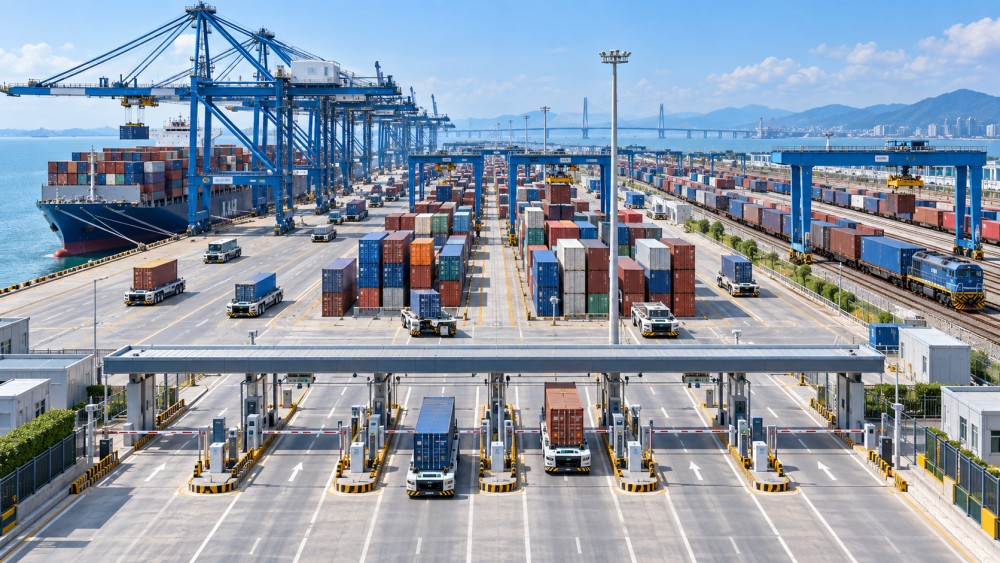
Intermodal terminals add another layer because rail schedules, wagon positions, gate arrivals, and yard capacity must remain aligned. A train may be physically present while its consist data is incomplete, a wagon identifier may not match the expected message, or a late container may arrive after a loading plan has been released. Software can manage these events only when the operating rule is clear: whether the unit is held, manually validated, re-planned, or escalated. Defining those rules consumes implementation time, but leaving them undefined produces costly workarounds after go-live.
Integration is often the unpredictable portion
Terminal software rarely operates as a closed application. It exchanges data with enterprise resource planning, finance, maintenance, customs or community systems, carrier portals, rail systems, access-control devices, weighbridges, optical character recognition equipment, handheld scanners, and industrial control platforms. The number of interfaces matters, but interface complexity matters more.
A message feed with stable identifiers and a documented error response is relatively straightforward. A feed assembled from manual exports, duplicated reference numbers, inconsistent time zones, or undocumented code values is not. The software team may be able to receive the data, yet still be unable to use it safely for dispatch, billing, or inventory control. Fixing this situation commonly requires data mapping workshops, cleansing rules, ownership decisions, and changes in upstream applications.
Equipment integration deserves separate scrutiny. Crane, conveyor, and automation suppliers may expose different levels of data: telemetry, alarms, work-order status, location data, or command interfaces. A terminal should distinguish between a display-level connection and a control-level connection when estimating cost. A dashboard can tolerate delayed information in some circumstances. Equipment dispatch cannot rely on uncertain timestamps, ambiguous completion messages, or network behavior that has not been tested under load.
Cybersecurity requirements also affect interface scope. Segmentation between office networks and operational technology, privileged access management, logging, patching rules, remote support methods, and recovery procedures must fit the terminal's architecture. Treating these items as late technical details can cause redesign after the functional build is already underway.
Configuration, customization, and the hidden cost of exceptions
Configuration uses the product's existing controls to express site rules. Customization changes the product itself or adds bespoke code. The first is usually easier to maintain through upgrades; the second may be justified where a terminal has a distinctive process or statutory obligation, but it should be priced as a continuing commitment rather than a one-time enhancement.
The difficult part is rarely the normal move. It is the exception: a container found in the wrong stack, a damaged seal, a wagon placed in an unexpected position, a scale reading rejected, a vessel plan revised after work begins, a conveyor taken out of service, or a truck with incomplete documentation. If exceptions are solved through informal calls and personal judgment today, implementation workshops must expose that knowledge before the system is configured.
There is a practical difference between genuine local requirements and habits that accumulated because prior systems were weak. Reproducing every old workaround can make a new platform expensive and brittle. Removing a workflow without confirming its operational purpose can create congestion or reconciliation problems. A sound design records the triggering event, the responsible role, the allowed action, the required evidence, and the downstream effect. That level of definition prevents vague requirements from becoming late-stage change requests.
Data migration is not just loading records
Migration costs depend on how much history must be active on the first day and what accuracy the new system requires. Master data usually includes locations, equipment identifiers, cargo attributes, customer records, tariff references, hazard classifications, vessel or train data, and operating calendars. Transactional data can include current inventory, active work orders, holds, bookings, maintenance statuses, and incomplete financial events.
Bringing every historical record into the new application is not always necessary. Retaining legacy access for audit and reference can be cheaper than converting years of old transactions. Active yard inventory, open orders, and balances still need reconciliation because an incorrect opening position will affect subsequent moves, claims, and billing. For bulk materials, the opening state may also involve stockpile quantity, grade, source, moisture basis, and blend composition. A system migration cannot correct uncertain physical inventory merely by changing the database.
Data cleansing needs named owners. A technical team can identify duplicates and missing fields, but it cannot decide whether two similar customer records represent the same commercial entity or whether a location code still corresponds to a usable yard position. These decisions should be settled before final migration rehearsals, not during a cutover window.
Implementation phases that need separate funding
Early discovery establishes the functional boundary, current interfaces, master-data condition, infrastructure constraints, and critical operating scenarios. This phase is often compressed to accelerate procurement, yet it is where uncertainty can be converted into a realistic estimate. A supplier cannot responsibly price an automation interface, for example, without knowing message ownership, handoff points, safety constraints, and the available test environment.
Design and build cover configuration, interfaces, reports, security roles, device setup, and data preparation. The schedule may appear linear, but terminal projects benefit from early validation of the most consequential workflows. A gate transaction, crane work instruction, rail loading sequence, or bulk loading reconciliation should be demonstrated with real-like data before every secondary report is polished.
Testing includes more than confirming that individual screens work. End-to-end testing should follow physical events across systems: arrival, identification, inspection, inventory update, work release, equipment execution, exception handling, completion, and commercial reconciliation. Peak-period conditions matter. A workflow that succeeds with a few transactions may fail when multiple vessels, gates, or loading lanes compete for the same resources.
Go-live and stabilization require a distinct contingency. During this period, configuration adjustments, interface corrections, data fixes, and intensified support are normal. Parallel operation can reduce immediate exposure but also introduces reconciliation work because two records of the same physical activity must remain aligned. The transition plan should specify which system is authoritative at each stage rather than asking shifts to infer the answer during disruption.
Comparing a phased rollout with a single cutover
A phased rollout can contain risk by introducing functions in operationally coherent groups. Gate and appointment management may precede yard optimization; a single berth or cargo stream may precede a wider deployment; reporting can follow once transaction quality is stable. This approach spreads expenditure and provides time to correct process design, but temporary interfaces and dual processes may remain longer than expected.
A single cutover removes the cost of maintaining a split operating model sooner. It is appropriate only when data, interfaces, procedures, training, and fallback arrangements are mature enough to change together. The financial exposure is higher because defects affect a larger share of daily activity at once. The decision should reflect operational dependency, not a preference for a shorter project calendar.
Budget questions that expose missing scope
Before treating an implementation estimate as comparable, clarify whether it includes integration design as well as interface construction; migration rehearsals rather than one final load; test environments for connected equipment; on-site support across shift patterns; training time for supervisors, planners, gate clerks, control-room staff, and maintenance coordinators; cybersecurity remediation; and support after stabilization.
It is also worth asking which assumptions sit behind the estimate. Examples include the number of operating locations, cargo flows, connected devices, languages, external message partners, historical records, reports, and automation interfaces. Assumptions are not a weakness in a proposal. Unstated assumptions are the problem, because they reappear later as scope changes.
The most reliable way to estimate terminal operations software implementation cost is to define a credible first operating state: the physical flows covered, the data that must be accurate, the systems that must exchange information, the exceptions that must be controlled, and the temporary arrangements permitted during transition. Once those boundaries are visible, license, integration, infrastructure, training, and stabilization costs can be evaluated as parts of the same operating investment rather than disconnected line items.
Related News
Related News
- 00
0000-00
How a rail network planning dashboard improves capacity decisions - 00
0000-00
Comparing bulk handling solutions by throughput reliability - 00
0000-00
What determines port crane intelligence pricing for terminal upgrades? - 00
0000-00
Rail equipment intelligence in Southeast Asia is reshaping fleet investment - 00
0000-00
Selecting Abrasion Control Systems for High-Wear Mining Transfer Points
Weekly Insights
Stay ahead with our curated technology reports delivered every Monday.