
Comparing Bulk Material Conveyors for Abrasive Ore, Coal, and Grain





Start with the Material, Not the Conveyor Catalogue
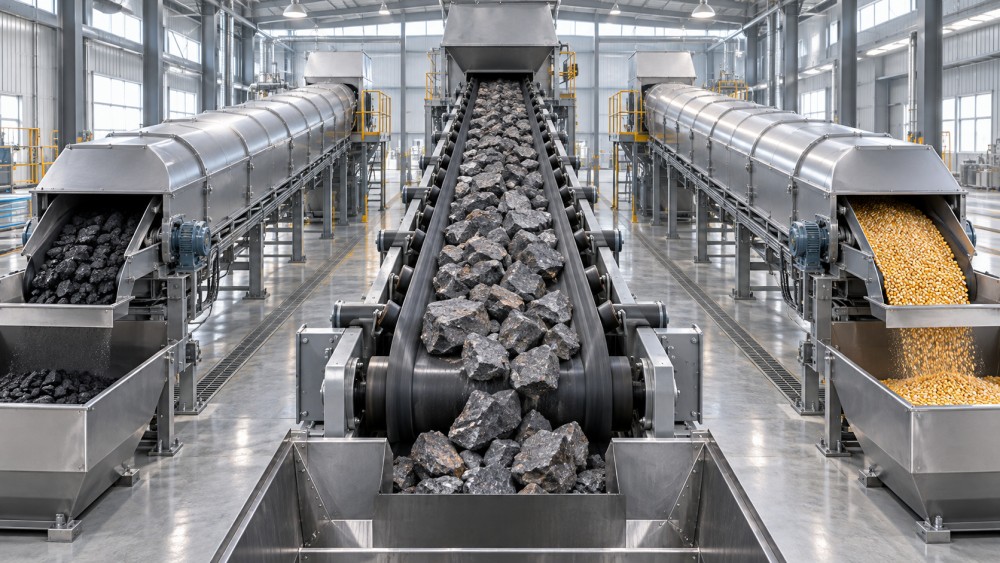
Ore, coal, and grain can all move through belt-based bulk material conveyors, but treating them as variations of the same duty is a costly procurement mistake. Abrasive ore attacks transfer points, liners, belts, and chutes. Coal creates a different combination of dust, moisture sensitivity, degradation, and, in some applications, fire risk. Grain is comparatively gentle on mechanical components yet demands far tighter control of contamination, product damage, hygiene, and combustible dust.
For buyers, the first decision is therefore not whether to choose a belt conveyor, screw conveyor, drag conveyor, or bucket elevator. It is whether the proposed system has been engineered around the material's behavior at the points where conveyance is least forgiving: loading, acceleration, transfer, discharge, cleaning, and upset recovery. A conveyor can meet its rated capacity on paper while generating unacceptable wear, dust emissions, carryback, breakage, or downtime in service.
The practical comparison is simple. Abrasive ore favors robust, low-speed, well-contained belt systems with replaceable wear components. Coal systems need balanced attention to capacity, dust containment, belt tracking, and safe handling of variable feed. Grain systems often reward enclosed, cleanable equipment and gentle transfer design more than sheer structural mass. The right equipment type follows from these priorities.
Why the Same Capacity Rating Does Not Mean the Same Machine
A rated throughput, such as tonnes per hour, is only a starting point. It says little about particle size distribution, lump content, moisture range, bulk density variation, abrasiveness, angle of repose, degradation tolerance, or how evenly material arrives at the loading point. Those properties determine the conveyor's real operating envelope.
Consider three materials delivered at the same nominal rate. A crushed ore stream with sharp fragments and occasional oversize lumps can impose severe impact and abrasion at the loading zone. Coal may have a lower abrasive effect but can arrive wet, sticky, frozen, or prone to producing fine dust. Grain may flow consistently through a receiving pit yet suffer commercial loss if it is cracked by excessive drop height or damaged by a high-speed transfer.
Procurement documents should require suppliers to state the design basis, including normal, minimum, and maximum material conditions. A single “typical” bulk density or moisture value can conceal the conditions that cause plugging, belt overload, spillages, or rapid component failure. Buyers should also distinguish between design capacity and sustainable operating capacity. The latter should account for the planned duty cycle, feed irregularity, maintenance windows, and realistic degradation of liners, skirts, and cleaners.
Abrasive Ore: Protect the Transfer System Before Optimizing Speed
For abrasive ore, the belt conveyor is often the most practical choice for long distances and high continuous volumes. It can move material across complex site layouts with relatively low energy use per tonne when correctly designed. But the belt itself is rarely the only, or even the first, component to fail. The transfer chute, loading zone, skirt sealing, impact support, and discharge arrangement usually determine whether the system remains stable between planned shutdowns.
Ore conveyance should be designed to control the material stream before it reaches the belt. Material that drops vertically onto a moving belt has to accelerate rapidly. That acceleration creates impact, turbulence, dust, belt wear, and tracking problems. A properly engineered chute aligns material velocity and direction with the belt travel, limits free-fall height where practical, and keeps large lumps from striking vulnerable surfaces at damaging angles.
Wear resistance must be specified as a system property. Heavy liners in one area do not compensate for a poorly shaped chute that repeatedly directs material into a sharp corner or exposed support structure. Buyers should ask which wear surfaces are replaceable, how they can be accessed, and whether replacement can occur without removing large sections of the conveyor. Liner material selection should match the ore's abrasion and impact characteristics; hard, highly wear-resistant materials can be unsuitable in locations subject to strong impact if they are prone to cracking.
Wide belts and high speeds can reduce the number of conveyor flights, but they should not be treated as automatic improvements. Higher speed may increase chute wear, complicate belt cleaning, raise spillage risk at transitions, and magnify the consequences of mistracking. A lower-speed conveyor with stable loading and maintainable components can offer better life-cycle performance than a faster unit that reaches the same capacity through more aggressive operating conditions.
For coarse or highly variable ore, evaluate the system's response to abnormal feed as seriously as its normal rating. Ask how oversize material is managed, whether loading conditions change after crusher wear or screen bypass, and what happens when the belt stops under load. These are the scenarios that expose weak take-up design, inadequate starting torque, poorly accessible cleanup areas, and underdesigned chute work.
Coal: Capacity and Dust Control Must Be Designed Together
Coal handling often appears less mechanically demanding than ore handling, particularly where particle size is smaller. That can lead to underspecified containment and cleanup provisions. In practice, coal's fines content, moisture variation, and tendency to generate dust can turn a straightforward belt route into a persistent operating problem if the transfer points are treated as secondary details.
Covered belt conveyors are commonly considered where the route is exposed to weather or where windblown loss and emissions matter. Full enclosure can improve containment, but it also changes access, inspection, ventilation, fire protection arrangements, and maintenance procedures. The purchasing decision should address those operational consequences rather than simply requiring a cover.
The loading zone deserves close scrutiny. Coal should be loaded centrally and in the direction of belt travel, with skirt boards and sealing systems sized for the material depth and belt movement that will occur in operation. Excessively tight skirts can create belt drag and wear; inadequate sealing allows fine material to escape and accumulate around idlers and structural steel. Neither outcome is solved by adding more housekeeping labor.
Moisture complicates the comparison. Wet coal can adhere to belts and discharge surfaces, creating carryback that falls along the return run. Dry coal increases airborne dust. A conveyor designed around only one condition may struggle through seasonal or source-related changes in feed. Buyers should request the intended belt-cleaner arrangement, secondary cleaning provisions where justified, and the method for collecting and safely removing cleaned material.
Coal applications also require a disciplined review of safety functions. The exact requirements depend on the facility, jurisdiction, and process arrangement, but the equipment scope should clearly identify relevant protective measures such as pull-cord switches, belt drift detection, speed monitoring, emergency stops, and controls for abnormal loading or blocked discharge. Where dust or fire hazards are relevant, conveyor and dust-control design cannot be evaluated as separate packages. The interfaces between mechanical equipment, electrical systems, ventilation, detection, and operating procedures need to be defined before award.
Grain: Gentle Handling and Cleanability Change the Equipment Choice
Grain's lower abrasiveness does not make it an uncomplicated bulk material. Grain buyers are often balancing throughput against breakage, cross-contamination, insect control, cleanup time, and the risk created by dust accumulation. A conveyor that performs efficiently for mineral products may be unsuitable where product quality and sanitation govern the commercial outcome.
For horizontal or shallow-incline routes, enclosed belt conveyors can offer high capacity with comparatively gentle handling when feed and discharge are controlled. Drag conveyors are often useful where enclosure and compact routing are priorities, especially for receiving, reclaim, and distribution duties. Screw conveyors fit certain short-distance metering or transfer tasks but may create more grain damage and power demand than a belt-based alternative when used for long or high-volume runs. Bucket elevators remain important for vertical lifting but require careful attention to boot design, belt or chain condition, and discharge arrangement.
The appropriate choice depends on the material path, not just the preferred equipment family. A facility with several transfer points can inflict more damage through repeated drops than through the primary conveyor itself. Procurement teams should map the full route from receiving to storage or loading, then count every transfer, diversion, and change in direction. Reducing one unnecessary drop can be more valuable than selecting a marginally more efficient drive package.
Cleanability should be made contractual where grain grades, food use, or contamination control require it. Buyers should assess access doors, residue-prone ledges, drainage where wet cleaning is used, ability to empty the conveyor, and whether the design leaves inaccessible pockets. Equipment that is sealed against external dust but difficult to clean internally can create a different operational risk.
Dust management deserves the same attention as mechanical handling. Fine organic dust can accumulate in pits, galleries, and enclosed conveyor sections. Collection points, enclosure design, housekeeping access, and compatibility with the site's hazard-control approach should be addressed during equipment selection. The objective is not simply to add extraction ducting after installation; it is to prevent dust escape at the source and avoid creating locations where dust can settle unnoticed.
Compare Conveyor Proposals by Failure Mode
Supplier quotations often make comparison difficult because each proposal may present a different combination of belt width, speed, drive power, steelwork, and accessories. A more useful purchasing method is to compare how each design handles the failure modes most likely for the material and route.
- At loading: How will impact, stream direction, dust, and uneven feed be controlled?
- Along the carrying run: What prevents belt mistracking, sag, spillage, and idler damage?
- At discharge: Will material release cleanly at the intended point across the expected moisture and fines range?
- On the return run: How are carryback, dropped material, and belt-cleaner discharge managed?
- During maintenance: Can personnel inspect, replace, and clean critical components without excessive isolation, confined access, or dismantling?
- During an upset: What occurs with a blocked chute, stopped belt, overloaded feed, power interruption, or abnormal lump size?
This approach prevents a procurement process from becoming a narrow comparison of capital price and nameplate capacity. It also gives technical and operations teams a common framework for evaluating offers. A supplier that can explain the load path, material trajectory, access strategy, and replacement philosophy in detail is providing more decision-useful information than one that relies mainly on a high-level performance figure.
Life-Cycle Cost Is Usually Decided at the Transfer Points
Conveyor purchase price matters, but the largest cost differences can emerge after commissioning. For ore, recurring expense often concentrates in wear parts, belt repairs, and downtime around transfer stations. For coal, cleanup labor, carryback, dust-system upkeep, and unplanned spillage can outweigh small differences in initial equipment cost. For grain, losses from breakage, rejected loads, cleaning time, and cross-contamination may be more consequential than mechanical wear.
Ask bidders to separate base equipment from the components that support reliable operation: chutes, liners, impact beds or idlers, sealing, cleaners, belt tracking devices, covers or enclosures, access platforms, controls, and spares. A low initial quote can omit the parts that make a conveyor workable in a demanding application. Conversely, a heavily featured proposal should show why each item addresses a defined condition rather than being treated as an unexamined upgrade.
Spare-parts strategy should also reflect the duty. Critical belt components, cleaners, skirt materials, idlers, liners, and sensors may have very different replacement patterns. Buyers should establish which items are consumable, which are long-lead, whether parts are proprietary, and what access is needed to change them. A component may have a respectable service life yet still be a poor choice if its replacement requires a long outage or specialized equipment.
A Practical Basis for the Award Decision
The most defensible selection starts with a material-handling data sheet that describes actual feed conditions, then tests each proposed conveyor against the route's operational risks. For abrasive ore, place the heaviest weighting on transfer design, wear management, structural robustness, and maintainability. For coal, ensure throughput claims are inseparable from containment, cleaning, and safety integration. For grain, give product integrity, cleanability, enclosure, and dust control equal standing with capacity.
Bulk material conveyors are long-life assets, but their performance is decided by many small design choices. The procurement question is not which conveyor category is best in the abstract. It is which configuration can move this material, through this route, under the inconvenient conditions that will eventually occur, while remaining accessible enough to keep operating.
Related News
Related News
- 00
0000-00
How dust control requirements shape bulk material transport system design - 00
0000-00
When does a container port crane supplier need STS crane experience? - 00
0000-00
How rail technology signaling reduces headways without compromising safety - 00
0000-00
When do port automation solutions in Europe justify the investment? - 00
0000-00
What should a rail transport provider guarantee in a metro project?
Weekly Insights
Stay ahead with our curated technology reports delivered every Monday.