
Why a Bulk Material Handling Conveyor Loses Throughput and How to Fix It





A bulk material handling conveyor usually loses throughput before it fails completely. The belt may still be running, the motor may still be drawing a normal-looking load, and operators may still be feeding material into the system. Yet the actual tonnage delivered downstream falls, spillage increases, or the line needs repeated short stops to recover.
The practical question is not simply “which component is bad?” It is: where is the system losing its ability to accept, carry, discharge, or recover material at the required rate? A conveyor is a continuous flow system. A restriction at the loading chute, a slipping drive, an overloaded discharge point, or a belt that cannot run centrally can all produce the same visible result: reduced output.
For maintenance work, begin with the operating condition when throughput drops. Compare the material feed, belt speed, belt loading profile, drive behavior, and discharge condition during normal production versus the reduced-rate condition. Replacing parts before locating that change often creates cost without restoring capacity.
Separate a true conveyor limit from an upstream or downstream restriction
A common mistake is to blame the conveyor whenever the plant output falls. In reality, the conveyor may be receiving inconsistent feed, or it may be backing up because the next crusher, screen, hopper, ship loader, or stockyard route cannot accept material. The belt then appears underperforming even though its carrying capacity is not the original constraint.
Start with three observations:
- Is the belt fully and evenly loaded? A lightly loaded belt points toward an upstream feed problem. A belt loaded heavily in one area but empty elsewhere suggests poor loading geometry rather than insufficient belt width.
- Does material accumulate at the discharge? A growing pile, plugged chute, or delayed take-away equipment creates back-pressure that will eventually force the line to slow or stop.
- Does throughput fall only with a particular material? Wet fines, sticky ores, clay-bearing coal, frozen product, or irregular lump sizes can expose transfer and cleaning problems that dry, free-flowing material does not.
Do not use motor current alone as a capacity measure. A conveyor can carry less material while consuming more power if misalignment, seized rollers, belt rubbing, or excess scraper pressure increases resistance. Conversely, a lightly loaded belt may show low current because the restriction is upstream.
Transfer points are often the real bottleneck
Most persistent throughput losses begin where material changes direction: from feeder to conveyor, conveyor to conveyor, or conveyor to process equipment. A transfer point must control material speed, trajectory, impact, and dust. If it does not, the belt receives an unstable load that is difficult to carry at design rate.
Look for off-center loading, material striking the skirtboard, lumps bouncing after impact, and fines escaping from the sides. Material should settle onto the receiving belt in the direction of travel, with its speed reasonably matched to the belt. When it is dropped across the belt or against the belt’s motion, it drags the belt sideways, accelerates wear, and promotes tracking problems.
Skirtboard seals deserve particular attention. Excessively tight skirting can create continuous belt drag and heat. Worn or poorly adjusted seals let fines escape, which reduces delivered tonnage and creates cleanup work that interrupts operation. A chute that has built up with sticky material may narrow gradually until it becomes a partial blockage, especially at transitions or bends where the material stream changes direction.
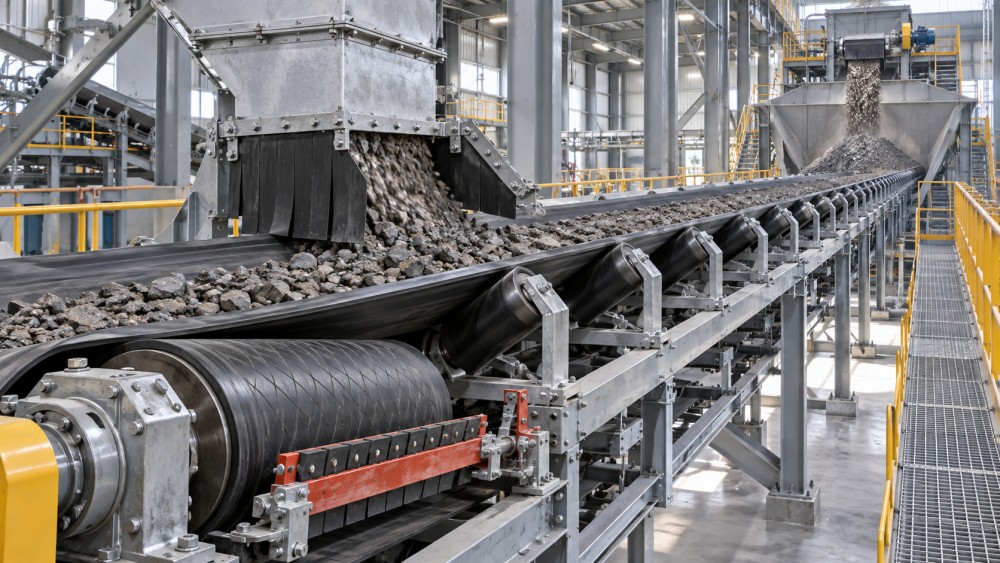
Corrective work should address the flow path, not only the spilled material. Remove buildup safely, inspect liner wear, confirm that the chute outlet is not restricting the burden, and check that the loading zone supports the belt properly. If the material stream is consistently off-center, adjust the chute design or loading arrangement. Repeatedly training the belt without correcting an off-center load treats the symptom, not the cause.
Belt tracking can reduce capacity long before it causes a shutdown
A belt that runs against a structure loses usable carrying width and sheds material at the edge. It also increases friction, damages covers and edges, and can force operators to reduce feed to avoid severe spillage. Tracking faults are therefore throughput faults, not just maintenance defects.
Tracking correction should follow a disciplined order. Inspect the belt path before adjusting any training device:
- Confirm that the belt is loaded centrally at the transfer point.
- Remove material buildup from return rollers, pulleys, cleaners, and the underside of the belt.
- Check for seized, damaged, or misaligned idlers, particularly close to loading and discharge zones.
- Inspect pulley lagging and belt condition for uneven wear or localized damage.
- Verify that the conveyor structure, pulleys, and idler frames remain square to the belt path.
- Only then fine-tune tracking devices or idler alignment.
Adjusting several idlers at once makes diagnosis harder and can create a belt path that only works under one loading condition. Make one controlled adjustment, observe the belt through a complete operating cycle, and record the result. If the belt tracks correctly empty but drifts when loaded, the loading condition or material distribution is usually more important than the return-side adjustment.
Check resistance, not just visible damage
Throughput can fall because the drive has less effective power available to move the belt and its load. This does not always mean the motor has failed. Rolling resistance rises when idlers seize, bearings deteriorate, return rollers collect carryback, or the belt rubs against guards and structure. A drive may then approach its operating limit at a lower material load than before.
Walk the conveyor while it is isolated and while it is operating under approved site procedures. Listen for bearing noise, look for stopped or slow-turning idlers, and identify hot spots using the inspection methods available at the site. Pay close attention to the return run beneath transfer points. Carryback often adheres to return rollers and gradually changes their diameter, causing vibration, belt wander, and extra drag.
Drive slip produces a different pattern. The belt speed may fluctuate, the drive pulley may show polished or glazed lagging, and the system may struggle particularly during heavy starts or peak feed. Before increasing tension, inspect the actual cause. Low take-up travel, contaminated lagging, a worn belt cover, incorrect tensioning, or a drive-control issue can all reduce traction. Over-tensioning a belt to mask slip raises stress on splices, bearings, pulleys, and structure.
Material changes can invalidate a previously stable setup
A conveyor that handled one material reliably may lose throughput after a change in moisture, particle-size distribution, temperature, or blend. This is especially common in mines, coal terminals, and bulk storage systems where feed sources vary. The conveyor itself has not necessarily become undersized; the material may now be more likely to stick, compact, segregate, or bridge.
Wet fines can adhere to chute walls and return components. Large lumps can damage skirts or block narrow chute sections. A high proportion of fines may increase dust and carryback, while a mixed-size stream may segregate during transfer and load one side of the belt. Maintenance teams should record the material condition whenever a problem occurs. That record often reveals why the same mechanical adjustment succeeds on one shift and fails on another.
Cleaning equipment must match the material behavior. A primary cleaner may remove larger carryback effectively but leave damp fines on the belt. Adding or adjusting secondary cleaning can help, but excessive blade pressure creates drag and belt wear. The appropriate setting is the lowest pressure that maintains acceptable cleaning over the working belt width. If cleaning remains ineffective because material is accumulating upstream of the blade, investigate the discharge geometry and material adhesion rather than continually tightening the cleaner.
Use operating data to find when the loss begins
Even a basic operating log is more useful than relying on end-of-shift impressions. Record belt speed, feed condition, drive load trend, stoppage reason, material type, weather exposure where relevant, and the location of any spillage or buildup. The goal is not to create paperwork; it is to identify the sequence of events.
For example, a gradual increase in drive load paired with increasing carryback points to resistance building over time. Stable drive load with declining delivered material suggests an upstream feed issue or material loss at a transfer. Repeated overload alarms immediately after a chute is cleaned may indicate that the system is clearing accumulated material in surges, rather than operating at a genuinely higher continuous rate.
Condition monitoring should support inspection priorities. Speed monitoring can reveal slip or unexpected slowdowns. Belt misalignment switches help identify recurring drift locations. Vibration and temperature checks can focus attention on deteriorating rotating equipment. These signals are most valuable when maintenance teams connect them to a physical location and an operating condition, rather than treating every alarm as an isolated event.
Restore throughput with a fault sequence, not a parts list
When production is affected, the fastest durable response is usually a short, repeatable troubleshooting sequence:
- Make the area safe and confirm whether the limitation is upstream, on the conveyor, or downstream.
- Observe the loaded belt at the feed point, along the carrying run, and at discharge before changing settings.
- Remove abnormal buildup and correct obvious restrictions such as blocked chutes, seized idlers, and failed cleaners.
- Check belt tracking under realistic load, then correct the loading geometry before making fine tracking adjustments.
- Verify drive traction, take-up movement, belt speed, and unusual resistance if the belt cannot maintain normal operation.
- Run at controlled feed, confirm stable flow, and document the condition that caused the loss.
This order prevents a familiar failure pattern: replacing idlers after a tracking complaint, increasing belt tension after a slip complaint, and then discovering that a poorly loaded transfer point created both symptoms.
For long-life assets, maintenance planning should distinguish between routine cleaning and recurring design issues. Replacing worn rollers, seals, and scraper blades is necessary work. Repeated wear in the same location, however, usually calls for a review of loading impact, chute geometry, support spacing, drainage, or material containment. Intelligence focused on bulk logistics equipment, such as the coverage provided by TC-Insight, can be useful when a site needs to compare recurring conveyor issues with wider operational practices across mines and bulk terminals.
FAQ
Can increasing belt speed restore lost conveyor throughput?
Only when the existing belt loading, transfer design, drive capacity, and downstream equipment can accept the higher speed. Increasing speed can worsen dust, spillage, belt tracking, and discharge problems if the actual restriction is a transfer point or a downstream bottleneck.
Why does a conveyor lose capacity after rain or when material moisture rises?
Moisture can make fines adhere to chutes, cleaners, and return rollers. It can also promote hopper bridging and change how material settles on the belt. Inspect buildup and flow restrictions before changing belt tension or drive settings.
Should a mistracking belt be corrected by adjusting idlers immediately?
No. First check loading alignment, carryback, pulley condition, and structural squareness. Idler adjustments are useful for final correction, but they cannot reliably overcome a belt that is being loaded off-center or pulled sideways by accumulated material.
When does repeated spillage indicate a design problem rather than a maintenance problem?
It becomes a design issue when the same area spills again after cleaning, replacement parts, and normal adjustments. Persistent spillage at one transfer point often means the material trajectory, chute outlet, containment, or belt support does not suit the actual material stream.
Related News
Related News
- 00
0000-00
When does a container port crane supplier need STS crane experience? - 00
0000-00
How rail technology signaling reduces headways without compromising safety - 00
0000-00
When do port automation solutions in Europe justify the investment? - 00
0000-00
What should a rail transport provider guarantee in a metro project? - 00
0000-00
What drives cargo handling automation pricing at container terminals?
Weekly Insights
Stay ahead with our curated technology reports delivered every Monday.