
Sizing Export Terminal Conveyors to Match Stockyard and Ship Loader Capacity





Sizing Export Terminal Conveyors to Match Stockyard and Ship Loader Capacity
An export terminal conveyor sized to a ship loader’s nameplate capacity can still leave vessels waiting if stockyard reclaim rates, transfer points, or operating availability constrain the material flow. The challenge is to align the entire handling chain—not simply specify a larger belt. That means translating vessel loading targets into conveyor design requirements, reconciling peak and sustained throughput, and accounting for material properties, surge capacity, and maintenance downtime. The aim is a balanced system that supports reliable ship loading without unnecessary capital cost.
The first question should not be “How many tonnes per hour can this conveyor carry?” It should be “What loading duty must the terminal deliver, under which operating conditions?” Those questions produce different equipment specifications and, often, different investment priorities.
Start with the vessel loading window, not the equipment catalogue
A berth productivity target usually refers to cargo loaded over an elapsed period. Conveyor capacity refers to material movement while the system is running. Confusing the two makes a terminal look adequately sized on paper while leaving too little time to recover from routine interruptions.
Separate the vessel’s berth window into time available for loading and time consumed by activities such as surveys, hatch changes, loader repositioning, trimming, and operational holds. Then account for interruptions within the loading period, including equipment trips and stockyard changeovers. The allocation should follow the terminal’s operating plan rather than a generic availability allowance.
Required average running rate = cargo parcel mass ÷ effective material-flow hours.
This gives the average rate needed while material is actually flowing—not automatically the conveyor’s final design rating. The selected equipment still needs a justified allowance for feed variability and recovery. Be careful not to deduct the same downtime twice: a loading window that already excludes maintenance stops should not receive another blanket maintenance derating.
Keep annual export capacity as a separate check. Annual tonnage helps establish utilization and maintenance opportunities, but it can conceal demanding individual vessel calls. A terminal may meet its annual target and still struggle whenever a large parcel arrives alongside a restricted sailing window.
Build a capacity map for each operating route
Trace the actual route from the selected stockpile to the vessel: reclaimer, yard conveyor, junction transfers, sampling equipment, weighing section, surge storage where provided, jetty conveyor, and ship loader. Record both the rated capacity and the expected sustained capacity of each element for the nominated cargo.
For an unbuffered series route, sustained output cannot exceed its lowest sustained-capacity element. Where storage decouples sections, instantaneous rates can differ, but the long-term material balance still applies. A faster downstream belt does not correct a persistent reclaim shortfall.
Pay particular attention to shared infrastructure. Two reclaimers may each have adequate capacity, yet their combined flow can exceed a common conveyor or junction chute. Conversely, a nominally large yard conveyor may rarely receive its design feed because only one reclaim route is available for the required grade.
This is where TC-Insight’s focus on the connections between bulk handling, automation, and wider logistics is useful: berth productivity depends on the operating route, not on an isolated machine rating. Rail receipt timing, stockpile readiness, and grade allocation can determine whether the mechanical capacity is usable when the vessel arrives.
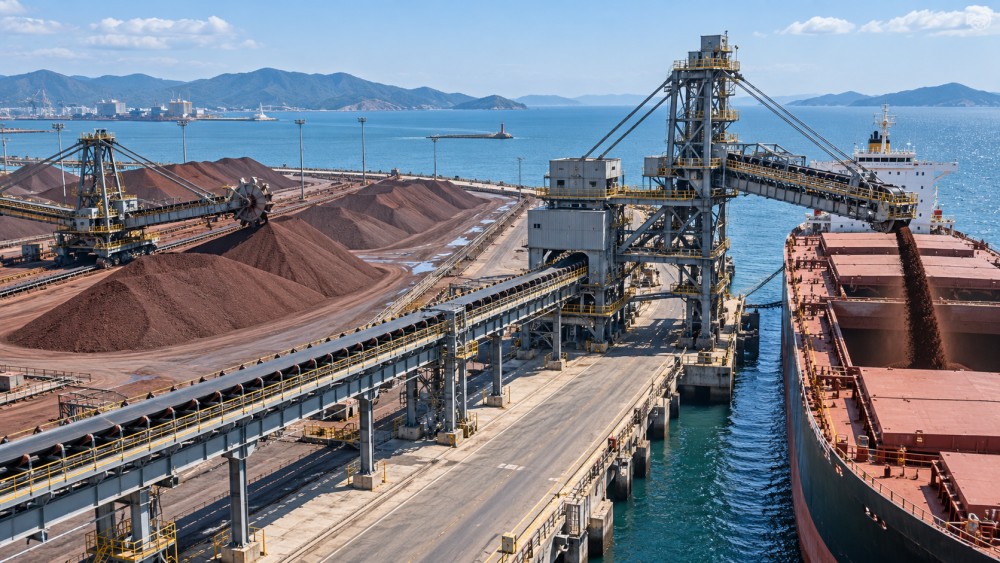
A useful capacity diagram should show flow direction, shared sections, route alternatives, and any buffer between reclaim and loading. Annotate the constraints directly on that diagram. It is easier to identify a hidden bottleneck there than in separate equipment datasheets.
Reclaim capacity needs an operating profile
A reclaimer’s maximum output is not necessarily the feed available throughout a vessel call. Stockpile geometry, bench transitions, machine travel, cleanup work, and material condition can change the delivered rate. Blending requirements may also force operation away from the highest-output reclaim pattern.
Ask for a time-based reclaim profile covering representative stockpile conditions, rather than a single average. Include pile entry, established reclaim, transitions, and the final recovery of material. For an existing terminal, historian records and belt-scale trends can reveal these patterns, provided the measurements are reliable and the operating context is retained.
Distinguish three rates in the design basis:
- Normal sustained rate: the expected stable flow for the selected cargo and route.
- Peak feed rate: short-duration inflow that conveyors and transfers must accommodate or actively limit.
- Recovery rate: a rate that the complete chain can sustain to regain lost loading time.
Recovery capacity is valuable only if it exists throughout the route. If the ship loader is already operating at its allowable maximum, increasing upstream conveyor capacity will not recover a delay. If reclaim is the constraint, more jetty conveyor capacity may simply create unused headroom.
Translate tonnes per hour into a credible belt design
Once the duty is clear, an export terminal conveyor must be checked against the material envelope. Mass flow depends on the loaded cross-sectional area, belt speed, and conveyed bulk density:
Q = 3,600 × A × v × ρ, where Q is throughput in tonnes per hour, A is the loaded material cross-section in square metres, v is belt speed in metres per second, and ρ is bulk density in tonnes per cubic metre.
This relationship is a capacity check, not a complete conveyor design method. The usable cross-section depends on trough geometry, surcharge angle, edge clearance, loading stability, and inclination. Use properties representative of the conveyed material—not an unrelated laboratory density or an optimistic catalogue assumption.
Lower bulk density generally demands more carrying volume for the same mass rate. Denser material can impose greater structural and mechanical loading under relevant loading conditions. The design therefore needs more than one “worst case”: volume capacity, power demand, belt tension, and chute behaviour may be governed by different cargo conditions.
Increasing belt speed is not a free capacity upgrade. It changes discharge trajectories and can increase the difficulty of controlling dust, wear, and loading-zone stability. A wider belt at a more moderate speed may be preferable for some duties, but it brings its own structural, equipment, and layout costs. Evaluate both options against the actual route and cargo.
Transfer points deserve a separate review. Check maximum lump size, moisture variation, cohesion, abrasion, and the incoming stream trajectory. A chute that passes dry material at the design rate may behave differently with wetter cargo. Increasing belt capacity without resolving chute restrictions can move the bottleneck into a less accessible location.
Use surge capacity to bridge interruptions, not hide a deficit
A buffer can keep the ship loader supplied through a short reclaim interruption. Its value depends on usable inventory, withdrawal capability, and the duration of the event—not simply its geometric volume.
Required usable buffer mass = downstream loading rate × interruption duration, with consistent units and an allowance justified by the operating scenario.
For changing inflow and outflow, calculate the inventory over time. Confirm both that the buffer does not empty during the interruption and that it does not overflow during a downstream stop. Material already travelling on upstream belts, together with stopping delays, can affect the latter check.
A buffer also needs to refill. If upstream capacity cannot exceed downstream demand after an interruption, the lost inventory will not be restored while loading continues. This is why a bunker cannot solve a persistent mismatch between reclaim and ship-loader capacity.
Before adding storage, examine flowability, feeder turndown, segregation, grade contamination, and cleaning access. Some terminals will gain more from an alternative reclaim route or a revised stockpile sequence than from a larger bunker. The right choice depends on the interruptions the project is actually trying to absorb.
Availability and controls belong in the sizing decision
Several machines with individually acceptable availability do not automatically form a reliable loading chain. A blocked transfer, failed shared power supply, or unavailable route can stop multiple otherwise serviceable assets. Assess route-level availability and common-cause failures rather than relying solely on equipment percentages.
Maintenance access affects that assessment. Belt repair space, chute inspection access, drive removal provisions, and the ability to isolate equipment safely influence outage duration. Additional rated throughput may offer less operational benefit than making a recurring failure easier to repair.
The control philosophy must also reflect the physical system. Define how feed is reduced when a transfer approaches its limit, how material in transit is handled during a ship-loader stop, and how restart sequences avoid overloading. Belt scales, speed feedback, chute blockage detection, and buffer level measurement should support clear operating responses.
Where variable-speed operation is proposed, verify the permitted range for the conveyor, drive cooling, loading conditions, and transfer trajectories. Slowing the belt while maintaining the same mass feed increases material cross-section; it is not automatically a safe way to smooth the flow.
Specify acceptance around the duty the terminal must deliver
Before procurement, agree on the material properties, routes, stockpile conditions, loading rates, and interruption scenarios used for design. Keep supplier guarantees consistent across interfaces. A conveyor guarantee based on one density and a ship-loader guarantee based on another can leave a contractual gap even when both suppliers meet their individual commitments.
Acceptance testing should distinguish mechanical capability from integrated operating performance. Define measurement methods, test duration, allowable interruptions, and treatment of cargo conditions outside the agreed envelope. A short peak-throughput test does not demonstrate sustained vessel loading or recovery after a stockyard changeover.
The practical next step is a route-by-route capacity balance supported by time-based operating scenarios. If it shows reclaim starvation, invest upstream. If it shows transfer restrictions, resolve the material-flow design. Specify a larger export terminal conveyor only when its additional capacity can be supplied, passed through every interface, and used at the vessel.
Have questions about the global trade trends discussed here, or planning your expansion and supply chain strategy? Leave a message below and let the trade experts at TTC-Insight guide you.
We respect your privacy. Your information is strictly confidential.
Related News
Related News
- 00
0000-00
How public funding shapes the urban rail transit market - 00
0000-00
How do terminal operations systems coordinate crane scheduling? - 00
0000-00
Evaluating Skeletal Container Chassis Capacity for Loaded Boxes - 00
0000-00
How much outreach does a container terminal crane need? - 00
0000-00
Which rail safety technology standards apply to CBTC systems?
Weekly Insights
Stay ahead with our curated technology reports delivered every Monday.