
Designing Bulk Loading Terminals to Reduce Ship-Loading Bottlenecks





Designing Bulk Loading Terminals to Reduce Ship-Loading Bottlenecks
A high-capacity ship loader cannot deliver its rated throughput if upstream handling systems leave it waiting for material. Designing bulk loading terminals means aligning rail or truck intake, stockyard capacity, reclaiming systems, conveyors, and berth operations—not simply selecting faster equipment. The design challenge is to maintain a reliable material supply while accommodating cargo changes, vessel movements, maintenance, and uneven delivery schedules.
That system-wide perspective connects with the Global Transit-Core Hub’s (TC-Insight) focus on rail transport, port machinery, and bulk logistics. Looking across these interfaces helps explain why a terminal can have apparently adequate equipment capacity yet struggle with vessel turnaround. The bottleneck is often not one undersized machine, but an operating condition that the original design failed to accommodate.
Start with the loading window, not the equipment catalogue
Annual tonnage is necessary for business planning, but it is a weak starting point for sizing the ship-loading chain. Two terminals handling similar annual volumes may need very different configurations because their vessel sizes, arrival patterns, cargo mixes, and available berth hours differ.
Begin with representative vessel parcels and the time available to load them. Separate productive loading time from berthing, inspections, hatch changes, trimming, weather interruptions, and departure activities. Dividing parcel tonnage by productive loading hours establishes an initial required average loading rate. It does not establish the ship loader’s final nameplate capacity.
The distinction matters because instantaneous transfer rate, average loading rate, and berth productivity measure different things. Equipment can meet its contractual instantaneous rate while the vessel remains alongside much longer than planned. Performance requirements should therefore state the measurement period, operating conditions, and treatment of interruptions.
A useful design basis also records cargo density, moisture variation, particle-size distribution, vessel geometry, and arrival uncertainty. These assumptions should remain visible throughout procurement. Otherwise, different suppliers may size their equipment against different interpretations of the same throughput target.
Trace the material path and identify competing demands
Map the complete route from unloading to the vessel hold. Include receiving hoppers, feeders, stacking conveyors, stockpiles, reclaimers, transfer towers, berth conveyors, and the ship loader. Mark where routes merge, where equipment is shared, and where cargo changes require cleaning or inspection.
A shared conveyor may support both stockyard replenishment and vessel loading, but not necessarily at the same time. Likewise, a stacker-reclaimer may have sufficient reclaim capacity yet be unavailable while stacking incoming cargo. These conflicts are scheduling constraints, not simply mechanical capacity shortfalls.
The flow diagram should show operating modes as well as equipment connections: receiving while loading, reclaiming from alternative piles, changing cargo grades, and isolating a route for maintenance. This reveals whether an apparently flexible layout actually depends on one transfer point or machine.
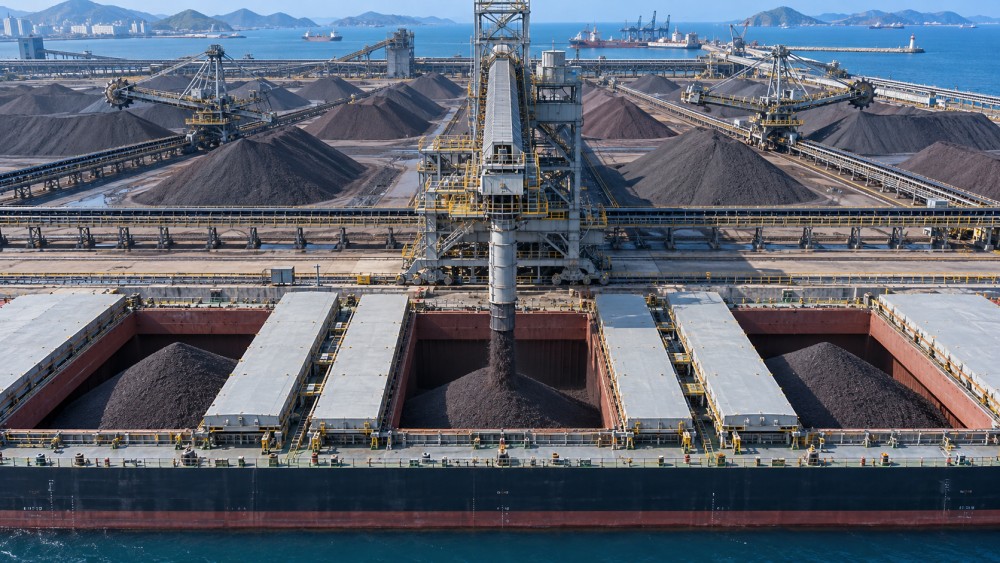
During uninterrupted operation, the active route’s sustainable capacity is limited by its lowest-capacity component under the relevant material conditions. Over a vessel call, however, route availability and switching delays also matter. Increasing ship-loader capacity will not resolve a reclaimer that cannot reach the required pile or a conveyor route reserved for another task.
Size the stockyard for accessible inventory
Stockyards decouple intermittent inland deliveries from continuous marine loading. Their value depends on how much usable material they can release when needed, not just how much material fits within the site boundary.
Gross storage capacity can overstate loading readiness. Inventory may be reserved for another shipment, awaiting quality clearance, segregated by grade, or positioned beyond the active reclaimer’s reach. Working inventory should therefore be assessed by cargo, reclaim route, and vessel schedule.
Buffer requirements should reflect credible delivery interruptions and the intended loading campaign. Rail terminals need to examine train arrival variability, unloading-cycle constraints, and wagon availability. Truck-fed facilities need to account for gate queues, operating-hour restrictions, and receiving rates during peak arrivals. An annual average obscures these differences.
More storage is not always the right answer. Longer stockpiles may increase reclaimer travel, tie up land, or complicate blending. A second reclaim route may be more valuable than additional pile volume where access is the constraint. Conversely, route duplication achieves little when insufficient cargo is available before vessel arrival.
Use surge capacity to absorb short interruptions
A surge hopper can smooth brief variations in reclaim output or transfer timing. Its required usable capacity depends on the mismatch between incoming and outgoing flow over the interruption being covered. It should not be treated as a substitute for stockyard inventory or reliable upstream equipment.
Hopper volume also needs a practical qualification: material must discharge predictably. Poor flow geometry, cohesive cargo, or unsuitable feeder arrangements can leave nominal storage unavailable when the downstream conveyor needs it.
Design transfer points around the actual cargo
Bulk materials do not behave as interchangeable loads. Moist ore fines, abrasive minerals, free-flowing grain, and dusty coal create different handling demands. The same nominal mass throughput can require different belt loading because bulk density and flow characteristics vary.
Conveyor selection should consider belt width, speed, inclination, loading profile, drive power, and acceptable operating limits. Faster belts are not automatically better: they can increase transfer-point demands and, depending on the material and geometry, worsen dust, wear, or degradation.
Chutes deserve particular attention. A restriction at one transfer tower can repeatedly stop an otherwise well-sized loading chain. Representative material testing can help establish flow behavior and inform chute and hopper design, especially where moisture or particle-size variability creates plugging risk.
- Check the full expected material envelope rather than only a convenient dry sample.
- Provide safe access for inspecting wear liners, clearing blockages, and replacing components.
- Coordinate dust control with material flow; water addition may be unsuitable for moisture-sensitive cargo.
- Assess fire, explosion, corrosion, and contamination hazards against the cargo and applicable local requirements.
These are capacity issues as much as environmental or maintenance issues. A route that regularly stops for spill cleanup cannot sustain its nominal loading rate.
Treat the vessel and berth as part of the handling system
A ship loader’s working envelope must match the expected vessel range. Outreach, travel, luffing movement, chute positioning, and clearances determine which holds can be served and how much repositioning is required. These checks should include relevant changes in draft and water level, not just one reference vessel condition.
Loading sequences also depend on the vessel’s approved loading plan and stability and structural constraints. A terminal cannot assume that every hold can accept material continuously at the maximum transfer rate. Hold changes, trimming, and coordination with ballast operations may reduce productive loading time even when material supply is uninterrupted.
The practical question is whether berth arrangements allow those transitions without excessive delay. Loader positioning, communications, operating visibility, and interfaces with vessel personnel deserve design attention. Marine operating limits and weather restrictions must be confirmed for the location rather than borrowed from another terminal.
Coordinate automation without concealing physical limits
Automation can reduce avoidable interruptions when it coordinates the entire route. Starting downstream equipment before upstream feed, confirming route readiness, and stopping feeders when downstream capacity is lost are basic functions. More advanced control can regulate feed using belt-scale measurements, hopper levels, and equipment status.
The important distinction is between equipment control and operational scheduling. A reclaimer controller may optimize its own movements while the terminal schedule requires a different cargo pile. Terminal-level coordination needs current inventory, cargo identity, vessel priorities, route availability, and maintenance status.
TC-Insight’s cross-sector intelligence perspective is relevant here: rail arrivals, stockyard operations, and berth machinery should be evaluated as connected decisions. Digital visibility is useful when it exposes an approaching shortage or route conflict early enough to change the plan—not merely when it displays more data.
Define degraded operating modes as carefully as normal operation. Sensor failure, communications loss, or unavailable inventory data should trigger a known response. Manual fallback must preserve safety protections, while alarm records should help operators distinguish material starvation from mechanical faults and planned vessel interruptions.
Validate the design against disruption, then test the interfaces
Capacity calculations should be supplemented by time-based scenarios. Depending on project complexity, a spreadsheet schedule or discrete-event simulation can test late deliveries, overlapping vessel calls, cargo changes, reclaimer outages, and weather-limited loading windows. The model should expose assumptions, not hide them behind a single throughput result.
Compare investments against the specific failure they address. A parallel conveyor may protect against one route outage but still depend on a common transfer tower or power supply. Extra receiving capacity helps only if inland deliveries and stockyard arrangements can use it. Better maintenance access may restore loading sooner than a larger machine would.
Before procurement, agree interface ownership: who verifies transfer geometry, coordinates interlocks, confirms material properties, and demonstrates integrated performance? Equipment packages can each pass individual tests while the complete route underperforms.
Commissioning should therefore cover representative cargo conditions, route changes, controlled stops, restart sequences, and sustained loading. Record stoppage causes alongside tonnes loaded so that an average rate does not conceal recurring losses.
The next design review should focus on three questions: Is enough suitable cargo accessible before loading starts? Can the selected route sustain the required flow under realistic conditions? Can the berth and vessel accept that flow throughout the loading sequence? Any unresolved answer is a stronger reason for investigation than a proposal to buy a faster ship loader.
Have questions about the global trade trends discussed here, or planning your expansion and supply chain strategy? Leave a message below and let the trade experts at TTC-Insight guide you.
We respect your privacy. Your information is strictly confidential.
Related News
Related News
- 00
0000-00
How public funding shapes the urban rail transit market - 00
0000-00
How do terminal operations systems coordinate crane scheduling? - 00
0000-00
Evaluating Skeletal Container Chassis Capacity for Loaded Boxes - 00
0000-00
How much outreach does a container terminal crane need? - 00
0000-00
Which rail safety technology standards apply to CBTC systems?
Weekly Insights
Stay ahead with our curated technology reports delivered every Monday.