
What Should Be Tested Before Buying a Driverless Transit System?





A driverless transit system should be tested as an operating railway, not as a vehicle demonstration. A train that starts, stops, and docks accurately on an empty test track may still perform poorly when it faces degraded communications, crowded platforms, a disabled train, an evacuation, or a timetable recovery period. Before a purchase commitment, testing should establish whether the complete system can maintain safe, predictable service across normal operation, foreseeable faults, and the awkward conditions that create disruption in real networks.
The most useful evaluation separates three questions that are often blended together: whether the train can move automatically, whether the railway can control movement safely, and whether the organization can manage an unattended service when something stops being routine. Grade of Automation 4 (GoA4) requires all three. Removing the driver changes the responsibilities of signaling, platform equipment, communications, control-room procedures, maintenance access, and passenger assistance. A credible test program makes those handoffs visible.
Prove the signaling system under degraded conditions
Automatic train control is the safety and capacity backbone of a driverless line. It should be evaluated for more than nominal headway performance. Test how train detection, movement authority, speed supervision, route setting, and automatic turnback behave when equipment becomes unavailable or reports inconsistent information.
Communication-based train control can deliver close headways, but its benefits depend on radio coverage, onboard localization, trackside interfaces, and fallback logic working together. A temporary loss of train-to-ground communication should lead to a defined, conservative response. The important question is not simply whether trains stop. The test should show where they stop, how quickly the control system identifies the event, how it prevents a secondary conflict, and how service resumes without creating long gaps across the line.
Test cases should include intermittent radio loss rather than only a complete outage. A system can appear stable during a clean disconnection test yet react poorly to repeated brief dropouts, delayed messages, or a train moving through a coverage boundary. Radio propagation also needs to be examined in tunnels, station crossovers, depots, sharp curves, and areas where metal structures or construction changes the local environment. Coverage maps alone are insufficient; moving trains, concurrent traffic, and operational radio loads reveal different behavior.
Turnback deserves separate attention. High-frequency automated service often depends on trains reversing at terminals within a narrow time window. Observe alignment, door release, route locking, confirmation of an empty cab or passenger area where applicable, and recovery when a train misses its intended stopping point. A terminal that works at low traffic volume may become the first source of delay when several trains approach close together.
Test the whole platform-train interface
Platform screen doors or platform edge doors are frequently treated as a station package, while automatic train operation is treated as a rolling-stock package. Their interface is operationally inseparable. Door alignment tolerance, train stopping accuracy, door command timing, obstacle detection, emergency release, and confirmation signals all affect dwell time and passenger safety.
A useful trial introduces realistic variation: a train with worn wheel profiles, a heavily loaded train with different suspension deflection, wet rail conditions that affect braking, and repeated stops at stations with curved platforms. The relevant outcome is not a single docking measurement. It is stable performance across the expected range of vehicle condition and adhesion.
Door obstruction testing should distinguish a detected obstruction from a persistent obstruction. A light object, clothing trapped in a door edge, and an object extending into the clearance envelope can produce different sensor responses. The system must make clear when it retries closure, when it holds the train, when an alarm reaches the control room, and when a station response is required. Repeated automatic retries can be acceptable only when they do not create a situation in which a trapped item is dragged or a platform crowd becomes less safe.
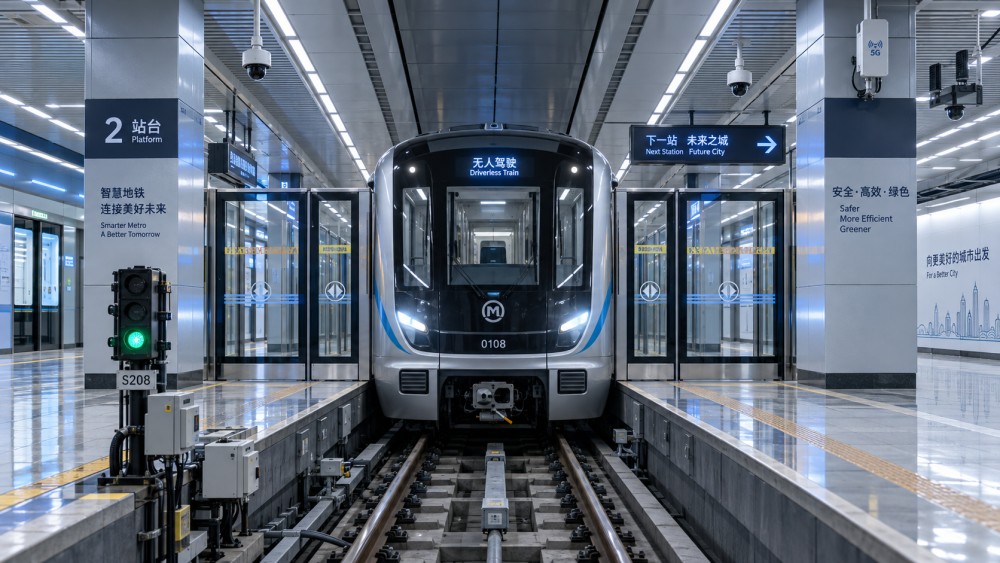
Platform monitoring also needs scrutiny. Cameras, intrusion detection, emergency intercoms, passenger information displays, and public-address systems must remain useful during glare, low light, crowding, and partial network loss. Image quality should be assessed at the point where a person needs to be identified or an unsafe situation needs to be interpreted, rather than by a general claim that cameras are installed. A wide view can be helpful for crowd monitoring but inadequate for confirming whether a person has entered the track area.
Compare automation claims with recoverability
Two systems can offer similar advertised headways and maximum speeds while having very different recovery behavior. The difference is often found in fault isolation and degraded-mode operation. Ask for scenario testing around failed door circuits, a train that cannot take traction power, a route that remains locked, an unavailable platform screen door, or a train that loses its automatic positioning reference.
Recovery tests should be timed, but elapsed time alone is not enough. A fast reset that leaves ambiguous equipment status is weaker than a slower process that confirms a safe state and returns capacity in a controlled sequence. The evaluation should follow the knock-on effects: whether following trains are held in tunnels, whether platform crowding grows, whether terminal capacity is consumed, and whether the published service can be rebuilt without cancelling an extended portion of the route.
Challenge cybersecurity as an operational safety issue
Driverless railways extend the attack surface beyond the train. Signaling networks, platform doors, depot equipment, passenger information, maintenance laptops, remote diagnostics, identity services, and third-party connections may all exchange data. Cybersecurity testing should focus on the consequences of compromised or unavailable functions, not solely on perimeter controls.
Network segmentation needs practical verification. A fault or malicious activity on a business network should not provide a path into safety-critical control functions. Remote maintenance access should be traceable, time-bounded, authenticated, and revocable. Test whether access remains available only to the intended asset and whether a disconnected maintenance session is actually terminated rather than merely hidden from the interface.
Resilience matters as much as prevention. Simulate loss of a non-safety service such as passenger information, video storage, or a depot scheduling application, then confirm that the impact does not unintentionally constrain train movement. Conversely, a control-center system that loses situational awareness should not continue accepting broad remote commands without appropriate restrictions. Incident logs must preserve an intelligible sequence of events, because recovery and later investigation depend on knowing which command, alarm, and state change occurred first.
Run emergency scenarios where assistance is delayed
A driverless train has no onboard staff member to inspect a passenger alarm, reassure people during a hold, or manually assess a door fault. Emergency tests must therefore examine the full response chain: alarm initiation, location identification, voice communication, video selection, remote assessment, dispatch of staff, access to the train, and return to service.
Train evacuation is particularly revealing. Test both station-adjacent and tunnel scenarios, including loss of normal lighting, a stopped train with an unavailable door, and communications that are degraded but not absent. Emergency walkways, cross-passages, signage, door release arrangements, ventilation response, and staff access routes must work as one sequence. A technically available evacuation path may be unusable if passengers cannot receive clear instructions or if the route leads to a location that cannot be supervised promptly.
Passenger assistance points should be tested with competing calls. When multiple intercoms, intrusion alarms, and equipment faults arrive together, the control interface needs to distinguish life-safety events from operational alerts without hiding either. The number of screens in a control room is not a measure of readiness. What matters is whether the event priority, train location, camera view, communications channel, and permitted response appear in a form that supports rapid action.
Examine interoperability before interfaces become contract disputes
Few driverless systems are entirely self-contained. Existing power supply, signaling boundaries, depot equipment, telecoms, fare gates, station fire systems, supervisory control, and asset-management tools can all create dependencies. Each interface should have an owner, a defined data exchange, failure behavior, and an acceptance method.
Interoperability testing is especially important where a new automated section connects to an existing railway with a different operating mode. Verify route protection at the boundary, train identification, transition rules, communications handover, and the procedure for a train that cannot complete the transition. A paper interface specification may describe messages correctly while failing to define what happens when one side receives a valid message too late, twice, or out of sequence.
Depot operation should not be overlooked. Automated stabling, washing, inspection, charging where relevant, wheel monitoring, and movement through maintenance zones introduce interfaces that do not exist on the passenger line. Test the handover between automatic movement and protected maintenance access. A permissive remote command must not conflict with a physical lockout, a worker protection device, or a vehicle that has been removed from service for inspection.
Inspect maintainability and lifecycle evidence
Driverless operation changes maintenance work; it does not reduce it to remote monitoring. More sensors, communications devices, door interfaces, onboard computers, and diagnostic systems create new failure points. Before buying, review access arrangements for equipment mounted under the car, on the roof, behind interior panels, and within platform door mechanisms. A component with strong reliability claims can still create excessive downtime if diagnosis requires lengthy train withdrawal or access equipment unavailable during the service window.
Fault records should separate transient faults, repeat faults, and faults that trigger a protective shutdown. A low count of recorded failures has limited value when many alarms are automatically cleared without identifying their cause. Ask whether remote diagnostics capture the relevant state before reset: software version, communication quality, train position, traction condition, door status, and preceding alarms. Without that context, maintenance staff may repeatedly replace components without eliminating the underlying interaction.
Lifecycle evaluation should include software support, spare-part obsolescence, test environments for updates, and the effort required to validate a change across train, wayside, and control-center systems. Software updates deserve the same discipline as hardware modifications. A new feature that improves diagnostics can inadvertently alter timing, interface behavior, or alarm handling.
Use an integrated operational trial
The strongest pre-purchase evidence comes from an integrated trial that combines passenger-service conditions, equipment faults, and recovery actions. It should include peak-like headways, realistic dwell variation, a delayed train, temporary radio impairment, a platform door event, concurrent alarms, and a controlled return to timetable. This exposes dependencies that separate subsystem tests rarely show.
Acceptance criteria should state the permitted operating condition after each event, not merely the desired final outcome. Clarify whether service continues at reduced speed, whether trains must be supervised remotely, whether a station requires local attendance, and what evidence authorizes restoration. A driverless transit system is ready for purchase when its limitations are understood as clearly as its automatic functions, and when those limitations can be managed without improvisation.
Related News
Related News
- 00
0000-00
Rail equipment intelligence in Southeast Asia is reshaping fleet investment - 00
0000-00
Which rail engineering standards govern a new freight line design? - 00
0000-00
What Should Be Tested Before Buying a Driverless Transit System? - 00
0000-00
Do Green Transport Upgrades Really Reduce Operating Costs? - 00
0000-00
How port machinery systems reduce container handling bottlenecks
Weekly Insights
Stay ahead with our curated technology reports delivered every Monday.