
Which Transit Technologies Are Mandatory for New Metro Projects?





Which Transit Technologies Are Mandatory for New Metro Projects?
What transit technology is mandatory for new metro projects? The honest answer is not a single equipment list. Mandatory requirements are set through national regulations, the local authority’s safety case, accessibility rules, fire and life-safety provisions, and the project’s contractual specification. A metro built for a dense, high-frequency corridor will not carry exactly the same obligations as a short airport shuttle or an extension of an existing network.
Still, the direction is clear. New projects are expected to include a protected train-control architecture, dependable communications, emergency systems, accessible passenger facilities, and digital systems that can be maintained for decades. Technologies such as communications-based train control (CBTC), platform screen doors, real-time passenger information, cybersecurity controls, and automation-ready operations are now central to many new-build metro specifications. In some markets they are explicit requirements; in others they are the practical baseline for obtaining the capacity, safety assurance, and operating resilience that the project promises.
“Mandatory” Has Three Different Meanings
Project teams often create avoidable confusion by treating every modern feature as either legally required or entirely optional. In practice, metro technology falls into three categories. The first includes systems required by law, regulation, or a formal safety approval process. These usually concern safe movement authority, emergency evacuation, fire detection, electrical protection, accessibility, and communications for incident response.
The second category is required by the employer’s operational brief. A city may specify headways, unattended train operation, passenger throughput, interchange capacity, or energy targets. Those commitments can make a technology functionally mandatory even when no regulation names it. A line expected to run frequent service with high platform crowding may need automated train protection, platform-edge protection, and centralized supervision simply to meet its operating plan.
The third category consists of technologies that are not compulsory at opening but are expensive to retrofit later. Fiber capacity, equipment-room space, secure network segmentation, interfaces for condition monitoring, and provisions for future automation belong here. They can be deferred on paper, but not always without locking the operator into costly future constraints.
Train Control: The Non-Negotiable Operational Core
Every new metro requires a safety-critical method of protecting train movements. At minimum, that means a train-control solution capable of enforcing safe separation, speed limits, route protection, and stop commands. The exact architecture varies. Conventional fixed-block signaling remains viable in some circumstances, particularly where capacity needs are moderate or compatibility with an existing network dominates the decision. Yet it may offer less flexibility for close headways and future service changes.
For many urban rail projects, CBTC has become the preferred approach because it supports continuous communication between trains and wayside systems, more precise train location, automatic train protection, and often automatic train operation. It is especially relevant where the business case depends on high frequency. However, specifying “CBTC” is not enough. The authority must define degraded-mode performance, radio coverage in tunnels and depots, fallback operating rules, data retention, test procedures, and the boundaries between signaling, telecoms, rolling stock, and platform systems.
A common procurement mistake is to focus on nominal headway while overlooking recovery after disruption. The stronger requirement is not merely the shortest possible interval between trains; it is the ability to restore a stable timetable after a train, communication link, or platform asset fails. That depends on system architecture, operating rules, maintenance access, and staff training as much as on signaling hardware.
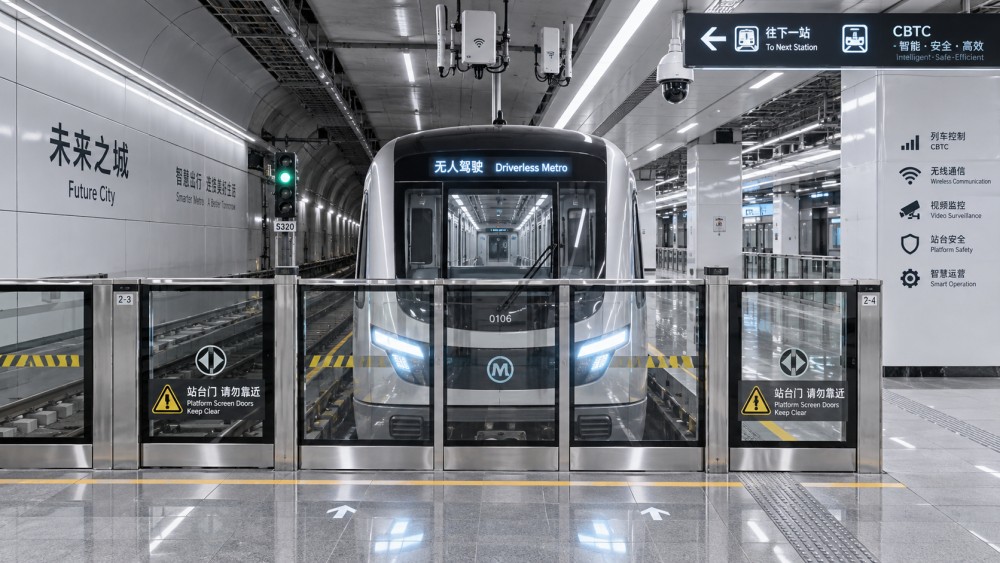
Automation Readiness Is Different from GoA4
Grades of Automation describe how much of the train operation is automated. GoA2 commonly involves automatic driving with staff responsible for selected duties. GoA4 refers to unattended train operation. Whether GoA4 is mandatory depends on the local project brief and approval framework; it should not be presented as a universal legal requirement for new metros.
What is increasingly difficult to justify is designing a new line with no automation pathway at all. Even a staffed railway benefits from automatic regulation, centralized traffic management, remote equipment monitoring, and data links that support future operational changes. A project may elect to open at a lower automation grade while preserving the interfaces, depot controls, platform arrangements, emergency procedures, and communications capacity needed for later conversion.
That decision has consequences beyond the cab. GoA4 readiness affects intrusion detection, platform safety, passenger emergency communications, evacuation strategy, stabling-yard design, remote diagnostics, and the operator’s control-room model. It is not a software option added near commissioning. If automation is in the long-term plan, it has to be reflected early in civil, systems, and operations design.
Platform and Passenger Safety Systems
Platform screen doors or platform edge doors are among the most visible technologies in a modern metro. They can reduce the risk of track intrusion, support climate control in enclosed stations, and provide a more controlled interface between the platform and train. On fully automated lines, they are frequently integral to the safety concept. On conventionally operated lines, their necessity depends on passenger volumes, platform geometry, tunnel environment, local safety policy, rolling-stock door alignment, and whole-life maintenance capacity.
The key issue is integration. Door systems must synchronize reliably with train stopping accuracy, signaling release logic, traction power arrangements, emergency procedures, and station operations. A platform door installation that performs well in isolation can still create operational delays if stopping tolerances, obstruction detection, or fault recovery were inadequately defined.
Other passenger-facing systems are far less discretionary. New projects generally need public-address capability, emergency help points or intercoms, CCTV appropriate to the safety and privacy framework, fire and life-safety systems, wayfinding, lighting, and accessible routes. Real-time passenger information is also increasingly expected. Its value is not limited to displaying arrival times: during disruption, it is the channel that explains platform changes, service restrictions, evacuation instructions, and alternative travel options.
Telecommunications and Cybersecurity Cannot Be Separate Workstreams
A metro’s communications network carries far more than office data. It may support train control, radio, CCTV, passenger information, fare systems, station management, power-control interfaces, maintenance systems, and control-center functions. These services have different availability, latency, security, and recovery requirements. Treating them as a single generic “IT network” is a design risk.
Cybersecurity is now part of operational safety and asset resilience. The required controls vary by jurisdiction and system criticality, but a credible design typically addresses asset inventory, identity and access management, network segmentation, secure remote access, patch governance, log collection, backup recovery, supplier access, and incident response. Procurement documents should also state who remains responsible after handover. A technically secure system can still weaken rapidly when passwords, configuration changes, and software updates have no clear operational owner.
Interoperability deserves the same discipline. Metro projects commonly combine equipment from several suppliers, with interfaces between rolling stock, signaling, telecoms, power, fare collection, station systems, and supervisory control. Open interfaces can reduce dependence on a single vendor, but only when interface ownership, testing responsibilities, data rights, and change-control processes are explicit. Otherwise, “open” can become a label rather than a working integration strategy.
Energy, Traction Power, and Asset Intelligence
Electrification and traction power are fundamental rather than fashionable. New metro schemes need an electrical distribution and protection design suited to their operating pattern, fleet characteristics, tunnel and station configuration, and emergency scenario. The choice between supply arrangements is project-specific, but resilience matters in every case: sectionalizing capability, backup arrangements for critical loads, control-center visibility, and safe isolation procedures should be considered from the beginning.
Energy metering, regenerative-braking management, and condition monitoring may not all be mandated in the same way as train protection, but they are increasingly relevant to long-life asset decisions. The real question is whether data will lead to action. Collecting traction, door, HVAC, escalator, or power data has limited value unless maintenance teams can interpret alerts, access spare parts, and adjust maintenance plans without compromising safety assurance.
This is where metro planning benefits from a wider high-volume transportation perspective. TC-Insight follows the relationship between traction systems, urban transit architecture, terminal automation, and logistics efficiency. The technical details differ between a driverless metro and an automated container terminal, but the management problem is familiar: critical equipment, control logic, cyber exposure, and maintenance decisions must be viewed as one operating system rather than isolated packages.
A Better Way to Define the Technology Baseline
Before selecting suppliers, project sponsors should build a requirements hierarchy that separates statutory obligations from operating commitments and future options. This prevents a familiar outcome: a tender contains ambitious digital language, but the budget and acceptance criteria only support basic installation.
The specification should then convert those decisions into measurable acceptance conditions. “Smart station” is not an acceptance criterion. Availability targets, alarm priorities, response times, interface test cases, passenger-information behavior during disruption, backup-recovery procedures, and maintainability documentation are far more useful.
The Practical Baseline for a New Metro
For most new metro projects, a safe and credible baseline includes protected train control; a resilient telecommunications architecture; station, tunnel, and onboard emergency systems; accessible passenger infrastructure; secure operational technology; traction power protection and supervision; control-center capability; and a tested approach to systems integration. CBTC, real-time passenger information, CCTV, centralized supervision, and robust cyber controls are increasingly difficult to exclude. Platform screen doors and GoA4 capability may be mandatory under particular operating models, but require project-specific justification rather than blanket assumptions.
The best technology decision is not the longest list of digital features. It is the set of systems that can be safety-approved, integrated, operated during disruption, maintained locally, and upgraded without destabilizing the railway. For authorities assessing a new line, the next useful step is to test each proposed technology against the operating concept, local approval requirements, interface map, and lifecycle support plan. That is the point where a modern metro specification becomes an operable one.
Related News
Related News
- 00
0000-00
What railway rolling stock market analysis reveals about fleet demand - 00
0000-00
How axle load limits shape mainline railway freight capacity - 00
0000-00
How to match ship loaders to bulk terminal throughput targets - 00
0000-00
How high speed rail system standards shape CBTC interoperability - 00
0000-00
How a rail network planning dashboard improves capacity decisions
Weekly Insights
Stay ahead with our curated technology reports delivered every Monday.