Which Logistics Technology Works Best With Legacy Rail Systems?





A freight railway can have sound locomotives, experienced dispatchers, and established operating rules, yet still lose time because its information moves more slowly than its trains. A wagon location may be updated only at a yard event, a maintenance issue may be found during inspection rather than before failure, and planners may rely on calls, spreadsheets, or disconnected control-room screens to resolve a disruption. In that setting, which logistics technology works best with legacy rail systems? Usually, the best choice is not a wholesale replacement platform. It is a layered combination: an integration layer that can read existing data, real-time asset visibility where it adds operational value, predictive maintenance for high-impact assets, and decision support for dispatching and yard planning.
The practical goal is to improve decisions without disturbing safety-critical systems that still work reliably. Legacy railways often contain long-lived signaling, onboard equipment, maintenance records, radio networks, and control applications that cannot simply be switched off for a software rollout. The technology that works best is therefore the one that interoperates with those systems, exposes useful operational data, and can be deployed in manageable stages.
Start with the operating bottleneck, not the technology category
“Digitalization” can mean very different things to a railway operator. A line with recurring wagon-search delays needs a different solution from a corridor constrained by locomotive availability or a terminal suffering from inconsistent handoffs between rail and port operations. Buying an advanced analytics tool before identifying the bottleneck often produces impressive dashboards with little effect on train performance.
Before comparing options, establish where uncertainty is creating cost, delay, or safety exposure. Typical questions include:
- Can planners see the current status of locomotives, wagons, crews, and loaded units without manual reconciliation?
- Are delays caused mainly by line capacity, yard dwell, missed connections, maintenance downtime, or poor demand forecasts?
- Which existing systems already hold useful data: dispatching software, maintenance systems, wayside detectors, ERP tools, gate systems, or radio logs?
- Does the proposed technology need to control railway operations, or only provide information and recommendations?
- Can field locations support the required communications coverage, power supply, and device maintenance?
This distinction matters because safety-critical control modernization has a much higher assurance burden than a logistics visibility application. A system that advises a dispatcher about likely congestion can often be introduced alongside existing processes. A system that directly changes movement authority, braking behavior, or interlocking logic requires a fundamentally different engineering and approval path.
The strongest foundation: integration middleware and a shared operational data layer
For most legacy rail environments, an integration layer is the first technology investment to consider. It connects information from older applications without demanding that every source system be replaced. Depending on the estate, it may ingest data through application programming interfaces, database replication, controlled file exchanges, message queues, or carefully managed adapters for older protocols.
Its value is less visible than a fleet-tracking map, but it is often more important. If locomotive status sits in one system, wagon movements in another, planned consists in a third, and customer milestones in a fourth, every downstream tool inherits those inconsistencies. A shared data layer can normalize identifiers, timestamps, location references, and event types so that planners are not comparing incompatible records.
Legacy systems commonly create problems such as duplicate wagon numbers, different definitions of “arrival,” location codes that do not match customer-facing names, or late manual updates. Integration does not magically correct bad data. It does make the problems measurable and manageable. Data-quality rules can flag missing events, conflicting positions, impossible sequences, and outdated asset status before those errors influence scheduling decisions.
A sensible implementation keeps the integration layer separate from safety control. It should generally read operational information, distribute approved data to planning and customer systems, and preserve an audit trail. Direct write-back into old dispatching or signaling applications should be limited and carefully governed. This approach reduces the risk that a logistics upgrade destabilizes an operational system with little tolerance for interruption.
Real-time tracking: valuable when event visibility is the actual problem
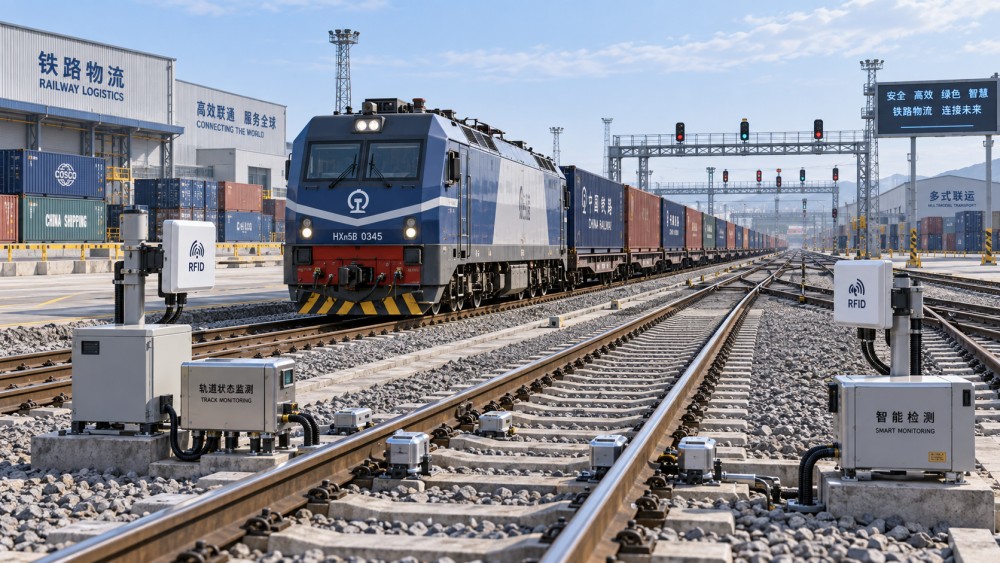
Asset tracking is often the most immediately understandable option. GPS devices, cellular or satellite trackers, RFID readers, wayside scanners, and mobile applications can provide location and status information for locomotives, wagons, containers, or selected high-value loads. Yet tracking technology is not equally useful in every rail operation.
It works best where existing events are sparse, unreliable, or too delayed to support operational decisions. Long-distance freight routes, interchange-heavy networks, private sidings, remote loading areas, and bulk-material flows may benefit substantially from better location confidence. It can also improve estimated arrival times when customers or terminals need to prepare labor, storage space, unloading equipment, or onward transport.
However, a location point alone does not solve a logistics problem. A train may be stationary because it is waiting for a path, undergoing inspection, changing crew, blocked at a yard entrance, or simply parked according to plan. The tracking system needs contextual rules that distinguish expected dwell from exception dwell. It also needs to associate an asset with a consist, commodity, route plan, and operational state. Without this context, a map becomes another screen that staff must interpret manually.
A phased approach is usually preferable. Start with the assets or locations where lack of visibility creates recurring decisions: interchange wagons, critical locomotives, terminal-bound trains, or high-consequence loads. Expanding tracking across every asset before proving how the information will be used can create unnecessary device and data-management work.
Predictive maintenance often delivers more than broad “AI” programs
When legacy rail operations are constrained by unplanned equipment downtime, condition-based maintenance can be more useful than a general artificial intelligence initiative. The objective is straightforward: detect deterioration early enough to schedule intervention before it becomes a service-affecting failure or an unsafe condition.
Useful inputs may already exist in scattered forms: locomotive fault codes, traction and braking alarms, wheel-impact readings, bearing-temperature alerts, inspection notes, work orders, component histories, and fuel or energy consumption records. Bringing those signals into a maintenance analytics environment can reveal patterns that isolated records do not show.
Not every asset should be treated the same way. A predictive model is most valuable where failure consequences are high, where condition signals are meaningful, and where maintenance teams have an actionable response. Locomotive traction equipment, critical brake components, high-utilization wagons, turnout machinery, and unloading equipment can be appropriate starting points. By contrast, trying to predict failures for poorly documented components with inconsistent inspection records may produce unreliable alerts and erode trust in the program.
The important comparison is between rules-based condition monitoring and more complex predictive models. Rules-based monitoring is easier to validate: a temperature, vibration, fault combination, or inspection threshold triggers a review. It suits organizations that need quick operational acceptance and have limited historical data. Predictive models can rank failure risk or estimate remaining useful life, but they require clean historical labels, stable sensor data, and clear governance when recommendations affect maintenance planning.
For legacy environments, rules-based monitoring combined with disciplined work-order feedback is often the better first step. It creates the structured history needed for more advanced prediction later, rather than assuming that sophisticated analytics can compensate for incomplete records.
AI-assisted scheduling is useful only after the timetable and event data are trustworthy
Dispatchers and yard planners already make complex trade-offs: prioritize a connection, hold a train for loading, route around a restriction, protect a maintenance window, or rebalance locomotives after disruption. Scheduling optimization can help by evaluating more scenarios than a person can test manually, especially where train paths, terminal slots, consists, crew limits, and customer commitments interact.
But scheduling tools should not be introduced as an automatic dispatch replacement. In a legacy rail system, the safer and more practical role is decision support. The system can identify likely conflicts, calculate feasible alternatives, estimate the effect of a delay, or rank options according to defined operating priorities. A dispatcher retains authority and can reject a recommendation that overlooks a local constraint.
The quality of the output depends on the quality of the operating model. Track layouts, passing-loop lengths, speed restrictions, loading times, locomotive compatibility, train priorities, crew rules, and terminal capacity all need to be represented accurately. An optimizer fed with simplified or stale assumptions may recommend a plan that appears efficient on screen but cannot be executed in the field.
Use scheduling support first in repeatable planning windows: daily yard sequencing, locomotive allocation, terminal appointment coordination, or disruption recovery on a defined corridor. These applications provide a narrower test of data quality and user acceptance than attempting network-wide autonomous optimization from the outset.
Where a transport management system fits—and where it does not
A transport management system can improve the commercial side of rail logistics by organizing orders, customer milestones, billing inputs, exception communication, and coordination with road, port, or warehouse partners. It is particularly relevant when rail is one part of a multimodal chain and customers need a consistent shipment view rather than separate rail and terminal updates.
It should not be mistaken for a rail operating system. A transport management system may know that a consignment is late, but it does not inherently understand signal blocks, train makeup constraints, brake tests, pathing rules, or the practical causes of yard congestion. Its effectiveness depends on timely and reliable operational events from the railway environment.
The best arrangement is usually a clear division of roles. Railway operational systems remain responsible for movement and asset events. The integration layer standardizes those events. The transport management system uses them for customer communication, order orchestration, and multimodal planning. This prevents duplicate master records and reduces the temptation to make a commercial platform perform railway-control functions it was not designed to handle.
A practical selection sequence for aging rail estates
Rather than comparing vendors or platforms only by feature lists, assess each option against deployment friction and operational usefulness. A technology that promises broad capability but needs extensive replacement of field hardware, communications, or core control software may be less suitable than a narrower tool that can use data already available.
- Map the current data path. Identify how a movement, defect, loading event, or maintenance action is recorded today, who changes it, and where delays or contradictions appear.
- Separate safety-critical interfaces from logistics interfaces. Define which systems may only be read, which can receive approved data, and which must remain isolated from new applications.
- Choose one measurable operational decision. Examples include earlier detection of late interchange arrivals, better locomotive availability planning, or reduced manual wagon-status reconciliation.
- Test data quality before scaling. Compare system events with field reality across a representative operating period. Resolve identifier and timestamp issues before building complex automation.
- Design for degraded operation. Determine what happens when connectivity is lost, a tracker stops reporting, an interface fails, or a recommendation is unavailable. Staff need an understandable fallback process.
- Build user feedback into the rollout. Dispatchers, maintainers, terminal coordinators, and field crews should be able to flag misleading alerts and missing context. Their feedback improves both the data rules and adoption.
The technology mix by operating condition
For a railway with fragmented information but reasonably reliable movement reporting, integration middleware and a shared event model should come first. It creates the base for later visibility, maintenance, and commercial applications. For a network where customers and terminal partners lack confidence in arrival information, targeted tracking and event management may be the immediate priority. For operations where locomotive or equipment outages drive cancellations, condition monitoring and maintenance workflow integration are likely to produce more operational value than customer-facing visibility tools.
Where the main constraint is capacity under disruption, AI-assisted scheduling can be effective after route, asset, and timing data are dependable. It is less suitable as an early investment when planners still rely on incomplete consist data or inconsistent location events. A transport management system becomes more important when rail must coordinate tightly with ports, trucks, warehouses, or bulk terminals, but it should consume validated railway events rather than become the primary source of operational truth.
The best logistics technology for legacy rail systems is therefore an architecture, not a single product category: stable legacy control remains in place; integration makes data usable; focused visibility removes blind spots; maintenance intelligence protects availability; and planning tools help people act on reliable information. This sequence improves lifecycle value while avoiding the operational risk of treating every aging system as something that must be replaced at once.
Related News
Related News
- 00
0000-00
How to match ship loaders to bulk terminal throughput targets - 00
0000-00
How high speed rail system standards shape CBTC interoperability - 00
0000-00
How a rail network planning dashboard improves capacity decisions - 00
0000-00
Comparing bulk handling solutions by throughput reliability - 00
0000-00
What determines port crane intelligence pricing for terminal upgrades?
Weekly Insights
Stay ahead with our curated technology reports delivered every Monday.