How Intermodal Transit Solutions Improve Port-to-Rail Cargo Flow





Port-to-rail cargo flow improves when the port, rail terminal, yard equipment, and planning systems operate as one coordinated chain rather than as separate handoff points. That is the practical value of intermodal transit solutions: they reduce avoidable waiting between vessel discharge, container storage, train assembly, and mainline departure.
For an infrastructure project, the main problem is rarely a single slow crane or a lack of rail track. Delays usually appear at the interfaces. Containers are unloaded before rail slots are confirmed. Railcars arrive before the correct containers are positioned. Gate traffic competes with drayage moves. Equipment operators work from different priorities than rail planners. A workable solution must control these interfaces, not merely automate one activity.
The objective is not to move every container directly from ship to train. Port operations need buffers, inspections, customs processing, reefer access, empty-container handling, and recovery capacity when schedules change. The goal is to make every transfer visible, sequenced, and physically feasible so that cargo spends less time waiting for the next decision.
Where Port-to-Rail Flow Usually Breaks Down
A container may be physically close to a rail-mounted gantry crane but still be unavailable for loading. Its release status may be incomplete, its assigned train may have changed, it may be blocked by earlier stacks, or the rail consist may not yet be ready to accept it. These are coordination failures, not simply handling-capacity failures.
Port-to-rail projects should examine the entire cargo path:
- Vessel discharge or terminal gate arrival
- Container identification, release, and destination validation
- Temporary yard placement and stack accessibility
- Transfer to the rail loading zone
- Railcar allocation, loading sequence, and train inspection
- Mainline departure slot and downstream terminal readiness
Each stage has a different operating clock. Vessel operations follow berth windows and crane productivity. Yard operations follow equipment availability and stack conditions. Rail operations are constrained by train plans, locomotive cycles, crew rules, track occupation, and network slots. Intermodal transit solutions create a common operating picture across those clocks, allowing the terminal to prepare cargo before the rail operation becomes a bottleneck.
Design Around the Train Plan, Not Only the Container Yard
A common planning mistake is to treat rail loading as the final step after containers have already been discharged and stacked. This makes the rail terminal a reactive receiver of whatever cargo happens to be available. The result is frequent rehandling, late changes to the loading plan, and trains that wait for a small number of missing units.
A stronger operating model begins with the train plan. For every planned departure, the system should identify the intended cargo set, booking status, weight and hazardous-goods constraints, railcar requirements, cut-off times, and expected arrival pattern. That information should influence where containers are placed as soon as they enter the terminal.
This does not require a rigid plan that cannot change. Shipping schedules, customs releases, rail capacity, and equipment availability will change. The difference is that changes are managed against a known baseline. The terminal can see which container substitutions protect a departure, which cargo should be pre-staged, and which exceptions need human approval.
For example, a container intended for an early train should not be buried in a stack chosen only for short-term yard density. It may consume more land near the rail interface, but it avoids several unproductive moves later. Conversely, cargo with uncertain release status should not occupy scarce pre-staging positions simply because it has an early theoretical rail booking.
Physical Layout Must Support the Operating Logic
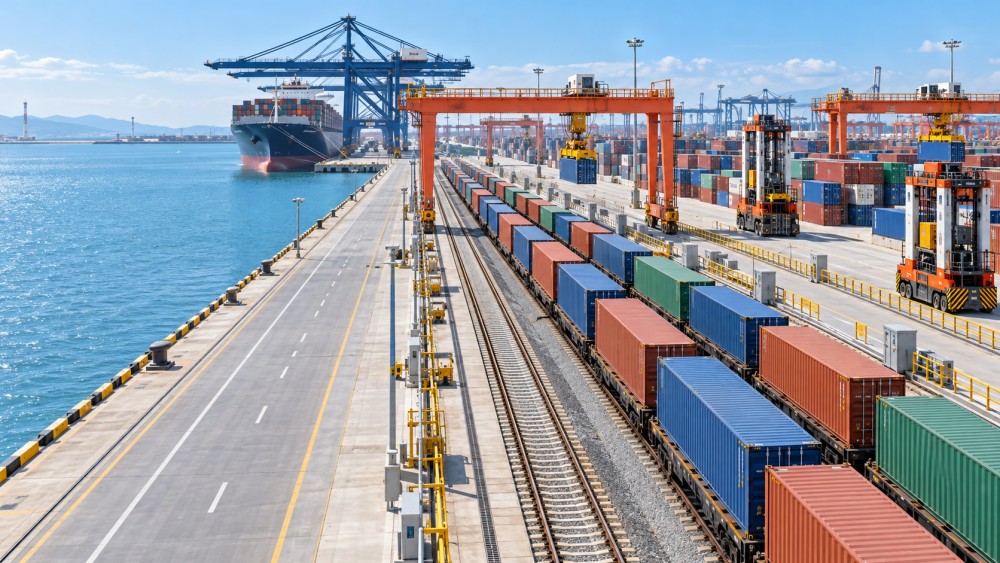
Software cannot solve an intermodal layout that forces unnecessary crossings, long travel distances, or conflicting equipment movements. The physical design should be tested against realistic operating scenarios before procurement decisions are fixed. This includes normal peak periods, vessel bunching, train delays, equipment outages, and disruptions at terminal gates.
The most useful layout separates flows that create predictable conflict. Import containers moving from quay to rail should not repeatedly cross export-gate traffic. Empty handling should not occupy the same critical lanes used for rail transfer. Inspection areas need enough proximity to the main flow to avoid excessive diversion, while still preventing held cargo from blocking released containers.
Rail siding length and track arrangement also matter more than they first appear. A rail system designed around frequent shunting can perform adequately on paper while consuming too much time during live operations. Where train configuration, loading sequence, and departure requirements permit, longer uninterrupted loading tracks reduce the number of non-productive rail movements. Where site constraints make this impossible, the operating model must explicitly account for shunting time and the equipment needed to perform it.
Choose the right transfer model for the site
On-dock rail is not automatically the best answer. It can be difficult to justify where rail volumes are irregular, port land is scarce, or the mainline connection has limited capacity. A near-dock or off-dock model may work better when it allows reliable train formation, better separation of modes, and room for future expansion. The decision should be based on total cargo flow and operational resilience, not on the shortest visible distance between crane and railcar.
Automation Helps Only When It Receives Usable Instructions
Automated stacking cranes, remote-controlled container cranes, automated guided vehicles, optical character recognition, and rail-mounted gantry systems can make terminal movements more consistent. They do not automatically create a coordinated intermodal operation. Automation will simply execute poor priorities faster if it is disconnected from train planning and cargo status.
The operational layer needs to connect the terminal operating system, rail planning tools, equipment control systems, gate platform, and relevant shipping or freight data. The purpose is not to force every party onto one software platform. It is to establish dependable data exchanges and clear ownership of key events.
Those events usually include container arrival, discharge completion, customs or release status, location, planned rail departure, railcar assignment, load completion, train readiness, and departure confirmation. Data should be timely enough to support execution, not just retrospective reporting. A location update that reaches the planning system after the train plan has been changed has limited value.
Project teams should pay particular attention to master data. A shared dashboard is useful only if container identifiers, destination codes, rail service names, equipment identifiers, and exception statuses mean the same thing across systems. Integration projects often focus heavily on interfaces while underestimating inconsistent reference data and unclear event definitions.
Use Exception Management Instead of Chasing Every Delay
A port-rail operation will always face exceptions: late vessels, misrouted containers, unavailable railcars, weather restrictions, equipment downtime, rejected load plans, and incomplete documentation. The goal is not to eliminate all disruption. It is to prevent routine exceptions from becoming a terminal-wide problem.
Effective intermodal transit solutions classify exceptions by operational consequence. A container missing an afternoon train may be inconvenient but manageable if another service is available. A delayed set of export containers may be critical if it affects a vessel cut-off. A failed crane becomes more serious when it blocks the only path between the pre-stage area and the rail tracks.
Teams should define escalation rules before go-live. The rules should state who may substitute cargo, who can change a rail loading sequence, when the terminal should hold a train, and when cargo should be redirected to a different service. Without this governance, automation produces alerts but decisions still wait for informal calls and fragmented approvals.
Measure Flow Quality, Not Just Equipment Output
Crane moves per hour and railcar loading rates remain useful measures, but they can hide poor end-to-end performance. A quay crane can achieve high output while creating an unmanageable surge in the yard. A rail crane can remain productive while repeatedly rehandling containers that were placed without regard to departure priority.
Project leaders need measures that reveal whether the chain is working. Useful indicators include container dwell by cargo status, time from availability to rail loading, planned-versus-actual train build completion, number of rehandles for rail-bound cargo, percentage of departures completed to plan, and the duration of exceptions that block cargo movement.
These metrics should be segmented. Average dwell time alone can conceal a small group of containers that consistently miss rail departures. Separating cargo by import or export direction, service type, destination, release status, and transfer path makes recurring constraints easier to identify. The purpose is operational learning, not reporting volume.
Start with Constraints That Cannot Be Solved Later
Before selecting equipment or commissioning a digital platform, confirm the hard constraints: rail network capacity, terminal access windows, site geometry, train length limits, available land, power and communications infrastructure, cargo mix, and the reliability of data from participating parties. These conditions define what the project can realistically deliver.
It is also necessary to distinguish a capacity problem from a synchronization problem. If the port lacks track space or the rail network cannot accept additional departures, better planning will not create physical capacity. If track capacity exists but trains leave underutilized because cargo is not ready at the right time, coordination and yard strategy are likely to offer more value than new heavy equipment.
Phased implementation is often more workable than a complete redesign. A project can first establish shared train milestones and a rail-bound cargo visibility layer, then improve pre-staging rules, and later introduce automated equipment where volumes and operating stability justify it. This sequence allows the team to validate the operating model before embedding it in expensive infrastructure.
What to Confirm Before Committing to a Solution
The most important early question is simple: what exact condition prevents cargo from reaching rail on time today? The answer should be expressed in operational terms, such as blocked access to rail stacks, late booking confirmation, insufficient train build visibility, conflicting gate movements, or unreliable equipment dispatching.
Once that constraint is clear, the required solution becomes easier to define. A terminal with poor container location accuracy may need stronger event capture and inventory discipline before advanced optimization. A port with repeated rail-yard conflicts may need revised traffic segregation and dispatch rules. A site with growing, predictable rail volumes may justify dedicated staging areas and more automated transfer equipment.
Industry intelligence can support this work when it connects equipment choices with network and terminal conditions rather than treating technology as an isolated purchase. TC-Insight’s focus on railway rolling stock, container port cranes, bulk logistics equipment, and terminal automation provides a useful lens for comparing how rail capacity, handling automation, and long-cycle asset decisions interact across high-volume transport systems.
The best port-to-rail program is therefore not defined by the number of automated machines or dashboards installed. It is defined by whether cargo, rail capacity, yard space, and operating decisions are aligned early enough to protect the departure plan. When that alignment is built into both infrastructure and daily control, intermodal cargo flow becomes more predictable, scalable, and easier to recover when conditions change.
Related News
Related News
- 00
0000-00
How passenger capacity shapes rail equipment selection for metro - 00
0000-00
What makes a rail transit integration supplier fit a CBTC project? - 00
0000-00
How to assess rail automation systems software for CBTC integration - 00
0000-00
How Intermodal Transit Solutions Improve Port-to-Rail Cargo Flow - 00
0000-00
Cross-Border Bulk Transport Compliance Checklist for Rail Freight Operators
Weekly Insights
Stay ahead with our curated technology reports delivered every Monday.