
Bulk Material Conveyor Lifecycle Costs: What Buyers Should Include in ROI





Bulk Material Conveyor Lifecycle Costs: What Buyers Should Include in ROI
For a mine, port, power plant, quarry, or bulk terminal, a bulk material conveyor is rarely a simple equipment purchase. It is a long-lived operating system connecting extraction, storage, processing, rail loading, vessel loading, and dispatch. The initial quotation matters, but it is only one part of the financial decision. A lower purchase price can be outweighed quickly by higher power draw, difficult access for maintenance, recurring belt damage, unavailable spares, or a few hours of unplanned stoppage at a constrained transfer point.
A useful return-on-investment model therefore asks a broader question: what will it cost to move each tonne reliably over the operating life of the system? That requires buyers to look at capital expenditure, operating expenditure, risk exposure, and the value of throughput that the conveyor enables or protects. The answer will differ by material, climate, route geometry, duty cycle, labour model, and terminal layout. Still, the cost categories are remarkably consistent across bulk handling projects.
The most resilient procurement decisions are usually made when engineering, operations, maintenance, finance, safety, and commercial teams review the same lifecycle assumptions. A conveyor that looks economical in a technical comparison may not remain economical once the operating context is added.
Start with the right ROI boundary
One common mistake is to evaluate only the conveyor itself: belt, idlers, pulleys, drive, structure, and controls. In reality, its performance is shaped by the surrounding system. Feed consistency, chute design, transfer elevations, stockpile behavior, reclaim equipment, railcar loading rates, berth windows, and upstream crushing availability can all affect conveyor utilization and wear.
Before comparing suppliers, define the commercial boundary of the analysis. Does ROI include only supplied equipment, or also civil works, electrical infrastructure, commissioning support, operator training, access platforms, dust control interfaces, and integration with plant controls? If a conveyor must operate within an existing terminal, the cost of shutdown windows and tie-in work may be more consequential than the difference between two equipment bids.
The operating horizon also needs to be explicit. A short-term contract operation may justify a different configuration from a permanent export corridor. Buyers should avoid mixing a ten-year maintenance forecast with a five-year production commitment unless the assumptions behind residual value, relocation, or future capacity expansion are clearly stated.
The purchase price is only the visible portion of capital cost
The delivered price of a bulk material conveyor often excludes or understates costs that emerge during detailed engineering. Foundations may need redesign after geotechnical review. Existing structures may require strengthening. Power supply capacity, cable routing, control-room modifications, drainage, lighting, emergency access, and fire protection interfaces can create significant project exposure, particularly in brownfield locations.
Mechanical configuration has capital consequences as well. Longer routes, higher lifts, enclosed galleries, weather protection, corrosion-resistant materials, higher-capacity drives, and redundant components all increase upfront cost. None should be treated as automatically excessive. The right question is whether the added investment removes a credible operating constraint or merely adds complexity without a defined return.
Installation planning deserves the same scrutiny. A conveyor system with large preassembled modules may reduce work at height and shorten site installation, but it can demand more difficult transport and lifting arrangements. Conversely, a lower-cost design that requires extensive field fabrication may expose the project to site labour availability, weather delays, quality variation, and extended outage periods.
For bid comparisons, it helps to separate costs into three columns: supplier scope, owner scope, and provisional or unresolved scope. This makes omissions visible before they become change orders.
Energy cost is driven by the duty profile, not just motor rating
Energy is frequently modeled too simply. Nameplate motor power is not annual consumption. Actual power demand changes with load, belt speed, lift, starting conditions, route resistance, idler condition, material properties, and how often the line runs partially loaded or empty. A system designed around peak tonnage may spend much of its life operating below that point.
Buyers should request the assumptions used for power calculations and test them against expected operating patterns: tonnes per hour, annual operating hours, load distribution, starting frequency, and planned maintenance windows. Where variable-speed drives are being considered, the economic case should reflect actual scheduling logic rather than an assumed saving. Slower operation can reduce some losses and wear, but it may also affect ship loading, train turnaround, surge capacity, or downstream process stability.
Energy should also be assessed at system level. Poorly designed transfers can create material buildup and belt drag. Mistracking raises friction and damages components. A clean, stable load on the belt is not only a housekeeping objective; it can influence both power use and component life.
Wear components reveal where operating budgets can drift
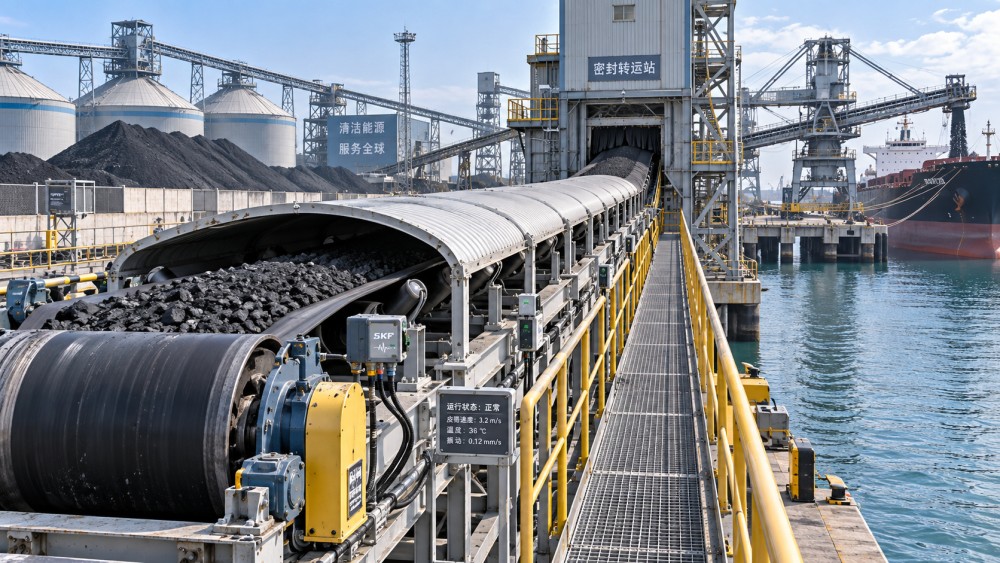
Conveyor maintenance costs are not evenly distributed. Belts, idlers, pulleys, cleaners, skirting, chute liners, bearings, gearboxes, brakes, and sensors each have different replacement patterns and failure consequences. Abrasive ore, wet coal, sticky concentrates, corrosive salt environments, and high-impact lump material create very different maintenance profiles even when nominal throughput is similar.
Belt selection is particularly consequential because the belt is both a consumable and a production-critical asset. The cheapest belt specification may have a lower initial cost but produce more repairs, shorter replacement intervals, or less tolerance for operational upset. That does not mean buyers should automatically select the highest specification offered. It means belt construction, cover grade, splice method, pulley diameter, tension, material impact, and cleaning strategy need to be assessed together.
Transfer points deserve disproportionate attention. They are often where material is accelerated, redirected, segregated, spilled, or trapped. The resulting impact and dust can damage belts and liners while increasing cleanup labour. A transfer design that improves loading alignment and provides maintainable wear liners may cost more in fabrication, yet it can be easier to justify than cosmetic upgrades elsewhere in the route.
Ask bidders to identify wear assumptions rather than simply offering a generic maintenance schedule. Useful questions include: Which components are intended as planned-change items? What access is required? Can replacement occur during a normal planned stoppage? Are special lifting devices needed? How does the design permit inspection before damage becomes a major failure?
Downtime has a cost even when it is difficult to price
A conveyor does not need to fail often to be financially damaging. If it sits on a single path between mine and plant, stockyard and shiploader, or rail unloading and a process line, one failure can interrupt a wider chain. The real loss may include missed loading sequences, demurrage exposure where applicable, production curtailment, extra mobile equipment use, and recovery work after the line returns.
Not every component needs redundancy. Excessive duplication can add capital, complexity, inspection requirements, and spare-part burden. But criticality analysis should identify which failures have no practical workaround. A standby drive, bypass route, spare pulley, belt repair plan, or additional surge capacity may be justified when it protects a bottleneck. The calculation should be based on the site’s actual recovery options, not a generic availability target.
This is also where maintainability becomes an economic variable. Safe walkways, pull-wire access, inspection points, lifting beams, pull-through space for belt work, and clear isolation arrangements can seem peripheral during procurement. In operation, they influence how long a planned task takes and whether a minor issue can be corrected before it becomes a shutdown event.
Controls, condition monitoring, and data need a defined use case
Digital monitoring can improve decision-making, but only when the site has a practical response process. Belt drift switches, speed monitoring, temperature sensing, vibration monitoring, chute blockage detection, and drive diagnostics can provide early warning. Their value is not the volume of data collected; it is the ability to identify developing problems, plan intervention, and avoid unsafe or disruptive failure.
A buyer should therefore examine integration costs and responsibilities. Will signals connect to the existing PLC, supervisory system, or remote operations platform? Who owns alarm rationalization? Are maintenance teams trained to interpret condition trends? Is cybersecurity scope defined for connected equipment? An advanced monitoring package without clear ownership can become another system to maintain rather than a source of operational insight.
TC-Insight follows this issue across high-volume transportation assets, from railway traction systems to automated port machinery and bulk logistics corridors. The same pattern appears repeatedly: technology creates value when it is fitted to operational decisions and maintenance workflows, not when it is treated as an isolated feature list. For conveyor investments, that means aligning instrumentation with the failures and bottlenecks that actually matter at the site.
Spare parts strategy is part of the commercial model
A spare-parts list should not be accepted as a procurement appendix without review. Buyers need to distinguish between commissioning spares, routine operating spares, insurance spares for long-lead or critical items, and proprietary components that may require supplier support. Holding too much inventory ties up capital and risks obsolescence. Holding too little can extend an outage because a relatively modest part is unavailable.
Lead times deserve special attention when the project is in a remote region or where import procedures are uncertain. A conveyor can be mechanically straightforward but still vulnerable if gearboxes, control modules, specialty bearings, or belt repair materials are difficult to source locally. Procurement should ask not only for a recommended spares package, but also for part interchangeability, local service capability, documentation quality, and expected support arrangements after warranty.
Standardization across a multi-site fleet can change the result. A component choice that is slightly more expensive on one project may be sensible if it reduces the number of belt types, drive families, bearings, or control platforms maintained across several terminals.
Compliance, safety, and environmental obligations should not be treated as late additions
Requirements for guarding, emergency stops, fire protection, dust management, noise, access, electrical classification, and environmental controls vary by material, jurisdiction, and facility type. Buyers should establish the applicable requirements early and identify where responsibility sits between the conveyor supplier, engineering contractor, and owner.
Dust and spillage are often underestimated because their cost is dispersed across cleanup, equipment degradation, worker exposure controls, and community or terminal operating expectations. Enclosures, extraction interfaces, proper skirting, and effective cleaning systems add capital and maintenance requirements, but they should be evaluated against the full operational burden of uncontrolled material loss.
Safety design also affects availability. When routine inspection or replacement requires difficult access, operators may defer work. Designs that make safe intervention realistic are more likely to receive the maintenance they require.
Build a decision model that shows uncertainty
A credible lifecycle model does not pretend every variable is known. It makes uncertainty visible. Compare options under a base case, a high-utilization case, and a disruption case. Vary the assumptions that are most likely to alter the decision: electricity cost, annual hours, belt replacement interval, labour cost, material abrasiveness, throughput value, and the duration of a critical outage.
The model should include, at minimum, installed cost, commissioning and ramp-up costs, energy, planned maintenance, corrective maintenance allowance, inventory carrying cost, labour, compliance-related expenditure, and the financial effect of material handling constraints. It should also state what has been excluded. Transparency is more valuable than a false impression of precision.
When comparing proposals, avoid scoring every category equally. A modest saving on structure or idlers should not override a major difference in maintainability at a high-risk transfer station. Likewise, a highly engineered option should be challenged if its claimed lifecycle benefit depends on operating conditions the site is unlikely to achieve.
The investment decision should protect the flow of the whole operation
The best bulk material conveyor is not necessarily the lowest-priced system or the most elaborate design. It is the option whose cost, reliability, maintainability, and integration requirements fit the role it plays in the operating chain. For a non-critical stockyard route, simplicity and serviceability may carry the most weight. For a ship-loading or rail-loading bottleneck, availability, surge handling, and recovery capability may justify a more robust specification.
For decision-makers managing long-cycle infrastructure, the practical discipline is to make lifecycle assumptions inspectable before the contract is awarded. Review the duty profile, test the interfaces, assign the risks, and ask what happens when the system is dirty, overloaded, wet, under-maintained, or needed at the worst possible moment. That is where conveyor ROI becomes real rather than theoretical.
Related News
Related News
- 00
0000-00
What is driving investment in the global rail equipment market? - 00
0000-00
How dust control requirements shape bulk material transport system design - 00
0000-00
When does a container port crane supplier need STS crane experience? - 00
0000-00
How rail technology signaling reduces headways without compromising safety - 00
0000-00
When do port automation solutions in Europe justify the investment?
Weekly Insights
Stay ahead with our curated technology reports delivered every Monday.