
Material Handling Conveyor Quotes: Costs Beyond the Equipment Price





Material Handling Conveyor Quotes: Costs Beyond the Equipment Price
A competitive material handling conveyor quote can look attractive until installation, controls integration, and ongoing maintenance enter the budget. For procurement teams sourcing systems for mines, bulk terminals, or logistics facilities, the equipment price is only the starting point. Freight, civil works, commissioning, energy consumption, spare parts, and downtime risk can all reshape total ownership costs. The real challenge is identifying exclusions early enough to compare proposals fairly, rather than discovering them after the purchase order is issued.
A lower bid is not necessarily a poor choice. It may reflect simpler engineering, a narrower supply boundary, or a genuinely efficient design. But those explanations have different commercial consequences. Before negotiating a discount, establish what each supplier has actually priced—and what your business must still provide.
Start with a common operating basis, not a price comparison
Two conveyor proposals cannot be compared meaningfully if they solve different operating problems. A quotation based on average throughput may look cheaper than one designed for sustained peak demand. Likewise, a conveyor specified for dry, free-flowing material may need substantial changes when moisture, sticky fines, or larger lumps enter the feed.
For bulk handling, the request for quotation should define material bulk density, size distribution, moisture range, abrasiveness, required throughput, route length, elevation change, and operating hours. Clarify whether capacity is expressed as mass or volume, and distinguish normal duty from short-duration peaks. For unit-load applications, package dimensions, weight distribution, accumulation behavior, and handling orientation become equally important.
Environmental conditions also affect the price: outdoor exposure, corrosion, ambient temperature, dust, and potentially hazardous atmospheres can change component selection. Applicable safety and electrical requirements need confirmation for the installation location. A statement such as “standard guarding included” is insufficient unless the supplier explains the guarding arrangement and its design basis.
Ask suppliers to identify deviations from the specification explicitly. Otherwise, an apparently cheaper material handling conveyor may simply carry less capacity, durability, or scope than the alternative.
The supply boundary is where hidden capital costs begin
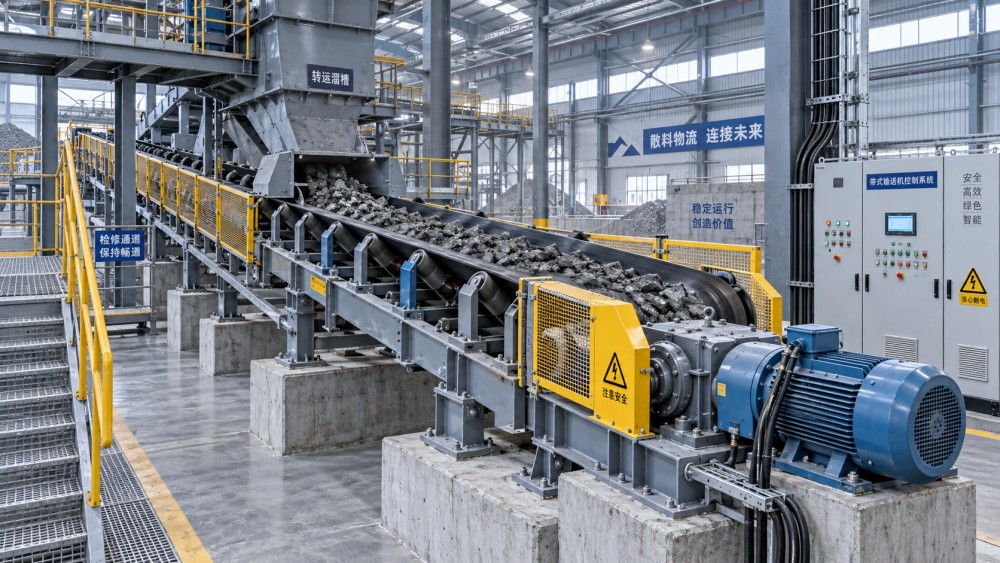
“Complete conveyor system” is a commercial description, not a reliable scope definition. One supplier may include drives, transfer chutes, supports, belt cleaning, and local controls. Another may supply the conveyor structure and mechanical components while leaving those interfaces to the buyer.
Build a scope matrix showing who designs, supplies, installs, connects, and tests each element. Separate exclusions from provisional allowances: an excluded foundation has no supplier budget attached, while an allowance may change once ground conditions and loads are confirmed. Neither should be mistaken for a fixed, fully engineered price.
- Mechanical interfaces: feed arrangements, discharge chutes, liners, skirts, cleaners, take-up systems, and downstream connections.
- Structural and civil scope: foundations, support steel, access platforms, maintenance lifting provisions, drainage, and existing-structure checks.
- Electrical scope: power distribution, motor control equipment, cables, trays, earthing, field instruments, and installation labor.
- Environmental and safety provisions: dust extraction connections, enclosure, noise treatment, guarding, and emergency-stop coverage.
Transfer points deserve particular attention. Poorly matched geometry can create spillage, dust, belt damage, and recurring cleanup work. Their design depends on both the conveyor and the upstream feed, so assigning responsibility to “others” without a coordinated review leaves a costly gap.
Delivery and installation depend on the site, not just the machine
Freight costs extend beyond the shipping rate. Packing dimensions, section weights, transport restrictions, unloading equipment, storage conditions, and access to the installation area all matter. For international purchases, confirm the named delivery location and agreed trade terms, then establish responsibility for import clearance, duties, taxes, insurance, and inland movement. Their treatment depends on the contract and destination.
The cheapest shipping configuration may not produce the lowest installed cost. Smaller sections can simplify transport but increase site assembly. Larger modules may reduce assembly work while requiring heavier lifting equipment and more demanding access arrangements. Ask for shipping dimensions and weights before the logistics budget is approved.
Brownfield installations add another layer. Existing foundations may require verification; buried services can constrain excavation; operating equipment may limit crane positioning. Work permits, isolation procedures, and shutdown windows can make installation slower than the supplier’s workshop-based estimate suggests.
Clarify whether “installation support” means supervision or a complete erection team. Identify responsibility for tools, cranes, scaffolding, belt splicing, alignment, travel, accommodation, and standby time. A delivery date alone does not tell you when the system will be ready to operate.
Controls integration can remain unfinished after mechanical completion
A conveyor that runs locally is not necessarily ready to operate within a mine, terminal, or warehouse. Its controls may need to exchange permissives, faults, operating states, and stop commands with upstream and downstream equipment. These interactions determine whether a blocked discharge stops the feed safely or allows material to accumulate.
The quote should distinguish control hardware from integration engineering. Define responsibility for programmable logic controller programming, supervisory system changes, communication interfaces, instrument configuration, safety-function validation, software licenses, and network access. Where remote diagnostics are proposed, include the site’s cybersecurity requirements rather than treating connectivity as an automatic benefit.
Commissioning also needs a written boundary. Factory testing may verify panels and logic but cannot fully establish performance with the actual material and installed transfer arrangements. Site testing should address no-load operation, loaded operation, interlocks, emergency stops, tracking, and agreed performance criteria, as applicable.
Acceptance conditions should specify the test material, feed conditions, duration, measurement method, and remedies for failure. If throughput depends on a consistent feed that the buyer must provide, record that dependency. Otherwise, a performance dispute can become an argument about test conditions rather than equipment capability.
Energy, maintenance, and downtime change the ownership calculation
Motor nameplate power is not an annual energy forecast. Consumption depends on the load profile, lift, friction, mechanical condition, starting strategy, and operating hours. Compare supplier estimates using the same duty cycle, including empty running where relevant. Variable-speed operation may help match flow to demand, but savings depend on the application; they should not be assumed from the presence of a drive alone.
Maintenance cost is similarly broader than replacement parts. Belt access, cleaner adjustment, bearing replacement, lubrication points, and component handling determine labor requirements and repair duration. A compact layout that saves structural steel can become expensive if routine work requires dismantling adjacent equipment.
Request a recommended spare-parts list with quantities, prices, lead times, and storage requirements. Separate startup spares, routine consumables, and critical recovery spares. Check whether motors, bearings, sensors, and drives are locally available or tied to a narrow supply channel. Warranty coverage does not eliminate the cost of waiting for a replacement.
Downtime should be evaluated against the facility’s operating constraints. At a bulk terminal, a conveyor interruption may restrict stockyard flow or vessel loading. In a distribution facility, it may block order movement unless a practical bypass exists. Use the business’s own lost-throughput and recovery-cost assumptions, accounting for buffers and alternative routes rather than assigning every stopped hour the same value.
Avoid counting lost output and lost revenue twice. Maintenance records, production schedules, and realistic repair scenarios provide a stronger basis than an unsupported availability promise.
Normalize bids before calculating total ownership cost
Create two comparisons: the cost to reach accepted operation, and the cost to operate over a common evaluation period. The first includes equipment, engineering, freight, site works, installation, integration, commissioning, training, and initial spares. The second adds energy, planned maintenance, replacements, support fees, and a justified allowance for disruption.
Add credible buyer-side estimates for excluded work to each bid. Mark uncertain items separately instead of burying them in a single contingency percentage. Civil works pending a survey and software integration pending an interface review are different risks with different owners.
Use consistent energy prices, labor rates, operating hours, and financial assumptions. If future costs are discounted, apply the same method to every option. Test whether the preferred proposal changes under higher energy prices, longer spare-parts lead times, or different utilization. A result that depends heavily on one optimistic assumption deserves further scrutiny.
Commercial terms belong in this review too. Quote validity, currency exposure, payment milestones, warranty start dates, and delivery dependencies can shift cost or risk to the buyer. Establish when the delivery clock starts: contract signing, advance payment, drawing approval, or release of final site information.
Close the information gaps before committing capital
TC-Insight’s focus on bulk logistics, port automation, and long-cycle transport assets offers a useful perspective: equipment value depends on how reliably it works within the wider logistics network. Conveyor procurement benefits from connecting mechanical design, automation interfaces, maintenance access, and facility throughput rather than evaluating the purchase price in isolation.
Before award, hold a scope review involving procurement, operations, maintenance, engineering, and the supplier. Resolve the largest uncertainties in writing and make them part of the contract documents. The strongest material handling conveyor quote is not necessarily the longest or the cheapest. It is the one whose operating assumptions, supply boundaries, acceptance conditions, and remaining buyer costs are clear enough to support a defensible investment decision.
Have questions about the global trade trends discussed here, or planning your expansion and supply chain strategy? Leave a message below and let the trade experts at TTC-Insight guide you.
We respect your privacy. Your information is strictly confidential.
Related News
Related News
- 00
0000-00
How public funding shapes the urban rail transit market - 00
0000-00
How do terminal operations systems coordinate crane scheduling? - 00
0000-00
Evaluating Skeletal Container Chassis Capacity for Loaded Boxes - 00
0000-00
How much outreach does a container terminal crane need? - 00
0000-00
Which rail safety technology standards apply to CBTC systems?
Weekly Insights
Stay ahead with our curated technology reports delivered every Monday.