
Is Smart Logistics Worth the Investment for a Mid-Size Terminal?





Is Smart Logistics Worth the Investment for a Mid-Size Terminal?
Is smart logistics worth it for a mid-size terminal? For operators balancing tight capital budgets, aging equipment, and unpredictable cargo flows, the answer depends on more than automation promises. Connected equipment, real-time yard visibility, and smarter scheduling can improve throughput and resource utilization—but integration costs, workforce readiness, and maintenance requirements shape the actual return. The useful question is not whether a terminal should become “smart.” It is which operational problem deserves investment, and whether technology can solve it at a defensible cost.
For many mid-size facilities, targeted digital upgrades are easier to justify than comprehensive automation. Better coordination between the gate, yard, handling equipment, and rail interface can release capacity without replacing the entire operating model. But when demand is weak, infrastructure is unreliable, or basic process discipline is missing, software may simply make existing problems more visible.
Start with the delay, not the technology
“Mid-size” is not a universal throughput category. A container terminal, an inland rail hub, and a bulk export facility can have similar investment constraints while operating very differently. Cargo mix, shift patterns, peak arrivals, storage space, and equipment redundancy matter more than the label.
Before comparing systems, trace where a shipment or material flow loses time. At a container terminal, the problem might be unplanned truck arrivals, inaccurate stack locations, or repeated rehandling. At a rail-connected facility, trains may wait because unloading resources are not synchronized with arrival windows. At a bulk terminal, conveyor interruptions or poorly coordinated stockpile movements may constrain output even when individual machines have adequate capacity.
These are different investment cases. A truck appointment platform cannot fix a failing conveyor drive. Crane automation will not necessarily shorten vessel turnaround if yard congestion prevents containers from moving away from the quay.
Establish a baseline across representative operating conditions, including busy periods and disrupted shifts. Record waiting time, equipment availability, cargo dwell, rehandles, overtime, and energy use per relevant handling unit. Separate productive work from movement that adds no customer value. Average throughput alone can hide the periods when service breaks down.
Visibility, decision support, and automation are different investments
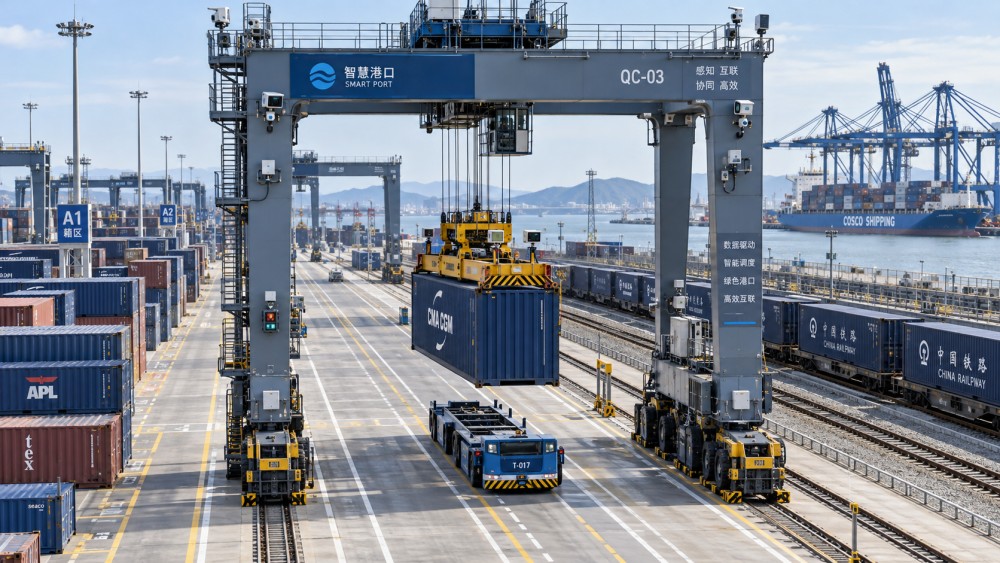
Smart logistics is often discussed as though it means autonomous machinery. In practice, a terminal can progress through three distinct capabilities: knowing what is happening, deciding what should happen next, and executing that decision automatically. Each requires a different level of integration and operational control.
Visibility connects equipment status, cargo location, work orders, and arrival information. Decision support uses that information to recommend dispatch sequences or maintenance actions. Automation transfers defined tasks to control systems, with appropriate safety measures and exception handling. Buying all three at once is not necessary—and may be premature.
A useful way to visualize the operating chain is to connect incoming demand with resource allocation, task execution, and confirmation. If task completion is reported late or cargo locations are unreliable, the next scheduling decision starts with a false picture of the yard.
For a brownfield terminal, improving that feedback loop may be the strongest first investment. Reliable digital dispatch and completion records can be useful even when cranes, reach stackers, or loaders remain manually operated. More advanced control becomes credible only when the underlying information and workflows are dependable.
Where targeted upgrades can earn their keep
The best starting point is usually a repeated, costly constraint with a clear operational owner. Consider these options as separate interventions rather than a mandatory technology package:
- Gate and arrival coordination: Appointment tools and pre-arrival data checks can address arrival bunching and document delays. Their value depends on carrier participation and the terminal’s ability to honor planned service windows.
- Yard location and dispatch accuracy: Consistent cargo identification and timely task confirmation can reduce searching and unnecessary moves. Benefits disappear if operators must maintain conflicting paper and digital records.
- Equipment condition monitoring: Monitoring selected failure modes can support maintenance planning. Sensors alone do not prevent breakdowns; alerts need inspection procedures, spare parts, and people authorized to act.
- Rail, berth, and material-flow scheduling: Shared planning can reduce resource conflicts, but external arrival information must be sufficiently reliable. A precise schedule built on uncertain inputs still needs contingency rules.
Broader automation deserves consideration when work is repetitive, operating zones can be controlled, and sustained utilization supports the capital commitment. Highly variable cargo, frequent manual exceptions, and constrained layouts make the case harder. The right comparison is not “manual versus modern”; it is the best feasible operating arrangement for the site.
Build the business case around cash, not impressive metrics
A faster process is not automatically a profitable one. Increased capacity has financial value only if it can capture additional business, avoid an otherwise necessary expansion, or improve service in a commercially meaningful way. Likewise, labor hours saved are not equivalent to payroll savings unless staffing, overtime, or contractor spending actually changes.
Start with annual cash benefits that can be traced to the proposed intervention. These may include avoided overtime, lower repair costs, reduced energy consumption, or contribution from additional cargo. Use contribution after variable costs rather than treating all new revenue as a benefit. Keep service improvements visible, but do not assign them speculative monetary values.
Annual net cash benefit = verified operating savings + incremental contribution − additional recurring operating costs.
The investment side must include more than equipment and licenses. Account for surveys, interfaces, network upgrades, installation, data cleanup, training, temporary production losses, and commissioning. Recurring costs can include subscriptions, connectivity, cybersecurity, calibration, specialist maintenance, and internal system administration.
Simple payback is a useful screening measure, but it ignores the timing of cash flows and asset life. A fuller assessment should consider discounted cash flow, replacement cycles, and residual value where supportable. Run downside scenarios for lower cargo volumes, delayed adoption, and higher integration costs. A project that works only at maximum throughput is fragile.
Avoid double counting. Reduced rehandling might lower fuel use and release equipment capacity, but that released capacity is not also a cash saving unless it changes expenditure or enables profitable additional work.
Integration risk is often the deciding factor
Older equipment can sometimes be connected without wholesale replacement, but retrofit feasibility must be checked machine by machine. Controller access, signal quality, communications protocols, warranty implications, and safe installation conditions affect both cost and scope. “Compatible with existing equipment” is not a sufficient technical commitment.
Ask suppliers to demonstrate the actual data exchange required: cargo identifiers, equipment states, job assignments, timestamps, and exception messages. Establish which system owns each record and what happens when messages arrive late, twice, or not at all. Clarify data export rights and interface documentation before dependency on a single platform becomes expensive to unwind.
Operational technology also requires a different security mindset from ordinary office software. Remote access, network segmentation, account permissions, backups, and incident response should be designed around continuity and safe operation. If connectivity fails, the terminal needs a workable fallback—not merely a message saying the service is unavailable.
Remote control and automated movements introduce additional safety questions. Changes to operating zones, emergency stops, access control, and human-machine interaction require competent assessment against applicable local requirements. A successful scheduling pilot does not demonstrate that machinery is safe to automate.
Use a pilot to test the operating model
A useful pilot is narrow enough to manage but exposed to real operational friction. One yard zone, a defined gate workflow, or a selected equipment group can provide a practical test. Include shift changes, exceptions, and degraded communications; a demonstration under ideal conditions tells management little about daily reliability.
Agree on acceptance criteria before deployment. These should cover data accuracy, task completion, recovery after interruptions, operator adoption, and measurable changes in the chosen bottleneck. Compare similar cargo mixes and operating conditions where possible. Otherwise, an unusually quiet period may look like a technology improvement.
Workforce involvement is part of the technical design. Dispatchers understand exceptions that planning logic can miss; equipment operators can identify screens or procedures that slow work; maintenance teams know which alarms are actionable. Give them a role before workflows are finalized, and make responsibility for overrides explicit.
Expansion should follow evidence. If the pilot succeeds, confirm that support capacity, network coverage, and interface performance will scale. If it fails, distinguish a weak concept from poor implementation before committing more capital.
The investment is worthwhile when the constraint is real
For a mid-size terminal, smart logistics is most defensible when a recurring coordination problem consumes measurable resources, the necessary data can be trusted, and the organization can act on better information. It is less compelling when the dominant constraint is deteriorating infrastructure, uncertain demand, or a process nobody owns.
TC-Insight’s coverage across railway rolling stock, urban rail, high-speed train integration, container port cranes, and bulk material handling offers a useful perspective on these decisions: equipment performance must be understood within the wider transport network. Its Strategic Intelligence Center connects technology trends with logistics-node efficiency and long-cycle asset decisions. That intelligence can inform an investment shortlist, but it cannot replace a site-specific baseline or compatibility assessment.
Before approving a broad modernization program, define one constraint, quantify its cost, and identify the smallest intervention that could remove it. Then confirm interfaces, safety responsibilities, recurring costs, and acceptance criteria. If the business case still holds under conservative demand assumptions, there is a credible reason to invest. If it does not, fixing the underlying operation may be the better use of capital.
Have questions about the global trade trends discussed here, or planning your expansion and supply chain strategy? Leave a message below and let the trade experts at TTC-Insight guide you.
We respect your privacy. Your information is strictly confidential.
Related News
Related News
- 00
0000-00
How public funding shapes the urban rail transit market - 00
0000-00
How do terminal operations systems coordinate crane scheduling? - 00
0000-00
Evaluating Skeletal Container Chassis Capacity for Loaded Boxes - 00
0000-00
How much outreach does a container terminal crane need? - 00
0000-00
Which rail safety technology standards apply to CBTC systems?
Weekly Insights
Stay ahead with our curated technology reports delivered every Monday.