
How Can Rail Equipment Projects Reduce Global Supply Chain Delays?





How Can Rail Equipment Projects Reduce Global Supply Chain Delays?
How can we reduce global supply chain delays for rail equipment? For manufacturers, operators, and project teams, the answer starts with addressing bottlenecks before they disrupt delivery schedules. Long component lead times, fragmented supplier networks, certification requirements, and congested logistics hubs can turn manageable procurement risks into costly project setbacks.
Rail projects add a complication: a component can arrive on time and still be unusable. Missing traceability records, an unresolved interface, or an unapproved design change may prevent installation or testing. Delivery reliability therefore depends on more than transport speed. It requires technical readiness, manufacturing capacity, acceptance evidence, and logistics planning to move together.
Drawing on TC-Insight’s focus on rail technology and logistics intelligence, the practical approach is to manage the entire path to installation—not simply the purchase order or vessel booking.
Find the Constraint That Actually Controls Delivery
A late item is not automatically a critical item. Its importance depends on which activity it blocks and whether the project can resequence work without creating rework. A traction converter may gate powered testing; a wheelset may prevent bogie assembly; an interior fitting might be installed later. The consequences differ even when the delivery dates are identical.
Procurement teams should connect the bill of materials to assembly, testing, and commissioning milestones. For each critical package, identify the required-on-site date, the approved technical configuration, the release conditions, and the latest point at which corrective action remains useful.
Supplier lead times also need unpacking. “Delivery in six months” may include engineering approval, material purchasing, production, testing, and transport—or exclude several of them. Ask when the clock starts and what stops it. A quotation based on approved drawings is not a commitment measured from purchase-order placement.
This review should extend below the direct supplier. Two equipment manufacturers may depend on the same semiconductor source, bearing producer, or specialist foundry. Separate contracts do not necessarily create independent supply chains.
Resolve Technical Interfaces Before They Become Procurement Delays
Rail equipment is difficult to substitute because compatibility involves more than dimensions and rated output. Electrical interfaces, control software, environmental conditions, braking behavior, maintainability, and safety requirements can all affect whether an alternative is acceptable.
For a traction system, early alignment should cover the supply characteristics, duty cycle, cooling arrangement, mechanical envelope, communication interfaces, and relevant operating conditions. For bogie-related equipment, loading, installation geometry, suspension interfaces, and inspection requirements need similar attention. The exact parameters depend on the vehicle and operating environment.
These discussions should produce controlled interface documents and a clear approval process. Otherwise, procurement may place an order against a specification that engineering is still changing. The resulting delay can appear to be poor supplier performance when the underlying problem is an unstable requirement.
Freeze what must be fixed, but define how changes will be assessed. A complete design freeze may not be possible early in a complex project. However, teams can establish which interfaces are stable enough for long-lead purchasing and which decisions remain open. Any later change should be reviewed for tooling, testing, approval, spare-parts, and schedule consequences before release.
Diversify Suppliers Without Creating a Qualification Bottleneck
Supplier diversification is useful only when the alternative can actually support the project. Adding a company to an approved vendor list does not establish interchangeable equipment, reserved capacity, or permission to use its product in the intended application.
The sensible strategy varies by component. Standard consumables may allow relatively straightforward sourcing alternatives. Safety-relevant or tightly integrated assemblies can require substantial engineering review, validation, and acceptance work. A late switch may consume more time than waiting for the original supplier.
- Check independence: establish whether alternative suppliers share critical upstream sources or transport routes.
- Verify usable capacity: distinguish general factory capacity from available production slots, tooling, and test resources.
- Define the substitution pathway: identify the evidence, assessments, and approvals needed before an alternative can be installed.
- Consider lifecycle consequences: different configurations may introduce additional spares, maintenance instructions, diagnostic tools, or training.
Qualification work belongs in the baseline schedule. Where dual sourcing is impractical, resilience may instead come from reserved production capacity, agreed material holdings, repair capability, or a targeted stock of critical components. These options need commercial justification rather than blanket adoption.
Make Acceptance Evidence Part of the Delivery Plan
Rail equipment delivery is both a physical flow and an evidence flow. Depending on the component and contract, release may require inspection records, material traceability, test reports, configuration records, or other compliance documentation. Requirements must be confirmed against the destination market, project specification, and applicable approval framework.
Treating this evidence as paperwork to collect after manufacturing creates avoidable risk. The project should agree the inspection and test plan, witness points, document format, review responsibility, and release criteria before production reaches those stages. Where external assessors or customer representatives are needed, their availability must also be scheduled.
A useful delivery view follows linked gates:
Technical approval → material readiness → production completion → testing and inspection → document acceptance → shipment release → receipt and installation readiness.
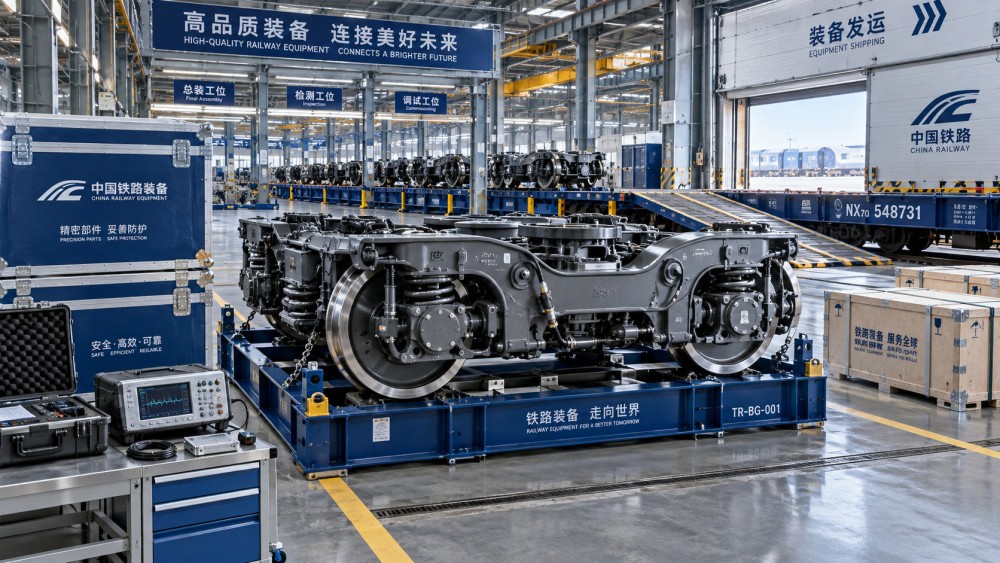
Progress at one gate does not prove readiness at the next. Equipment awaiting a required test report should not be reported as fully ready for dispatch. Equally, teams should distinguish contractual release conditions from documents that can legitimately follow later; unnecessary approval gates also cause delays.
Replace Status Updates with Evidence-Based Delivery Visibility
A dashboard helps only if its dates reflect observable progress. “On track” is weak information when nobody can confirm whether critical materials have arrived, machining has started, or a test slot has been secured.
Shared reporting should separate the contractual delivery date, the supplier’s current forecast, and the project’s required-on-site date. Combining them into a single field hides the gap that managers need to address. Each forecast should have an owner, an update date, and a stated dependency.
Useful early indicators include unresolved engineering queries, missed material commitments, delayed first-article review, unavailable test resources, and repeated movement of production milestones. These signals often become visible before the shipment date changes.
Reporting must trigger decisions. If a milestone slips, the team should establish what activity is blocked, whether schedule float remains, and who can authorize recovery. Possible actions include resequencing assembly, increasing inspection availability, splitting an approved delivery, or using a qualified substitute. Each option needs a feasibility check—not just an optimistic recovery date.
Plan Transport Around the Equipment and the Receiving Site
A shorter international transit time does not guarantee earlier installation. Port dwell, customs clearance, inland transport, unloading access, and receiving inspection can erase the apparent advantage. Heavy or oversized assemblies add constraints that ordinary parcel or container planning may miss.
Transport planning should begin once reliable dimensions, mass, lifting points, packaging requirements, and handling limits are available. Depending on the load and route, teams may need to confirm suitable lifting equipment, road permits, bridge or clearance restrictions, terminal capability, and delivery windows. Sensitive electronics may also require defined storage and preservation conditions.
Customs preparation deserves the same attention. Classification, declared value, origin documentation, and any applicable import restrictions should be checked with qualified specialists. Contractual delivery terms should clearly allocate transport, clearance, insurance, and handover responsibilities; they do not replace a detailed execution plan.
Alternative routes are worth evaluating before disruption, but not every port can handle every load. Compare total arrival reliability and handling exposure, not merely sailing time. Air freight may help with a small, critical electronic component, while being impractical for large rail assemblies.
Use Buffers and Market Intelligence Where They Change Decisions
Inventory is not a universal cure. Holding expensive equipment too early can tie up capital, require preservation, and expose the project to design changes. Buffers are more defensible where an item has uncertain replenishment, high disruption consequences, limited substitutes, and a reasonably stable configuration. Schedule contingency should likewise reflect specific uncertainties rather than one arbitrary allowance applied everywhere.
This is where external intelligence can support project controls. TC-Insight connects coverage of railway rolling stock, urban transit, high-speed EMU integration, container port cranes, and bulk material handling. That cross-sector perspective is relevant because rail delivery depends on both equipment production and the logistics nodes moving it.
Its Strategic Intelligence Center’s sector news, technology trends, and commercial insights can help teams frame questions about competing demand, technology changes, and logistics constraints. Such intelligence should inform supplier conversations and route reviews, not replace project-specific capacity checks or acceptance decisions.
A practical next step is to review the packages that currently control assembly or testing. For each, verify the technical baseline, upstream dependency, acceptance evidence, transport plan, and recovery owner. When one of these remains unclear, expediting shipment is usually not enough. Resolve the uncertainty while the project still has room to act.
Have questions about the global trade trends discussed here, or planning your expansion and supply chain strategy? Leave a message below and let the trade experts at TTC-Insight guide you.
We respect your privacy. Your information is strictly confidential.
Related News
Related News
- 00
0000-00
How public funding shapes the urban rail transit market - 00
0000-00
How do terminal operations systems coordinate crane scheduling? - 00
0000-00
Evaluating Skeletal Container Chassis Capacity for Loaded Boxes - 00
0000-00
How much outreach does a container terminal crane need? - 00
0000-00
Which rail safety technology standards apply to CBTC systems?
Weekly Insights
Stay ahead with our curated technology reports delivered every Monday.