
Overseas Buying Checklist for Sand Slurry Dredging Dredgers from China





Buying a sand dredging vessel from overseas is rarely a matter of comparing engine power and quoted price. The buyer must match a dredger’s hydraulic capability, wear resistance, transport arrangement, electrical specification, documentation, and commissioning scope to a real working site. A machine that performs well in loose river sand may be poorly suited to compacted material, long discharge distances, tidal operation, or a remote site with limited maintenance support.
For procurement teams sourcing from China, the main challenge is converting a project requirement into a purchase specification that can be quoted, inspected, shipped, and accepted without assumptions. A clear checklist reduces the risk of receiving equipment that is technically complete on paper but difficult to assemble, operate, or maintain after arrival.
Start with the material, not the dredger model
“Sand” covers a wide range of materials. Fine, free-flowing construction sand behaves very differently from coarse aggregate, gravel-bearing deposits, silty sand, weathered soil, or sand containing shells and debris. The dredging system must be selected around the material’s particle size, density, compaction, abrasiveness, and expected variability across the working area.
Procurement documents should describe the site as precisely as practical. If laboratory data are available, include grading curves, estimated solids concentration, particle size range, and any information about gravel, clay, organic matter, or hard inclusions. If no formal survey exists, buyers should at least obtain representative material samples and operational observations from the project owner or contractor.
A supplier cannot reliably size a pump, cutter head, pipeline, or power package from a generic request for “sand dredging equipment.” The project brief should state:
- Required excavation depth and expected water-level variation;
- Target production basis, such as in-situ volume, loose volume, or saleable sand output;
- Approximate material composition and maximum expected particle size;
- Discharge distance, elevation gain, bends, and booster-pump requirement;
- Working hours per day and expected seasonal operating conditions;
- Site constraints, including bridge clearance, shallow access channels, power availability, and transport limitations.
These details matter because dredger output is not determined by pump capacity alone. A large pump may move water efficiently but produce disappointing solids output if the cutter cannot loosen the material, the suction line is undersized, or the discharge pipeline creates excessive friction loss.
Define production in terms that cannot be misunderstood
Quoted production figures often cause disputes because they may refer to different measurement methods. A stated capacity can mean total slurry flow, solids volume in the pipeline, in-situ excavation volume, or theoretical output under favorable conditions. Buyers should require the quotation to identify the exact basis used for every performance claim.
Ask the supplier to explain the assumptions behind expected production: material type, dredging depth, discharge distance, pipeline diameter, solids concentration, operating cycle, and allowable wear condition. A useful proposal separates hydraulic flow from estimated solids production and identifies the conditions under which each figure is expected.
It is also wise to distinguish between maximum capability and normal operating range. A dredger may be capable of reaching a certain depth or pumping over a long distance, yet only at reduced solids concentration or slower excavation speed. Procurement teams should evaluate the duty point needed for the project rather than selecting equipment solely on a peak figure.
Match the dredging configuration to the site
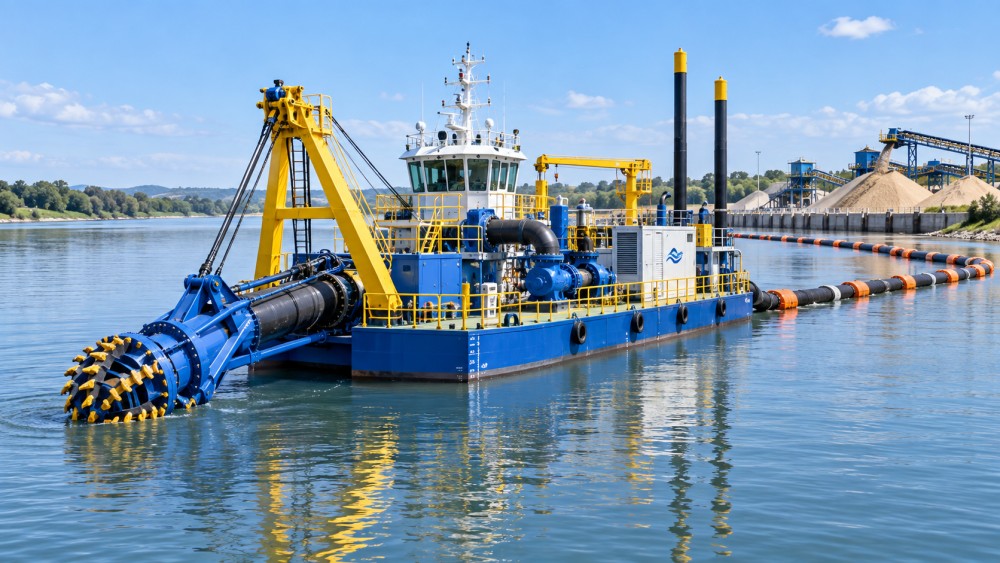
For many sand extraction projects, a cutter suction arrangement is considered because it combines mechanical cutting with hydraulic transport. The cutter loosens material at the suction inlet, while the pump carries the slurry through a floating and shore pipeline. Its suitability depends on the material and the working method. Loose sand may require relatively modest cutting effort, while compacted layers can demand more torque and a more robust ladder arrangement.
When evaluating a slurry dredging dredger, buyers should look beyond the overall vessel category and review the complete hydraulic system. Pump inlet size, impeller design, liner material, cutter drive, ladder depth, discharge pipe diameter, and installed engine power must work together. A mismatch can create cavitation risk, excessive wear, repeated blockages, or low solids concentration.
Shallow-water access deserves special attention. A dredger with a suitable pumping system may still be impractical if it cannot be floated into the site at the required draft, or if the spud arrangement cannot maintain position in soft ground. Conversely, a highly compact pontoon design may simplify transport but impose limits on working depth, installed power, or onboard maintenance space. The right balance depends on whether the equipment will remain at one site for years or move between short-term projects.
Cutter head and ladder considerations
The cutter head should be assessed according to material resistance rather than appearance. Tooth pattern, cutter diameter, drive power, gearbox arrangement, and replaceable wear components influence how effectively the dredger can expose material to the suction flow. For sand containing occasional hard material, the buyer should ask how teeth, adapters, and protective components are replaced in the field.
The ladder structure also affects reliability. It supports the suction pipe and cutter assembly while operating under vibration, cyclic loading, and abrasive slurry exposure. Review fabrication drawings, steel thicknesses where supplied, lifting points, lubrication arrangements, and access for inspection. A ladder that is difficult to service can increase downtime even when the major equipment is correctly sized.
Examine wear parts as a lifecycle cost issue
Abrasion is a normal part of sand dredging, not an exceptional failure event. Impellers, pump casings, liners, suction pipes, discharge pipes, elbows, reducers, cutter teeth, and valves may all require periodic attention. The speed of wear depends on particle hardness, particle shape, solids concentration, pump speed, and operating discipline.
Instead of asking whether a dredger is “wear resistant,” buyers should ask which components are classified as consumables, what materials are used in the wet end, and how replacement is performed. A low initial price can become less attractive if spare parts are proprietary, difficult to identify, or costly to ship individually after commissioning.
Include a recommended start-up spares list in the tender request. The list may cover common wear items, seals, bearings, cutter teeth, fasteners, pressure gauges, hose connections, and electrical consumables. The required stock level should reflect the remoteness of the project and the likely shipping lead time to the destination country. For an isolated site, holding only one emergency part can be inadequate if several components wear at similar rates.
Separate the vessel price from the complete operating package
Overseas quotations can appear comparable while including very different scopes. One proposal may cover only the dredger body and main pump, while another includes pipeline, floating hoses, pontoons, control cables, anchors, assembly tools, spares, and commissioning support. Procurement teams should issue a line-by-line scope schedule and require suppliers to mark every item as included, optional, excluded, or supplied by the buyer.
Pipeline scope is often overlooked. The dredger may be properly sized, but the project can still be delayed by insufficient floating pipe, unsuitable shore pipe, missing couplings, or inadequate buoyancy. Buyers should confirm pipe diameter, wall thickness, connection method, float spacing, bend radius, and whether the proposed pipeline length matches the actual discharge route. If a booster station may be needed later, leave room in the design for pressure monitoring and connection points.
Power and controls require the same discipline. Diesel-driven packages should identify engine make, rated output, cooling arrangement, fuel consumption basis, emissions requirements where applicable, batteries, exhaust configuration, and local availability of filters and routine service items. Electric dredgers require confirmation of voltage, frequency, cable length, starting method, protection devices, and the site’s available power supply. A machine designed for one electrical standard may need substantial modification before it can be safely operated elsewhere.
Use the factory review to verify process control
Factory inspection is most effective when it is based on agreed acceptance points rather than a general visit. Before production begins, buyers should confirm the approved drawings, bill of materials, major purchased components, technical specification, and inspection schedule. Changes made during fabrication should be documented and approved where they affect performance, maintenance, transport, or regulatory compliance.
During inspection, focus on areas that are difficult to correct after shipment: hull fabrication, internal compartment arrangement, weld quality, pump alignment, engine foundation, piping supports, electrical cabinet construction, cable routing, and access around service points. Visual inspection alone is not enough. Ask for relevant material certificates, welding records where contractually required, coating records, test reports for purchased equipment, and identification of serial numbers for major components.
Factory testing should be defined realistically. A full dredging performance trial may not be possible at every manufacturing site, especially when the machine requires water, pipeline, and material conditions that are unavailable at the factory. In that case, the contract should state what can be tested before shipment: engine operation, pump rotation, hydraulic functions, control interlocks, alarms, winches, cutter drive, electrical systems, and instrumentation. Any site-dependent performance verification should be reserved for commissioning with agreed criteria.
Plan shipping, assembly, and handover before placing the order
Many dredgers are designed for modular transport, but “containerized” or “easy to ship” should be verified with a packing plan. Buyers need the dimensions, weights, lifting requirements, and packing list for every module. Oversized pontoons, long ladders, heavy pumps, and pipe sections may affect freight selection, port handling, inland transport permits, and crane capacity at the destination.
Clarify who provides assembly drawings, installation tools, welding equipment if field joining is required, and technical personnel for commissioning. The site should be ready before equipment arrives: mooring area, lifting equipment, fuel or power connection, pipeline route, safety equipment, and access for maintenance staff. Delays at this stage can create storage costs and expose equipment to corrosion or handling damage.
Handover documents should be usable by the operating team, not merely sufficient for customs clearance. Require operating manuals, maintenance schedules, electrical diagrams, hydraulic diagrams, spare parts lists, packing lists, certificates included in the contract, and as-built drawings for the delivered configuration. Manuals should identify routine service points, lubrication intervals, safe start-up and shutdown steps, and troubleshooting guidance for common pump, cutter, and pipeline issues.
Build commercial protections around technical uncertainty
The purchase contract should connect payments to identifiable deliverables. Common milestones may include drawing approval, completion of fabrication, successful pre-shipment inspection, shipment documents, and site commissioning where included. The exact structure depends on the parties and project risk, but payment terms should not leave critical technical questions unresolved until after final payment.
Warranty wording also needs practical detail. Specify the warranty start date, excluded wear parts, response process for a defect claim, documentation required, responsibility for replacement-part freight, and whether remote technical support is included. Wear caused by abrasive slurry is normally different from a manufacturing defect, so both parties should understand where that line is drawn.
A disciplined checklist will not eliminate every overseas procurement risk. It does, however, force the buyer to test whether the proposed dredger, pipeline, documents, spares, and delivery plan form one workable system. The strongest purchase decision is usually the one based on defined site conditions, measurable acceptance criteria, and a realistic plan for operating the equipment after the shipment reaches its destination.
Related News
Related News
- 00
0000-00
Comparing bulk handling solutions by throughput reliability - 00
0000-00
What determines port crane intelligence pricing for terminal upgrades? - 00
0000-00
Rail equipment intelligence in Southeast Asia is reshaping fleet investment - 00
0000-00
Selecting Abrasion Control Systems for High-Wear Mining Transfer Points - 00
0000-00
Designing Agricultural Port Loading Systems to Protect Grain Quality and Cut Spillage
Weekly Insights
Stay ahead with our curated technology reports delivered every Monday.