
Choosing a Material Handling Conveyor Belt for Abrasive Loads





Choose a material handling conveyor belt for abrasive loads by identifying how the material damages the belt, then matching the cover compound, carcass, and loading arrangement to that damage. A thicker cover can provide more wear allowance, but it will not solve repeated cutting, punctures, or a transfer chute that drives sharp rock into the belt.
For ore, crushed stone, sand, and other abrasive bulk materials, the useful comparison is between complete belt constructions under the same operating conditions. The strongest candidate should withstand the dominant wear mechanism, fit the conveyor’s mechanical limits, and deliver an acceptable cost per tonne conveyed.
Start with the damage pattern, not the belt catalogue
If an existing belt is available, examine its surface, edges, underside, and splice areas before specifying a replacement. Damage patterns often reveal whether the problem is the cover material, the conveyor arrangement, or a combination of both.
These patterns guide investigation; they do not establish a cause on their own. A groove might originate at a skirt seal or from a lodged object elsewhere. Trace the damage to the corresponding conveyor location before deciding that a different rubber grade will fix it.
For a new installation, define the material beyond its name. Include particle-size distribution, maximum lump size, shape, bulk density, moisture, temperature, and expected contaminants. Rounded gravel and freshly crushed angular rock can impose very different demands even when their nominal sizes are similar.
Record normal operation and credible upset conditions separately. Occasional oversized lumps, feeder surges, or tramp metal may determine the required impact protection even when most of the conveyed material is fine.
Compare cover compounds on the properties that matter
Abrasion-resistant rubber covers are a common starting point for abrasive bulk conveying. However, a compound that performs well against fine-particle wear may not provide the best resistance to sharp cuts or severe gouging. Rubber formulation balances several properties, so a single abrasion figure cannot represent every failure mode.
Ask suppliers to identify the test method and conditions behind their abrasion results. In a comparable volume-loss test, a lower loss indicates better resistance under that test’s conditions. Results obtained using different methods or conditions should not be treated as directly equivalent.
Laboratory abrasion data helps compare compounds, but it does not predict service life by itself. The conveyor may expose the cover to impact, sliding rock, heat, moisture, and repeated flexing that the test does not reproduce. For coarse, angular material, request supporting information on cut and tear resistance alongside abrasion performance.
Hardness is not a reliable shortcut for durability. A harder cover is not automatically more abrasion resistant, and it may respond differently to impact or bending. Evaluate hardness as part of the compound’s overall behavior rather than using it as the deciding specification.
Environmental exposure can change the choice substantially. Hot material requires a suitable temperature-resistant construction; oil contamination may require oil-resistant rubber. Where fire performance or electrical conductivity matters, those requirements belong in the specification from the beginning. An abrasion-focused compound may not satisfy them.
How much cover thickness is useful?
Top-cover thickness provides a reserve of rubber that can wear away before the carcass becomes exposed. More thickness can therefore extend service where gradual surface loss is the main limitation. Its value is lower when belts fail early through punctures, longitudinal rips, or splice damage.
Additional cover also adds weight and can affect flexibility, pulley compatibility, and energy demand. The benefit should be assessed against the actual conveyor geometry and duty. Specify top and bottom covers separately: the carrying side faces material abrasion, while the underside must tolerate pulley and idler contact, flexing, and contamination.
For replacement belts, use measured wear history to inform thickness selection. Compare cover loss at several positions and relate it to operating hours or conveyed tonnage. Localized severe loss calls for investigation of the contact point; it should not automatically justify a thicker cover across the entire belt.
Choose the carcass for tension, impact, and conveyor geometry
The carcass carries belt tension and supports the covers. Its required strength comes from the conveyor’s loading, length, lift, drive arrangement, take-up system, and starting or stopping conditions. Abrasiveness alone does not determine the correct tensile rating.
Textile-reinforced belts are widely used on bulk conveyors where their strength, flexibility, and impact behavior suit the duty. Steel-cord belts are often considered for long conveyors or high-tension applications because of their high strength and low elongation. The appropriate choice depends on system demands and maintenance capability.
Neither construction eliminates the risk of longitudinal ripping. A sharp object trapped at a loading point can cause extensive damage as the belt continues moving. Depending on the exposure, transverse reinforcement, breaker layers, material screening, or rip detection may be justified. Reinforcement can improve resistance to particular damage mechanisms; detection can limit how far a tear progresses by triggering a stop.
A higher belt rating is not automatically a better replacement. Changes in carcass stiffness or thickness can affect trough formation, transition behavior, splice design, and minimum pulley diameter. A belt that cannot conform properly to the idler profile may create sealing problems or unfavorable stresses.
Require each proposed construction to be checked against the existing pulleys, trough angle, transition distances, take-up travel, and splice arrangement. Include available installation access and repair methods. A construction that performs well mechanically can still be an awkward choice if the site cannot support its splicing requirements.
Loading conditions can determine whether the belt survives
Abrasive wear increases when material slides relative to the belt. At a transfer point, the aim is to deliver material centrally, in the direction of travel, and with a velocity reasonably matched to the receiving belt. Poor delivery creates scrubbing as the belt accelerates or redirects the load.
Large drop heights add impact energy. Sharp lumps can concentrate that force over a small area, damaging both cover and carcass. Chute geometry and loading-zone support therefore deserve the same attention as the belt specification.
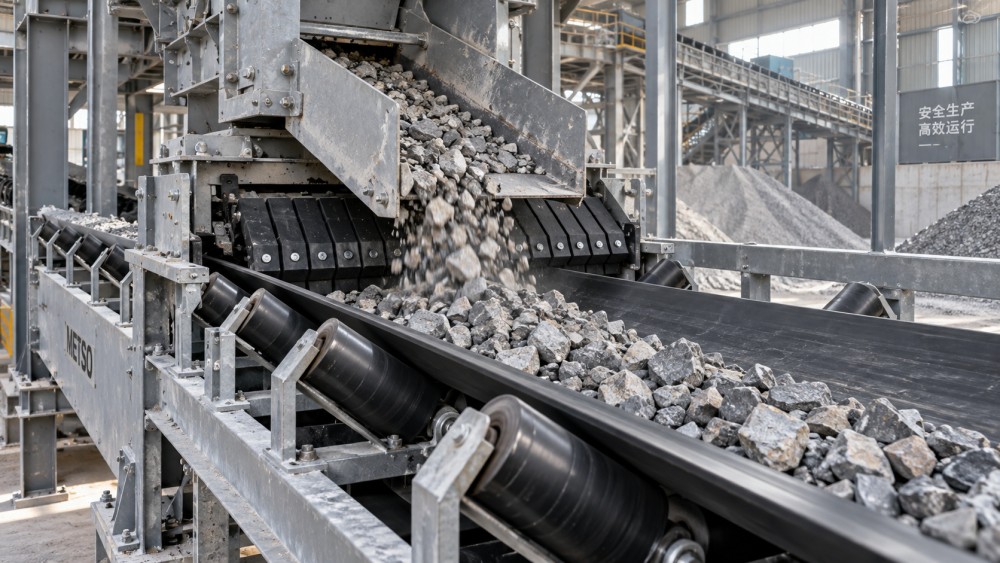
Assess the material trajectory, the point of first contact, and belt support beneath that point. Impact beds or suitable impact idlers should support the load while remaining compatible with the belt and conveyor design. An uneven loading surface or poorly arranged support can create additional contact and wear.
Skirt systems also need careful adjustment. Seals should contain material without excessive pressure against the moving cover. Abrasive particles trapped between the seal and belt can cut persistent grooves, particularly where the belt sags between supports.
Belt cleaners introduce another tradeoff. Too little cleaning leaves carryback that contaminates return idlers and promotes further wear. Excessive cleaner pressure, damaged blades, or unsuitable blade geometry can damage the surface or splice. Include cleaner compatibility in belt selection, especially when changing cover construction or splice type.
Changing belt speed also changes the conditions being assessed. At the same throughput, higher speed may reduce the material cross-section, but it alters transfer trajectories, impact behavior, dust generation, and cleaning demands. Recalculate loading and transfer conditions before assuming a speed increase will improve belt life.
Build a supplier comparison that exposes meaningful differences
Send suppliers the same operating brief. Without a common basis, one quotation may assume smooth, steady loading while another allows for severe impact. Their prices and recommended constructions will then reflect different duties.
A useful brief should include:
- Material characteristics, including maximum lumps, sharpness, moisture, temperature, and contaminants.
- Normal and peak throughput, operating hours, loaded starts, and surge conditions.
- Belt width, speed, conveyor length, lift, troughing arrangement, and calculated tension requirements.
- Pulley diameters, take-up arrangement, transitions, and existing splice constraints.
- Transfer-point geometry, loading support, skirts, cleaners, and known damage locations.
- Required environmental performance, maintenance access, and available splicing facilities.
Compare the proposed carcass, top and bottom covers, compound properties, reinforcement, and splice system separately. Ask suppliers to explain how each addresses the stated duty. Descriptions such as “heavy duty” or “premium abrasion resistant” have limited decision value without a defined construction and supporting test information.
For demanding applications, performance evidence is most useful when its operating conditions resemble yours. A reference involving rounded aggregate on a short conveyor offers limited insight into sharp ore on a high-tension system. Where uncertainty remains material to the decision, a controlled site trial can compare wear and damage under representative conditions.
Judge value by the failure it prevents
The lowest purchase price can become expensive if it brings frequent splicing, cleanup, or unplanned shutdowns. Equally, a more costly belt may offer little benefit if a misaligned chute remains the primary cause of damage.
Compare lifecycle cost over a common operating period or conveyed tonnage. Include purchase, installation, scheduled maintenance, expected replacement frequency, repair work, and the operational consequences of downtime. Account for changes in belt weight or rolling resistance where they materially affect energy use.
A proposed service-life improvement should have a credible mechanism. Better abrasion resistance may slow uniform cover loss. Cut-resistant rubber may reduce gouging from angular lumps. Improved loading support may reduce punctures. Keep these benefits tied to the damage observed on the conveyor rather than combining them into an unsupported life-extension estimate.
Before approving a material handling conveyor belt, resolve three points: the dominant failure mechanism, compatibility with the conveyor, and how performance will be measured after installation. Establish baseline cover thickness, document transfer conditions, and inspect consistent locations during service. That creates a practical basis for the next replacement decision—and makes it easier to distinguish a successful belt upgrade from an improvement caused by maintenance or chute changes.
Have questions about the global trade trends discussed here, or planning your expansion and supply chain strategy? Leave a message below and let the trade experts at TTC-Insight guide you.
We respect your privacy. Your information is strictly confidential.
Related News
Related News
- 00
0000-00
How public funding shapes the urban rail transit market - 00
0000-00
How do terminal operations systems coordinate crane scheduling? - 00
0000-00
Evaluating Skeletal Container Chassis Capacity for Loaded Boxes - 00
0000-00
How much outreach does a container terminal crane need? - 00
0000-00
Which rail safety technology standards apply to CBTC systems?
Weekly Insights
Stay ahead with our curated technology reports delivered every Monday.