
Material Handling Conveyors for Pallets: Roller, Chain, or Belt?





A pallet stops at a transfer point, its leading board drops into a gap, and the upstream line begins to queue. The conveyor may have adequate load capacity, yet its support geometry is wrong for the pallet. When selecting material handling conveyors, start with the pallet underside and travel direction: powered rollers generally suit pallets with continuous support surfaces across successive rollers; chain conveyors suit pallets whose underside can be supported reliably along discrete chain tracks; belts suit applications needing broader contact and controlled movement.
None is automatically the best choice for heavy loads, damaged pallets, or high throughput. A warehouse buffer may favor independently controlled roller zones, while a production transfer may need chains positioned under specific pallet members. A belt can reduce gaps in support, but introduces tracking, traction, and replacement considerations. The decision should follow the actual pallet population, transfer arrangement, accumulation strategy, and maintenance access—not the conveyor’s nominal capacity alone.
Start with the underside, not the rated load
A pallet’s outside dimensions do not describe how it behaves on a conveyor. Stringers, blocks, bottom deck boards, feet, and molded ribs determine where the load reaches the conveying surface. Map these contact features in both intended travel directions. A pallet that runs reliably lengthwise on rollers may behave differently after a right-angle transfer because the orientation of its lower boards changes.
Inspect representative pallets, including serviceable worn examples. Look for missing bottom boards, protruding nails, bowed runners, cracked plastic feet, and repairs that change the underside profile. Distinguish acceptable wear from damage that should trigger rejection. Selecting a conveyor to accommodate every broken pallet can increase complexity without removing the underlying handling risk.
- Support geometry: Identify which members carry the load and whether they remain supported throughout travel and handoff.
- Load condition: Record maximum gross mass, uneven loading, overhang, and the highest expected center of gravity.
- Pallet variability: Include different constructions, dimensions, materials, and permissible deformation.
- Operational interfaces: Define travel direction, forklift entry, transfer locations, and required stopping position.
Average load per support is not enough for mechanical sizing. An offset load can place much more force on one roller, bearing, or chain track than an evenly distributed pallet. Obtain the supplier’s allowable concentrated loads and verify the worst supported position, including the moment when a pallet bridges two conveyor sections.
Where roller, chain, and belt designs fit
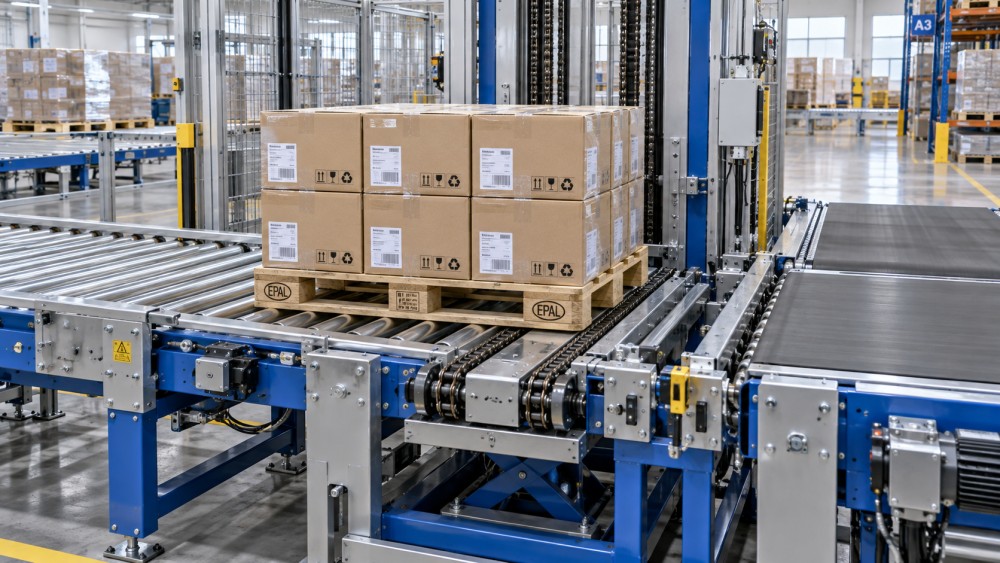
Rollers: a practical starting point for pallet buffering
Powered roller conveyors are often suitable for straight pallet routes with frequent stopping and release. Individually controlled zones can hold pallets apart rather than allowing upstream loads to push against a stationary downstream pallet. That separation matters when loads are unstable, packaging is vulnerable, or downstream equipment needs one pallet at a time.
Roller pitch must follow the pallet’s effective support length, not simply its overall length. The shortest continuous underside member may determine whether support remains adequate. Check the manufacturer’s required number of supporting rollers under the worst pallet orientation, then examine entry and exit gaps separately. Closely spaced rollers in the main section do not compensate for an oversized transfer gap.
Also verify roller tube strength, shaft and bearing capacity, and available drive force. A conveyor can support the static weight yet struggle to restart a loaded pallet because of bearing resistance, misalignment, or contact with side guides. Gravity rollers are a different operating choice: without appropriate braking and stop control, heavy pallets can accelerate or collide. They should not be treated as equivalent to powered, controlled transport.
Chains: useful when the load path is clearly defined
Chain conveyors support pallets on parallel moving tracks, commonly positioned beneath selected underside members. They can provide robust transport for suitable heavy loads, and their open layout can accommodate lifting mechanisms between tracks. This makes them useful in right-angle transfers where chains rise between rollers, lift the pallet clear, and move it sideways.
The number and spacing of tracks must match pallet structure and load distribution. More tracks do not necessarily improve support if some sit beneath gaps or weak boards. Evaluate local bearing pressure, pallet deflection, and the possibility of a foot or damaged board catching near sprockets and transitions.
Contact conditions still matter. Unless the design uses positive engagement, moving chains rely on friction to carry the pallet; oil, moisture, or debris can alter that behavior. Inspect chain wear, sprocket condition, tensioning travel, and lubrication provisions. Differential wear or poor alignment between tracks can skew the pallet and increase guide contact.
Belts: broader support, with a different maintenance burden
A full-width belt can provide a more continuous conveying surface than spaced rollers or chains. That may suit pallets with small contact features or undersides that do not bridge discrete supports well. Multiple narrow belts, however, still create unsupported spaces; they need the same contact-map assessment as chain tracks.
Broader contact does not make a belt tolerant of every pallet. Exposed nails, sharp edges, and trapped debris can cut or abrade the belt. Heavy loads can create substantial drag on slider-bed designs, so the support bed, drive sizing, and thermal duty need verification. Roller-supported belts behave differently and should be assessed on their own construction.
Specify the belt surface for actual traction conditions, including moisture, dust, or oil where relevant. Incline service requires a separate assessment of rollback and load stability. Belt tracking, tension adjustment, splice access, and the route for removing a replacement belt should be resolved before installation, particularly where surrounding equipment restricts access.
The transfer point can overturn the initial choice
Many pallet-handling failures occur at interfaces rather than along straight runs. Examine each transition as a supported motion sequence: which members carry the pallet before transfer, during bridging or lifting, and after the receiving conveyor takes over? Draw the pallet underside over the actual roller, chain, or belt arrangement at each stage.
A right-angle transfer needs compatible support in both directions. The lift mechanism must clear the original conveying surface before lateral motion begins, and the controls must confirm that the receiving space is available. Lift stroke, support-track position, pallet deformation, and mechanical clearances all affect whether the handoff works reliably.
For straight transfers, inspect changes in elevation, end-roller or pulley geometry, gaps, and speed matching. A small step can catch a damaged board; mismatched speeds can rotate a pallet or disturb its load. A turntable preserves a chosen travel orientation after rotating the pallet, but adds positioning time and another mechanism to maintain.
A mixed conveyor system is often justified at these interfaces. Roller buffering with chain lift-and-transfers, for example, can address different functions without forcing one conveying principle through the entire route. The added interfaces must still be evaluated for control complexity, maintenance access, and recovery after faults.
Size the operating sequence, not just the transport speed
Required throughput depends on pallet spacing, acceleration, stopping, transfers, identification, and downstream availability. A high straight-line speed does little when every pallet waits for a slow lift-and-transfer cycle. Establish the sequence at the limiting station and calculate its cycle time, including confirmation signals and release delays.
Accumulation requirements deserve explicit specification. Define the number of pallets that must be buffered, whether pallet-to-pallet contact is permitted, and whether release is individual or grouped. Do not assume that “powered roller,” “chain,” or “belt” automatically means zero-pressure accumulation. That behavior depends on drive segmentation, sensing, and control logic.
Zone length should accommodate the longest load envelope, including overhang and stopping tolerance—not only the pallet base. Sensor placement must detect every accepted pallet type without confusing gaps, wrapping, or protruding products. The control sequence also needs a defined response to a missed detection, a skewed pallet, or a blocked downstream zone.
Start and stop profiles should reflect load stability. A tall load with a high center of gravity may require gentler acceleration than a compact load of the same mass. Verify behavior at maximum mass and under unfavorable traction conditions; drive sizing based only on steady running resistance can miss restart demands.
Compare lifecycle costs against the expected faults
Purchase price is only one part of the evaluation. Compare energy use under the intended duty cycle, accessible wear components, inspection effort, spare-part requirements, and the time needed to restore operation. Ask which components can be replaced without removing adjacent machinery or dismantling long sections of the route.
Match maintenance questions to the technology. Roller systems require attention to bearings, drive transmission, and damaged rollers. Chain systems need wear measurement, lubrication management, and sprocket inspection. Belt systems need tracking checks, surface inspection, and practical replacement arrangements. Contamination may change the ranking: loose wood fragments can lodge in mechanisms, while oil can affect traction and create housekeeping concerns.
Jam recovery also has a cost. A design that requires personnel to enter an inaccessible transfer area for routine faults is not merely inconvenient. Pinch points, moving chains, lift mechanisms, and unexpected restart hazards require engineered guarding, suitable safety controls, and isolation procedures. Final safety requirements must be established for the complete installation and applicable operating environment.
Use acceptance testing to resolve the remaining uncertainty
Before committing to a configuration, agree on a representative pallet-and-load test matrix with the equipment supplier. Include accepted pallet variants, maximum and offset loads, relevant surface conditions, and serviceable wear. Test the interfaces and operating sequences that could cause stoppages, rather than demonstrating only a clean pallet on a straight section.
- Verify support: Observe entry, travel, stopping, and transfer for catching, excessive deflection, or loss of contact.
- Challenge the sequence: Test full-buffer release, downstream blocking, loaded restart, and safe fault recovery.
- Measure functional performance: Check achieved cycle time, stopping repeatability, pallet skew, and load movement against agreed requirements.
- Confirm maintainability: Demonstrate access to wear parts, tensioning points, sensors, and isolation locations.
Set acceptance limits before testing. If rollers fail because an accepted pallet cannot bridge the spacing, reconsider pitch or support technology. If chains create excessive local deflection, revise track placement or pallet compatibility. If a belt meets transport needs but cannot be replaced within the available access envelope, resolve that layout constraint before purchase. These findings turn a general comparison into a defensible equipment specification.
Have questions about the global trade trends discussed here, or planning your expansion and supply chain strategy? Leave a message below and let the trade experts at TTC-Insight guide you.
We respect your privacy. Your information is strictly confidential.
Related News
Related News
- 00
0000-00
How public funding shapes the urban rail transit market - 00
0000-00
How do terminal operations systems coordinate crane scheduling? - 00
0000-00
Evaluating Skeletal Container Chassis Capacity for Loaded Boxes - 00
0000-00
How much outreach does a container terminal crane need? - 00
0000-00
Which rail safety technology standards apply to CBTC systems?
Weekly Insights
Stay ahead with our curated technology reports delivered every Monday.