
Production Checks for Rubber Conveyor Belts: Common Defects in Fabric Reinforcement





Why fabric reinforcement defects deserve early attention
A rubber conveyor belt can look acceptable on the surface and still carry a hidden weakness inside the carcass. For quality control teams and safety managers, that is the main challenge with fabric-reinforced belts: many critical defects begin in the reinforcement layers long before they become visible as edge damage, cover cracking, mistracking, or premature splice failure.
In operation, the fabric structure carries tensile load, helps the belt maintain dimensional stability, and influences troughability, impact resistance, and splice performance. If the reinforcement is uneven, contaminated, misaligned, or poorly bonded to rubber, the belt may still pass a casual visual check but fail under startup tension, repeated loading cycles, or localized impact at transfer points.
This matters most in plants where downtime is expensive or where belt failure creates secondary hazards. A torn carcass on a quarry line, a delaminating belt in a grain handling system, or a belt with poor tracking in a recycling plant can expose workers to emergency interventions near moving equipment. For that reason, production checks should not focus only on final dimensions and cover appearance. They need to examine how the textile reinforcement was selected, handled, embedded, and cured.
What the fabric reinforcement is expected to do
Fabric-reinforced rubber belts are commonly built with one or more textile plies embedded between top and bottom rubber covers. The reinforcement may use polyester, nylon, cotton, or blended constructions depending on tension requirements, elongation behavior, troughing needs, impact conditions, and the nature of the conveyed material. In many industrial applications, choosing among fabric-based benzi transportoare cauciuc is not just a matter of belt strength. It also affects how well the carcass tolerates pulley flexing, mechanical damage, and splice preparation.
When teams review benzi transportoare cauciuc or comparable fabric-belt options, the most relevant question is whether the belt construction matches the actual duty conditions: starting tension, conveyor length, lump size, loading profile, edge stress, moisture exposure, and expected cleaning method. A belt selected only by nominal strength may pass procurement but create recurring quality and safety issues later.
Production checks become more meaningful when the intended service is clear. A short indoor conveyor handling packaged goods has different reinforcement demands than a dusty aggregate line with impact loading and frequent stop-start cycles. The same visible defect may be tolerable in one application and unacceptable in another.
Common defects in fabric reinforcement and how they show up later
Ply misalignment
One of the most consequential defects is poor alignment of the fabric plies during build-up. If the textile layers are skewed relative to the belt centerline, the finished belt may have unequal stretch characteristics across its width. In service, that can appear as chronic mistracking, edge curling, uneven wear, or difficulty keeping the belt centered even after idlers and pulleys have been checked.
For safety managers, this is more than a maintenance annoyance. Persistent mistracking increases the chance of edge contact with structure, heat buildup, material spillage, and emergency adjustment work while the system is under pressure to restart.
Wrinkles, folds, and trapped distortion
Wrinkles in the fabric plies are often introduced during lay-up, tensioning, or calendering. A local fold creates a stress concentration point that weakens flex life and interferes with even rubber penetration. The defect may remain invisible after vulcanization, especially when cover thickness hides the internal irregularity.
Belts with internal folds may later show local bulging, cover separation, splice weakness, or a crack pattern that repeats at a regular interval matching belt travel. In heavily loaded sections, the area may become the starting point of a longitudinal tear.
Insufficient rubber penetration into the fabric
The bond between rubber and textile depends on proper penetration and adhesion during manufacturing. If rubber does not adequately enter the weave or cord structure, the carcass can contain micro-voids or poorly bonded zones. These areas are vulnerable to flex fatigue and moisture ingress.
In practical terms, weak penetration often leads to ply separation after repeated bending over pulleys. The belt may first present as a soft spot, blister, or unusual sound at the return side. Once delamination begins, the residual strength of the carcass can fall quickly under load.
Contamination between plies
Dust, release agent residue, moisture, loose fibers, or foreign particles trapped between reinforcement layers can interrupt adhesion. The source is not always dramatic; sometimes it comes from poor storage of fabric rolls, handling in a dusty shop, or long hold times before assembly.
Contaminated zones can cause localized bond failure and are especially risky near splices or high-impact loading points. If the conveyor handles wet or abrasive material, the defect may accelerate internal wear because the interface is already compromised.
Uneven fabric tension during assembly
Reinforcement must be laid under controlled conditions. Excess tension can distort the fabric geometry, while insufficient tension may allow waviness or inconsistent ply spacing. Either condition can alter belt elongation behavior and make the carcass respond unpredictably under startup load.
For QC teams, belts with uneven internal tension are troublesome because they may pass dimensional inspection at rest but behave differently once installed. Tracking instability, cover rippling, and nonuniform splice strain are common downstream symptoms.
Edge defects in the textile carcass
Frayed reinforcement edges, trimmed damage, or poor edge build-up can later evolve into edge delamination. This is especially important where conveyors run with marginal alignment, side sealing pressure, or frequent side loading. A small edge defect in production can become the first open path for water, fines, or chemicals to enter the carcass.
Why these defects are often missed in routine acceptance
Many incoming or final inspections concentrate on what is easy to measure quickly: total thickness, width, cover gauge, hardness, appearance, and roll length. Those checks are necessary, but they do not fully reveal the quality of the reinforcement package. A belt can meet nominal dimensions while still carrying internal construction problems.
Another issue is that some plants rely too heavily on operational trial as the real test. That shifts defect detection from controlled production inspection to live service, where the cost of failure includes lost production, emergency labor, and safety exposure. For belts used in critical transfer routes, waiting for symptoms is an expensive strategy.
Production checks that help catch reinforcement problems earlier
Review the fabric specification before looking at the finished belt
Inspection is stronger when it begins with the intended carcass design. QC personnel should verify the specified ply type, number of plies, nominal strength class, expected elongation behavior, and cover-to-carcass relationship. If the selected fabric is mismatched to the conveyor duty, a perfectly manufactured belt can still perform poorly.
This is where procurement and quality control need to stay connected. A lower-cost fabric construction may look acceptable on paper but become difficult to splice, less resistant to impact, or more sensitive to edge damage in rough service.
Check storage and handling conditions for reinforcement materials
Fabric rolls should be protected from moisture, dirt, crushing, and uncontrolled temperature exposure. Distortion introduced before processing can remain in the carcass even if downstream operations are well run. If production records do not show how reinforcement materials were stored, later defect analysis becomes harder.
Observe lay-up discipline and centerline control
Direct observation during assembly often reveals risks that final inspection cannot. Teams should pay attention to ply centering, wrinkle formation, edge consistency, and whether the reinforcement is being fed under stable tension. Repeated small deviations tend to become systematic belt behavior problems later.
Use section cuts when defects are suspected
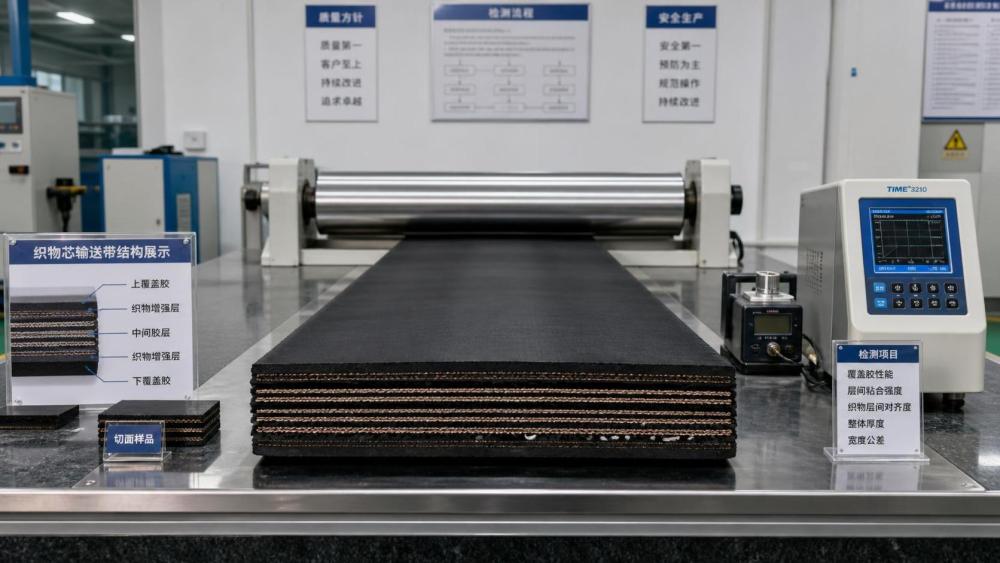
When visual symptoms suggest internal irregularity, a cross-section can reveal ply spacing, alignment, trapped air, bond continuity, and edge construction. Section checks are destructive, so they are usually selective rather than routine. Still, for critical lots or after repeated field failures, they provide much better evidence than surface inspection alone.
Inspect splice zones and sample joints carefully
Even when the belt body is acceptable, poor reinforcement control often becomes obvious at the splice. Fabric skew, weak bonding, and irregular ply geometry tend to show up there first because the joint concentrates stress. If sample splice preparation is difficult or the joint behaves inconsistently, the root cause may lie in carcass construction rather than installer technique.
Compare production records with field complaints
If a plant repeatedly reports mistracking, edge separation, or early splice problems on the same belt type, production history should be reviewed for common variables: reinforcement batch changes, lay-up conditions, curing deviations, or handling issues. That kind of comparison helps distinguish installation error from manufacturing-related carcass defects.
How safety managers should interpret belt defects differently from purchasing teams
Purchasing teams often focus on price, lead time, and nominal specification match. Safety managers and plant QC staff need a different filter. The main question is not whether the belt can be bought to a strength rating, but whether internal reinforcement quality leaves enough margin for the real operating environment.
A belt running near design load with frequent starts, heavy impact, or limited guarding access does not tolerate hidden carcass defects well. In these cases, even moderate reinforcement irregularities can turn into events that require urgent maintenance near rotating equipment. The risk is not only belt replacement cost. It includes cleanup, lost containment, blocked chutes, and unsafe troubleshooting conditions.
Warning signs after installation that may point back to production defects
Not every field issue originates in manufacturing, but some recurring symptoms should trigger a review of reinforcement quality:
- Tracking problems that persist after alignment corrections
- Edge separation appearing early in service
- Localized bulges or soft spots in the belt body
- Splice failures that repeat despite correct jointing procedure
- Regularly spaced cracks or delamination patterns
- Unexpected elongation differences across the belt width
These symptoms can also be influenced by pulley condition, idler arrangement, loading geometry, or material impact. That is why root-cause review should combine operating conditions with production and acceptance records rather than assign blame too early.
Practical checkpoints for procurement and incoming inspection
For organizations buying fabric-reinforced belts from external suppliers, a more useful acceptance approach is to ask for evidence that supports carcass consistency, not just final dimensions. The exact documentation available varies by supplier and application, but the receiving team can still examine several basics:
- Does the delivered belt match the specified ply construction and cover arrangement?
- Are the roll edges clean and consistent, without visible carcass exposure or abnormal waviness?
- Do sample sections, where justified, show centered and uniform reinforcement layers?
- Are there visible signs of handling damage, storage compression, or contamination?
- Is the belt intended for the actual pulley diameters, loading profile, and splice method used on site?
That last point is easy to overlook. A technically valid belt can still be a poor fit if the conveyor uses smaller pulleys, sharper transitions, or rougher loading than the carcass design comfortably supports.
Where production control has the biggest payoff
Some defects can be managed in service for a while. Fabric reinforcement defects usually cannot. Once the internal carcass is flawed, the belt carries that weakness for its entire working life. Better production checks do not eliminate all failures, but they reduce the number of hidden defects that only appear after installation, when correction is expensive and operational risk is higher.
For QC personnel, the most effective habit is to connect final belt appearance with internal construction discipline. For safety managers, the priority is to treat unexplained mistracking, early edge damage, and repeated splice issues as possible carcass warnings rather than isolated maintenance incidents. That approach leads to better investigations, cleaner acceptance criteria, and fewer surprises once the conveyor is under load.
Related News
Related News
- 00
0000-00
How port machinery systems reduce container handling bottlenecks - 00
0000-00
How smart port logistics systems reduce container dwell time - 00
0000-00
How transport equipment intelligence analysis identifies bottlenecks - 00
0000-00
How rail technology advancements are reshaping signaling standards - 00
0000-00
What is driving growth in the global EMU market size?
Weekly Insights
Stay ahead with our curated technology reports delivered every Monday.