
Used Conveyor Belt Curing Lines: What to Check Before Purchase





A used conveyor belt curing line should be assessed as a complete production system, not simply as a press with an attractive purchase price. Before committing, buyers need evidence that it can handle their belt construction, maintain the required curing conditions, index material consistently, and operate safely after relocation. Missing handling equipment, worn platens, or unsupported controls can turn an apparently inexpensive machine into a lengthy rebuilding project.
The central purchasing question is whether the line can produce the required belt reliably at an acceptable installed cost. Answering it requires a product specification, a condition survey, and an acceptance plan agreed before dismantling. A demonstration that the press opens, closes, and heats is useful, but it does not establish production capability.
Define the belt specification before comparing machines
Start with the products the line must manufacture: belt width, finished thickness, textile carcass construction, cover compounds, intended belt lengths, and required output. Distinguish routine products from occasional orders. A machine sized around an uncommon maximum specification may introduce unnecessary installation expense, while one chosen only for current products may constrain foreseeable work.
Fabric-cord conveyor belts and steel-cord belts should not be treated as interchangeable applications. Carcass preparation, tensioning, handling, and associated equipment need separate evaluation. For general-purpose textile belts, ISO 14890 provides a relevant product-specification reference, but buyers must confirm its applicability to their intended service and customer requirements. A machinery listing alone cannot establish conformity with a finished-belt specification. Source: ISO 14890, Conveyor belts — Specification for rubber- or plastics-covered conveyor belts of textile construction for general use.
Prepare a requirement sheet that separates mandatory capability from negotiable preferences. Include usable curing width and length, thickness range, heating medium, required services, control functions, and material-handling arrangements. Specify whether quoted dimensions describe the platen, the nominal machine size, or the actual usable curing area. These descriptions are not necessarily equivalent.
Establish exactly what the used line includes
A curing press may be offered separately from the equipment that originally fed, positioned, and collected the belt. Request an itemized inventory covering the press structure, hydraulic power unit, heating system, piping, electrical cabinets, operator stations, tensioning equipment, indexing devices, cooling equipment where fitted, and winding or take-up arrangements. Identify loose components and dismantled assemblies against drawings and photographs.
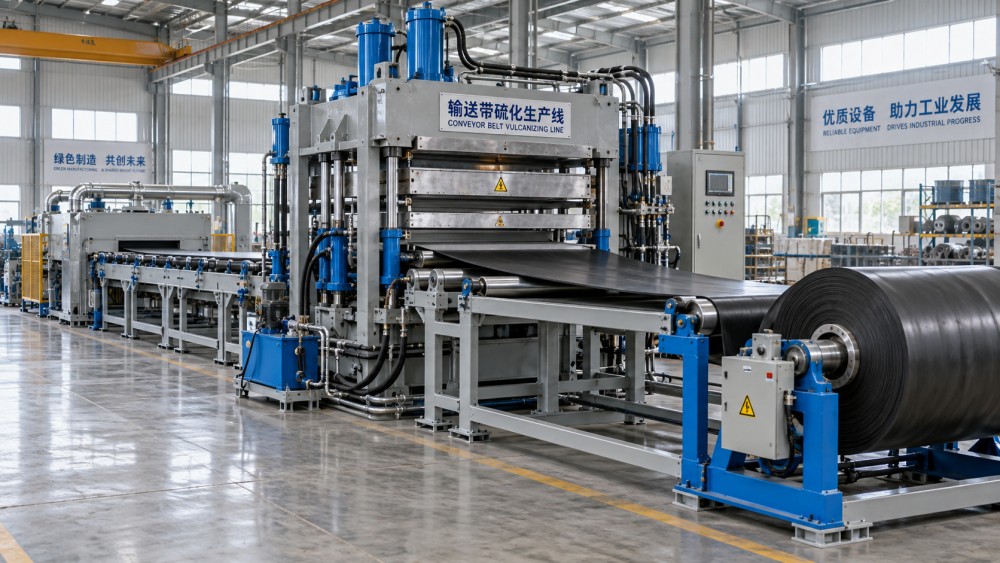
When reviewing belt-frame curing production line features, separate the press frame and curing assembly from the surrounding handling and control equipment. For a used fabric-cord line, that distinction helps buyers identify whether the offered package matches the intended manufacturing process. Treat listed features as items to verify, rather than evidence of condition, completeness, or achievable output.
Ask for the original manufacturer, model identification, serial numbers, available manuals, maintenance records, and modification history. Where records are missing, price the work needed to reconstruct drawings and establish component specifications. An undocumented retrofit is not automatically unacceptable, but it increases the burden of inspection and engineering review.
Inspect the structure, platens, and hydraulic system under load
Cosmetic condition can distract from expensive mechanical problems. Have a competent machinery specialist examine load-bearing members, connections, guide arrangements, and accessible platen surfaces. Record corrosion, damaged threads, uneven wear, suspected cracks, and evidence of repairs. Any questionable structural repair should receive an engineering assessment; paint and photographs cannot establish load-bearing integrity.
Platen condition deserves particular attention because the curing process depends on controlled contact and heating. Ask how flatness, alignment, and parallelism will be measured, at what temperature, and under which loading conditions. A cold inspection may reveal damage, but it cannot by itself establish behavior at operating temperature. The inspection method and permissible deviations should be agreed for the intended products, not borrowed from an unrelated machine.
For the hydraulic system, inspect cylinders, rods, seals, hoses, fittings, valves, filtration, and oil condition. Observe pressure build-up, holding behavior, and controlled release during an authorized trial. Leakage, unstable readings, unusual noise, or excessive heating warrant investigation rather than an immediate diagnosis from appearance alone.
Clarify the relationship between hydraulic gauge pressure and pressure applied to the belt. Cylinder area, machine arrangement, and loaded area affect that relationship. Buyers should obtain the manufacturer's calculations or a competent engineering assessment instead of treating the gauge value as the curing pressure.
Check process control, not just the displayed temperature
Rubber curing depends on the compound and its time-temperature history. A controller reaching its setpoint does not demonstrate that the entire belt section has experienced the intended cure. Compound cure behavior should be established through appropriate laboratory methods, then connected to a validated production recipe. ISO 6502-1 addresses the use of curemeters; it does not supply a universal press recipe. Sources: ISO 6502-1, Rubber — Measurement of vulcanization characteristics using curemeters — Part 1: Introduction; Maurice Morton, editor, Rubber Technology, third edition, chapter on vulcanization.
Review sensor locations, heating zones, control loops, and the way the cycle timer starts. Does timing begin when the controller reaches its setpoint, when all monitored zones satisfy a condition, or following another defined event? Establish whether the system records actual values or merely stores recipe settings. These distinctions affect how a buyer can investigate inconsistent product after commissioning.
Request a temperature survey using calibrated instruments at agreed locations and operating conditions. The method should represent the intended working area and loading as closely as practical. Check heating response, stability during the hold period, and differences between zones. If the line uses steam, investigate supply requirements, drainage, traps, and condensate handling; if it uses another heating medium, assess the corresponding supply and circulation arrangements.
Controls also need a maintainability review. Obtain PLC and HMI identities, program backups, access credentials where transferable, electrical drawings, and a list of unavailable components. An older control system may remain serviceable, but a failed proprietary module without a replacement route can create a disproportionate production interruption.
Evaluate indexing and belt handling as quality risks
For a line that cures successive belt sections, assess how material is advanced and positioned between cycles. Request an explanation of the indexing sequence, the treatment of transitions between cured sections, and the provisions for tension and alignment. The appropriate arrangement depends on the belt construction and the manufacturer's process; there is no universal indexing setting suitable for every product.
Watch the handling equipment during a representative trial. Look for slipping at the gripping device, inconsistent advancement, lateral movement, and difficulty supporting the uncured belt. Confirm that the operator can position the material without routine entry into a hazardous area. A press that performs well in isolation may still be unsuitable if its handling system requires extensive modification.
Capacity estimates should include loading, positioning, heating, holding, pressure release, opening, indexing, and unloading where applicable. Ask whether the quoted output represents a complete production cycle or only the curing hold time. Compare estimates using the same belt specification and operating assumptions, including the available labor and utility supply.
Separate machinery safety from product acceptance
A successful production trial is not a safety assessment. Used equipment may have missing guards, altered interlocks, incomplete electrical documentation, or maintenance practices that relied on knowledge held by its previous operators. Relocation also changes access routes, service connections, and the surrounding work environment.
Arrange a documented risk assessment covering normal operation, setup, cleaning, fault recovery, and maintenance. ISO 12100 provides a framework for machinery risk assessment and risk reduction, but citing the standard does not certify a machine. Applicable legal duties depend on the installation jurisdiction and the equipment's circumstances. Source: ISO 12100, Safety of machinery — General principles for design — Risk assessment and risk reduction.
Energy isolation requires specific attention to electrical supply, hydraulic pressure, heating services, gravity-loaded parts, and residual heat. For installations subject to United States federal OSHA requirements, hazardous-energy control and machine guarding are addressed by 29 CFR 1910.147 and 29 CFR 1910.212 respectively. Other jurisdictions require their own compliance review. Trials and inspections should follow approved procedures performed by qualified personnel; an emergency stop is not a substitute for energy isolation. Sources: OSHA, 29 CFR 1910.147 and 29 CFR 1910.212.
Write an acceptance plan that tests the intended product
The strongest acceptance plan combines machinery measurements with a representative belt trial. Specify the material, belt construction, operating recipe, instruments, sampling positions, and documents required. Where a seller cannot run the buyer's compound or carcass, record that limitation explicitly and allocate the resulting commissioning risk in the purchase agreement.
Finished-belt checks may include dimensions, appearance, and adhesion between constituent elements, according to the product specification. ISO 252 provides test methods for adhesion between conveyor-belt elements. Applicable test methods do not automatically define the acceptance limits for every application; those limits must come from the agreed specification. Avoid accepting a visually satisfactory sample as proof of all required properties. Source: ISO 252, Conveyor belts — Adhesion between constitutive elements — Test methods.
Record unresolved defects and distinguish items the seller must correct from work the buyer will undertake. Define separate milestones for inspection before shipment and acceptance after installation. This prevents transport damage, assembly errors, and site-service limitations from being confused with the machine's original condition.
Compare installed cost and make uncertainty contractual
Use the quoted purchase price as one line in a broader cost assessment. Include dismantling, lifting, packing, transport, foundations, service upgrades, reassembly, controls work, guarding, inspections, commissioning material, and initial spares. Establish who is responsible for identifying lifting points, labeling connections, preserving platen surfaces, and documenting the dismantling sequence.
Evaluate uncertain items separately rather than hiding them in a general contingency. For example, an unsupported controller creates a different risk from worn hydraulic seals: the former may require a redesign, while the latter may be a defined repair once components are identified. Obtain scoped estimates where possible and identify which costs remain unverified.
The purchase agreement should state what is supplied, which condition claims have been demonstrated, how acceptance will work, and what happens if agreed requirements are not met. A used curing line is a defensible purchase when its suitability can be demonstrated and its remaining refurbishment work can be bounded. If structural condition, process stability, or essential documentation remains unresolved, the purchasing decision should wait for evidence—not rely on the discount.
Have questions about the global trade trends discussed here, or planning your expansion and supply chain strategy? Leave a message below and let the trade experts at TTC-Insight guide you.
We respect your privacy. Your information is strictly confidential.
Related News
Related News
- 00
0000-00
How public funding shapes the urban rail transit market - 00
0000-00
How do terminal operations systems coordinate crane scheduling? - 00
0000-00
Evaluating Skeletal Container Chassis Capacity for Loaded Boxes - 00
0000-00
How much outreach does a container terminal crane need? - 00
0000-00
Which rail safety technology standards apply to CBTC systems?
Weekly Insights
Stay ahead with our curated technology reports delivered every Monday.