
Urban Rail Systems Explained: From Metro Trainsets to CBTC Control





Urban Rail Is a System of Interdependencies
Urban rail is often described through visible assets: metro trains, stations, tunnels, or elevated guideways. Yet a high-frequency metro line succeeds or fails through the way several subsystems work together. A trainset with strong acceleration cannot deliver short headways if signaling cannot safely separate trains. A modern communications-based train control system cannot maintain service if doors, traction power, passenger circulation, and maintenance processes introduce recurring delays.
For researchers trying to understand an urban rail system, the useful starting point is therefore not a catalogue of components. It is the operational question the system must answer: how can a line move large passenger volumes safely, predictably, and at a frequency that makes waiting time acceptable? Metro trainsets and CBTC control are central to that answer, but they must be assessed as parts of one operating model.
An urban rail project may have different priorities depending on its role. A dense central corridor may require maximum throughput at peak periods. An airport link may value luggage space, reliability, and passenger information more than extreme headway. A suburban metro extension may need compatibility with an existing fleet and control center. These distinctions affect decisions on rolling stock, signaling architecture, platform design, depot capacity, and the appropriate level of automation.
What the Metro Trainset Actually Contributes
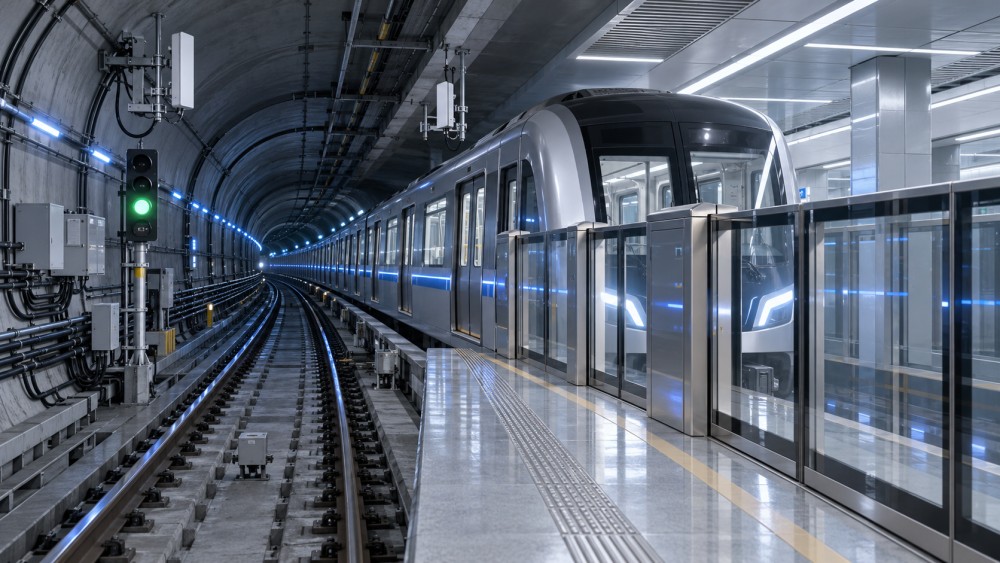
A metro trainset is designed for repeated stopping, rapid passenger exchange, and intensive daily utilization. That sets it apart from mainline passenger rail equipment, where higher top speed, longer inter-station distances, and seated comfort often carry more weight. In urban rail, the train’s practical value lies in how consistently it can complete its cycle between stations and return to service after disruptions.
Train length, car width, door layout, interior arrangement, and traction performance all influence that outcome. More doors can reduce boarding and alighting time, but they also affect seating configuration and structural layout. Wider cars can increase capacity, though tunnel and platform constraints may rule them out. A longer train can carry more people, but only where stations, depot facilities, power supply, and evacuation arrangements support it.
Acceleration and braking performance are similarly easy to oversimplify. Fast acceleration can reduce journey time between closely spaced stations, but the benefit depends on speed restrictions, passenger comfort requirements, adhesion conditions, and the train’s ability to brake consistently under different loads. High acceleration alone does not create a high-capacity railway. It needs to work with signaling margins, dwell-time discipline, and a timetable that can absorb normal variation without collapsing into delay propagation.
The train’s traction system converts electrical supply into controlled movement. Modern equipment generally combines traction converters, motors, braking systems, auxiliary power equipment, and onboard control electronics. Regenerative braking can return energy to the electrical network when conditions allow, but the usable benefit depends on whether nearby trains are drawing power, whether the supply system can accept returned energy, and how the wider energy-management strategy is configured. It should be viewed as a system-level efficiency opportunity rather than an automatic saving attached to every braking event.
Rolling stock architecture also determines the maintenance burden. A fleet that is difficult to inspect, isolate, repair, or return to service can undermine the economics of even a technically capable line. Fleet planners therefore look beyond purchase specifications toward access to components, diagnostic quality, software support, workshop processes, spare-parts strategy, and the expected availability of trains during peak operating windows.
Passenger-facing features matter because dwell time is operational time. Door obstruction detection, clear interior circulation, accurate route displays, audible announcements, and reliable air conditioning all influence how passengers behave at stations. In a crowded network, small delays at one doorway or one platform can recur hundreds of times per day. The boundary between passenger experience and railway performance is much narrower in urban rail than it first appears.
Why Signaling Sets the Practical Capacity Limit
Railway capacity is often discussed as a question of how many trains can fit on a line. In practice, the limiting factor is the minimum safe and sustainable interval between trains. This interval, commonly called headway, includes more than train speed. It reflects train detection, braking assurance, route setting, station dwell, door status, platform conditions, and the control system’s ability to respond when operations depart from plan.
Traditional fixed-block signaling divides the railway into defined track sections. A following train must maintain separation based on the occupancy of those sections and the applicable safety rules. This approach can provide robust operation, but block length and conservative margins may restrict how closely trains can run, particularly on lines with short station spacing and demanding peak loads.
CBTC changes the control model by enabling more precise information exchange between trains and wayside equipment. Depending on system design and operating mode, it can support moving-block principles, where safe separation is calculated with reference to a train’s position, speed, braking capability, and movement authority rather than only a sequence of fixed sections. The aim is not to remove safety margins. It is to manage them with more timely and granular information.
That is why CBTC is associated with higher-frequency metro operation. It can allow trains to operate at shorter intervals when the rest of the railway is prepared to support those intervals. However, the phrase “CBTC capacity” can be misleading when treated as a standalone property. A line running at a short technical headway may still deliver less capacity than expected if station dwell times vary, passenger crowding blocks doors, turnback tracks constrain reversals, or the power system is poorly matched to simultaneous acceleration.
CBTC Is Both a Control System and an Operating Discipline
A typical CBTC environment brings together onboard equipment, wayside zone controllers, radio communication, trackside interfaces, automatic train protection functions, and a supervisory control layer. The onboard system monitors movement authority and helps enforce speed limits. Wayside equipment manages route availability and train separation. Communication links must maintain the availability, latency, and redundancy necessary for the safety architecture. The supervisory layer supports traffic regulation, service adjustment, alarms, and operator visibility.
These interfaces make CBTC implementation more complex than a single equipment replacement. Legacy interlockings, platform screen doors, automatic train supervision, depot control, telecoms networks, radio spectrum arrangements, and central control-room procedures may all require coordinated treatment. Migration on an operating railway can be particularly challenging because the new and old arrangements may need to coexist temporarily without creating confusing operational boundaries.
For that reason, a signaling assessment should examine more than nominal headway. Useful questions include:
- What peak service pattern is the line intended to sustain, and what assumptions are made about dwell time?
- How does the system recover after a delayed train, door fault, communication interruption, or blocked platform?
- Which functions are safety-critical, and what degraded modes remain available when a subsystem fails?
- How are trains admitted to depots, turned back at terminals, or moved through junctions during disruption?
- Can the system interface cleanly with existing rolling stock, interlockings, platform equipment, and control-center tools?
A favorable answer requires technical evidence, operating rules, and maintainability planning. It cannot be established by the presence of a CBTC label alone.
Automation Levels Change Responsibilities, Not the Need for Control
Urban rail automation is usually described through Grades of Automation, ranging from systems where a driver controls the train under protection to fully unattended train operation, often referred to as GoA4. The terminology is useful, but it can create a false impression that automation is a simple ladder from basic to advanced.
Higher automation can support consistent driving profiles, rapid response to timetable commands, and more flexible service deployment. Removing a driver from the cab may also create space for passengers and alter staffing models. But fully automated operation shifts responsibilities into the wider system. Platform monitoring, passenger assistance, incident response, cybersecurity, remote supervision, evacuation procedures, and recovery management become even more important because there is no onboard driver to make local judgments in the conventional way.
The core safety question is not whether a train has a driver. It is whether the railway can detect abnormal conditions, prevent unsafe movement, communicate clearly with passengers and staff, and restore service in a controlled manner. A GoA4 line needs mature procedures for intrusion detection, failed doors, stalled trains, track access, fire response, communications loss, and emergency evacuation. It also needs staff who can act quickly from stations, control rooms, depots, and field locations.
Automation can be a strong fit for a purpose-built line with segregated infrastructure, consistent station design, platform screen doors or equivalent risk controls, and an organization prepared for data-intensive operations. It is harder to justify when legacy interfaces are extensive, station geometry is highly variable, or the operator cannot sustain the maintenance and governance model that automated service requires. The relevant comparison is not “driverless versus conventional.” It is the reliability, capacity, and lifecycle implications of a specific operating concept.
The Station Often Determines Whether the Line Performs
At high frequency, stations become part of the control system even when they are not described that way. Passenger flow affects door closing. Door closing affects dwell time. Dwell time affects train spacing. A late departure can force following trains to brake earlier, increase platform crowding, and create a cycle that is difficult to unwind during a peak period.
Station design therefore deserves the same analytical attention as trains and signaling. Platform width, vertical circulation, fare-gate placement, transfer paths, signage, ventilation, screen-door integration, and staff access can all affect operational resilience. A platform may be adequate under average demand but struggle when a transfer surge, event crowd, service gap, or incident changes the passenger pattern.
Passenger information also has an operational role. Clear, timely messages can distribute waiting passengers along a platform, direct them to alternative routes, and reduce uncertainty during disruption. Poorly coordinated information can produce the opposite result: people cluster near doors, hold back boarding, or attempt last-minute transfers that complicate recovery.
How to Read an Urban Rail System as a Researcher
For an initial review, it is helpful to map the railway around its service promise rather than around supplier categories. Start with demand and service frequency, then trace the dependencies required to deliver them. This approach exposes where an attractive component-level claim may depend on an unresolved infrastructure or operations issue.
This framework also helps distinguish a system’s design capacity from its usable capacity. Design capacity is often calculated from assumptions about train length, frequency, load factor, and passenger movement. Usable capacity depends on whether the organization can repeatedly operate close to those assumptions while preserving safety and allowing enough margin for disruptions, inspections, and maintenance.
Interoperability deserves particular attention where a network is expanding in phases or connecting different generations of infrastructure. Differences in train control, radio systems, platform doors, voltage arrangements, maintenance software, and data ownership can introduce costs and operational constraints long after construction ends. Standardization can reduce that burden, but it should not be mistaken for universal compatibility. Interface responsibility and change control need to be explicit across the life of the system.
What Deserves Attention Next
The most consequential changes in urban rail are likely to be those that improve the railway’s ability to sense, predict, and recover. Condition monitoring can help maintenance teams detect degradation before it becomes a service failure, provided that diagnostic alerts are connected to workable maintenance decisions. Energy management can coordinate traction demand and regenerative braking more effectively when rolling stock and power systems share usable operational data. Control centers can use richer real-time information to regulate service, but only if operators retain understandable procedures for exceptions.
Cybersecurity belongs in this discussion because CBTC, automated operation, passenger information, depot systems, and remote diagnostics increasingly rely on connected digital infrastructure. The concern is broader than unauthorized access to a single application. Operators need to understand network segmentation, identity management, software updates, supplier access, incident response, and how the railway remains safe when digital services are degraded.
Urban rail should therefore be read as a coordinated capacity machine. Metro trainsets provide the physical ability to move passengers quickly and repeatedly. CBTC provides the control logic that can safely compress train separation. Stations, power supply, communications, maintenance, and operating staff determine whether those capabilities become reliable daily service. For anyone assessing the sector, the most useful question is not which subsystem is most advanced, but whether the whole railway can deliver its intended frequency under ordinary pressure and recover when ordinary pressure turns into disruption.
Have questions about the global trade trends discussed here, or planning your expansion and supply chain strategy? Leave a message below and let the trade experts at TTC-Insight guide you.
We respect your privacy. Your information is strictly confidential.
Related News
Related News
- 00
0000-00
How public funding shapes the urban rail transit market - 00
0000-00
How do terminal operations systems coordinate crane scheduling? - 00
0000-00
Evaluating Skeletal Container Chassis Capacity for Loaded Boxes - 00
0000-00
How much outreach does a container terminal crane need? - 00
0000-00
Which rail safety technology standards apply to CBTC systems?
Weekly Insights
Stay ahead with our curated technology reports delivered every Monday.