Compare Rail and Road Transport by Capacity, Reliability, and Emissions





Rail and Road Serve Different Jobs
To compare rail and road transport properly, start with the shipment pattern rather than a simple question of which mode is “better.” Rail is usually strongest when freight moves in large, repeatable volumes between fixed origins and destinations. Road transport is usually stronger when loads are dispersed, time-sensitive, irregular, or require direct collection and delivery.
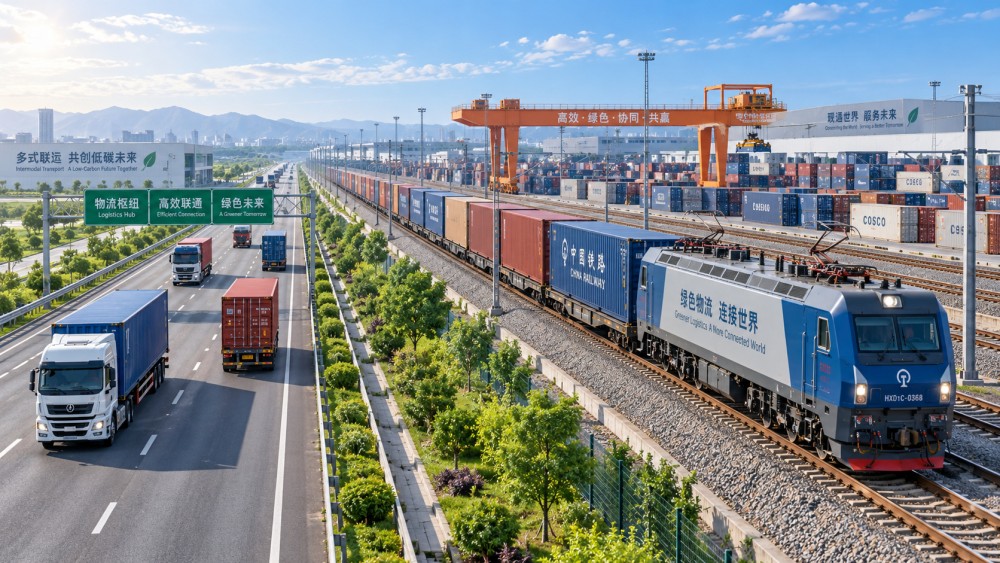
For many supply chains, the practical choice is not rail versus road in isolation. Rail carries the long, high-volume trunk movement, while trucks connect factories, mines, warehouses, ports, terminals, and final customers. The more concentrated the cargo flow, the more compelling rail can become. The more fragmented the delivery network, the more road retains its advantage.
Capacity, reliability, and emissions are useful comparison points because they expose this difference clearly. They also prevent a common mistake: judging transport modes only by quoted freight rates or nominal transit time.
Capacity: Rail Favors Concentrated, Repeating Volume
Rail’s main advantage is its ability to move substantial tonnage or many container units in one scheduled movement. A train can consolidate freight that would otherwise require a large number of truck journeys. That characteristic matters most for commodities and industrial goods with predictable production and consumption patterns, such as minerals, aggregates, grain, steel inputs, chemicals, fuel-related products, or port-bound containers.
Capacity should not be assessed only at the level of a single vehicle or train. The relevant question is how much freight can move through a corridor over a day, week, or season. A well-connected rail corridor with suitable loading facilities, sidings, terminals, and available train paths can support high-volume movement with relatively few departures. This can reduce pressure on road access routes and make planning easier for shippers with stable dispatch volumes.
Road transport has a different kind of capacity. Individual trucks carry less than a train, but they can be assigned to almost any collection point, delivery point, or route that road infrastructure can reach. A shipper can add or remove trucks with comparatively little fixed infrastructure, redirect them during the day, and serve multiple stops on one run. That flexibility is valuable when cargo is spread across many customers or when shipment sizes vary sharply.
The capacity comparison therefore changes by operating model:
- Rail is usually well suited to: recurring full-load movements, long-distance trunk routes, bulk commodities, high-volume port connections, and cargo with a predictable loading schedule.
- Road is usually well suited to: distributed deliveries, smaller shipment sizes, changing destinations, urgent replenishment, construction access, and locations without rail access.
- Combined rail-road transport is often suited to: containerized flows, inland port connections, regional distribution from rail terminals, and supply chains where the long haul is concentrated but the final mile is dispersed.
A high-volume rail option can still underperform if the volume is not sufficiently regular. Loading a train only when enough cargo happens to accumulate may create long dwell times and uncertain departures. Conversely, a road network may handle a large total volume effectively when it is divided across many locations and delivery windows. The question is less about annual freight volume than about whether enough freight is available at the same place, within the same operating window, and for the same destination corridor.
Terminal capability is often the deciding factor. Rail needs effective interfaces: loading loops for bulk freight, container handling equipment, storage space, track access, train assembly capacity, and dependable onward transport. If cargo spends excessive time waiting at either end of the rail journey, the line-haul capacity advantage loses much of its commercial value.
Reliability Depends on the Definition of “On Time”
Road is commonly perceived as the faster and more responsive mode because it offers door-to-door movement. For a direct shipment over a short or medium distance, that can be true. A truck can leave a facility when the load is ready and deliver without an intermediate terminal transfer. This reduces handoffs and makes road especially practical where a customer needs a specific delivery slot.
Yet road reliability is exposed to conditions that can change rapidly: congestion, accidents, roadworks, weather, driver-hour restrictions, border procedures, access limitations, and local delivery constraints. A planned transit time may look attractive while still carrying substantial variability. For a manufacturer operating a tightly timed production line, variability may matter more than average speed.
Rail reliability has a different profile. Rail services operate within a network of timetables, train paths, infrastructure rules, maintenance windows, and terminal processes. When a service is well planned and the rail corridor has adequate capacity, scheduled rail can offer a stable rhythm for recurring flows. The shipper may know days in advance when cargo must be delivered to the terminal and when it will arrive at the receiving hub.
That predictability should not be assumed automatically. Rail networks can be affected by path conflicts, infrastructure maintenance, interchange delays, equipment availability, labor disruption, and congestion at terminals or ports. A missed rail connection can have a larger impact than a delayed truck because the next service may not depart until a later scheduled window. Rail reliability is therefore closely tied to service frequency. A daily or near-daily service gives a supply chain more recovery options than a service operating only once or twice a week.
When comparing reliability, shippers should separate four measures that are often mixed together:
- Transit time: the expected duration from dispatch to delivery.
- Schedule frequency: how often a viable departure is available.
- Arrival consistency: how much actual arrival times vary around the plan.
- Recovery capability: how quickly the network can absorb a missed departure, breakdown, closure, or peak-period disruption.
A road movement may have a shorter average journey but a wider arrival range. Rail may have a longer planned journey but offer a dependable delivery day for a recurring flow. Neither pattern is universally preferable. Perishable products, emergency spare parts, and short-cycle retail replenishment may prioritize fast response. Bulk industrial supply chains may benefit more from a stable schedule that allows inventory, unloading labor, and production consumption to be planned in advance.
Reliability also changes at network boundaries. A truck can normally continue from a rail terminal to a customer site, but that last leg has its own traffic and appointment risks. Likewise, a rail shipment may arrive at a port on time but still face delay if the terminal cannot receive, unload, or release the cargo. A credible mode comparison maps the entire journey, including loading, pre-carriage, terminal dwell, mainline movement, unloading, and final delivery.
Emissions: Rail Has an Advantage, but the Route Still Matters
Rail is widely associated with lower transport emissions per unit of freight moved, particularly for heavy cargo and long distances. The underlying reason is straightforward: one locomotive-led movement can carry a large combined load, and electric rail can use low-carbon power where the electricity system supports it. Even diesel rail can benefit from moving substantial tonnage with fewer vehicles and less rolling resistance than an equivalent collection of trucks.
That does not make every rail movement lower-emission in every circumstance. The comparison depends on load factor, route length, traction type, terminal handling, empty repositioning, and the additional truck legs needed to reach rail facilities. A lightly loaded train, a poorly matched terminal location, or a route requiring extensive detours can weaken the environmental case.
Road freight emissions also vary materially. Vehicle size, engine technology, fuel type, route conditions, congestion, backhaul availability, and payload utilization all affect the result. A fully loaded truck operating efficiently on a direct route is not comparable to an empty or partially loaded truck running through congested urban roads. Similarly, a road operator that reduces empty mileage and improves route planning may cut emissions without changing transport mode.
For decision-making, the appropriate unit is usually the full logistics movement: emissions per tonne or container moved from origin to destination, including terminal activity and first- and last-mile transfers. Looking only at the rail line-haul can overstate the benefit where terminals are distant from the shipper and receiver. Looking only at the truck journey can miss the value of consolidating hundreds or thousands of tonnes onto a rail corridor.
Emissions can also affect future operating resilience. Many organizations face customer expectations, internal reporting requirements, investment screening, or public-policy pressure to understand the carbon intensity of freight. A rail option may therefore have strategic value even when its immediate cost is not the lowest. It can give a shipper an alternative for high-volume lanes, reduce exposure to some road constraints, and support a more credible long-term logistics plan.
Where Simple Comparisons Go Wrong
The most common error is to compare a rail quote with a truck quote while treating terminal costs and inventory effects as secondary details. Those details often determine the outcome. Rail may require handling, storage, packaging adjustments, longer lead-time planning, and coordination with terminal operators. Road may create more variable arrival times, driver availability exposure, road tolls, and a larger operational burden when many vehicles must be scheduled.
Another weak comparison treats freight as if it were interchangeable. Cargo density, handling method, damage sensitivity, hazardous-goods rules, temperature requirements, containerization, loading speed, and unloading infrastructure shape modal suitability. Rail can be highly effective for a commodity moving in dedicated wagons, but less practical for small, mixed consignments that need frequent delivery to many sites. Road can serve specialized cargo well when suitable vehicles are available, yet the economics become harder when a long-distance route needs a continuous stream of heavy loads.
Distance alone is also an incomplete guide. Longer distances often improve rail’s potential because terminal work represents a smaller share of total movement. But a shorter route with a direct rail connection and strong volume may work well, while a long route without dependable rail service may remain road-based. Network geometry, not distance in isolation, should guide the assessment.
A Practical Way to Assess the Best Fit
Before selecting a mode, define the actual lane: origin, destination, weekly volume, shipment size, required delivery window, cargo characteristics, seasonal variation, and the consequences of delay. Then identify the nearest viable rail terminals and estimate the full movement, rather than only the mainline segment.
A useful assessment asks whether enough volume can be committed to a regular rail departure; whether terminal handling will preserve cargo quality and delivery performance; whether service frequency matches production and inventory needs; and whether road transport remains necessary for a significant portion of the route. It should also test disruption scenarios. If a departure is missed, a terminal is congested, or a road leg is delayed, what happens to production, customer service, and working capital?
For researchers and planners, the strongest conclusion is often conditional. Rail tends to offer its clearest advantage where freight is heavy, concentrated, recurring, and moved over a corridor with capable terminals and reliable services. Road remains essential where freight needs direct reach, rapid adjustment, or delivery to many dispersed points. The most durable logistics designs recognize both realities and allocate each part of the journey to the mode that can perform it consistently.
Related News
Related News
- 00
0000-00
Which signaling standards apply to a new U.S. freight rail line? - 00
0000-00
How to assess wheel wear during freight rolling stock maintenance - 00
0000-00
Can digital freight logistics lower costs by reducing empty miles? - 00
0000-00
How bogie condition monitoring can reduce rolling stock downtime - 00
0000-00
How passenger capacity shapes rail equipment selection for metro
Weekly Insights
Stay ahead with our curated technology reports delivered every Monday.