
Automation Logic Errors That Slow High-Throughput Yards





In high-throughput yards, even minor automation logic flaws can trigger cascading delays, equipment conflicts, and hidden capacity losses. For technical evaluators, identifying how control rules, sequencing priorities, and exception handling affect real-world yard flow is essential. This article examines the logic gaps that quietly reduce throughput and explains why precise automation design is critical to operational resilience and asset efficiency.
Why automation logic is becoming a strategic yard issue
Across rail freight terminals, container yards, intermodal hubs, and bulk handling sites, the operating context has changed. Throughput expectations are rising, labor models are shifting toward remote or lean staffing, and asset owners are under pressure to improve energy efficiency without sacrificing reliability. In that environment, automation logic is no longer a hidden engineering detail. It has become a business-level performance lever that directly shapes crane cycles, vehicle dispatch stability, track occupancy, stack density, and recovery speed after disruption.
This shift matters because many yards have already completed their first automation wave. The next bottleneck is not always mechanical speed or installed equipment count. More often, it is the way software rules prioritize moves, allocate machines, release tasks, and manage exceptions under congestion. A terminal may appear fully automated on paper while still losing usable capacity due to conservative interlocks, poor handoff logic, or brittle decision trees that break down outside ideal operating conditions.
For technical evaluators, this creates a new assessment challenge. The question is no longer just whether the automation stack works, but whether its logic remains efficient when demand peaks, routing changes, or mixed equipment states appear simultaneously. The quality of automation logic now influences not only operational output, but also expansion timing, maintenance burden, and the credibility of digital investment programs.
The clearest trend signal: hidden losses are replacing visible failures
The most important industry signal is that yards increasingly suffer from hidden capacity erosion rather than dramatic system collapse. Severe faults still happen, but the more common problem is subtle underperformance: longer queue dwell, unnecessary empty travel, repeated task reshuffling, delayed slot release, and overprotection that blocks safe but productive moves. These issues often go undetected because core systems stay online and safety events remain low, yet the operation never reaches design throughput.
In practical terms, flawed automation logic can slow an entire node through small decisions repeated thousands of times per shift. A sequencing rule that favors task age over travel minimization may generate avoidable cross-yard movement. An exception handler that freezes a whole lane instead of isolating one conflict point can multiply delay. A dispatch engine that ignores downstream stack saturation may create local efficiency while reducing total yard flow.
This is why evaluation methods are changing. Operators are paying closer attention to decision latency, rule transparency, fallback behavior, and recoverability under non-ideal scenarios. The focus is moving from “Does automation exist?” to “Does automation logic preserve throughput when the yard becomes complex?”
What is driving the rise of logic-related throughput losses
Several forces are pushing automation logic to the center of yard performance analysis. First, equipment fleets are more interconnected than before. Cranes, autonomous vehicles, gate systems, train interfaces, and yard management layers now exchange decisions in near real time. That increases coordination value, but it also means that weak logic in one layer can propagate inefficiency across the entire operation.
Second, yard traffic is becoming less predictable. Demand swings, vessel bunching, rail arrival variability, and changing cargo mix make static rule sets less effective. Logic designed for stable flow may perform poorly when priorities shift quickly or when import, export, and transshipment tasks compete for the same resources.
Third, safety and cybersecurity expectations are rising. This often leads to additional permission layers, stop conditions, and system boundaries. These controls are necessary, but if they are implemented without throughput-aware design, the yard becomes technically safe yet operationally rigid. The result is a system that handles nominal cases well but reacts slowly to normal variability.
Finally, more organizations are trying to optimize asset utilization before committing to new capital expenditure. That puts pressure on existing automation logic to unlock capacity from current infrastructure. As a result, software design quality is increasingly evaluated as a substitute for physical expansion in the short to medium term.
The table above shows why automation logic should be treated as a trend indicator rather than a narrow software issue. In many high-volume yards, the difference between acceptable and superior performance now depends on how intelligently the control architecture responds to changing flow conditions.
The logic errors that most often slow high-throughput yards
Not all automation logic flaws have equal impact. Technical evaluators should concentrate on a short list of recurring patterns that repeatedly reduce throughput across terminal and yard environments.
One common issue is rigid priority logic. When task sequencing cannot adapt to congestion, transfer deadlines, or downstream blockage, the system may continue optimizing the wrong objective. It might clear easy moves while urgent ones age into disruption. Another frequent problem is poor exception isolation. Instead of containing one failed move, the logic may suspend a larger work zone, turning a local disturbance into network delay.
A third pattern is fragmented decision-making between systems. Yard management, equipment control, and traffic control may all apply valid local rules, yet together they create contradictory outcomes. For example, one layer minimizes queue length while another maximizes machine utilization, producing oscillation and task churn rather than smooth flow.
Another high-impact weakness is poor state awareness. If automation logic does not accurately interpret temporary equipment degradation, stack occupancy constraints, or train loading sequence dependencies, it may issue technically executable commands that are operationally inefficient. The result is not a fault alarm but a hidden reduction in productive cycles.
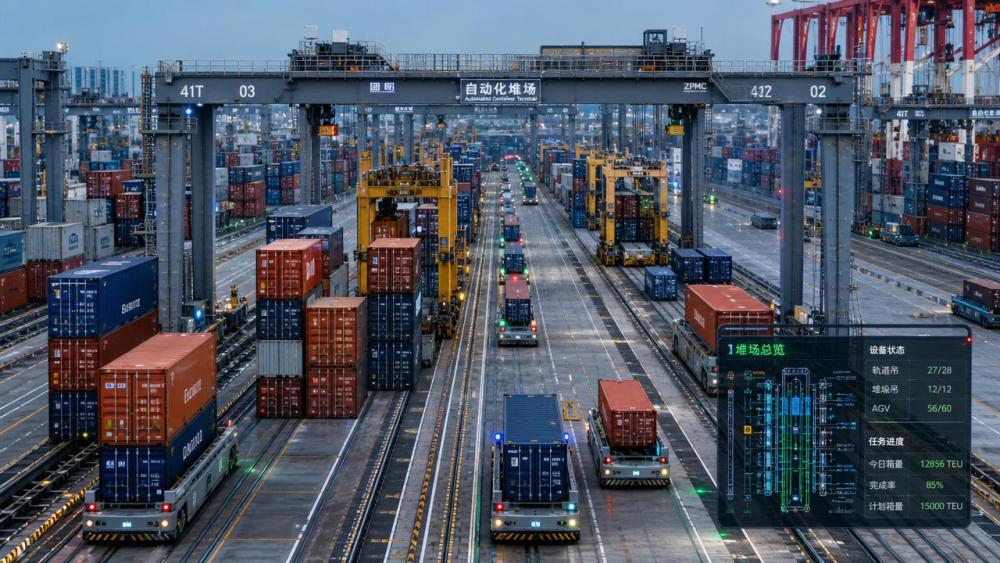
Finally, many yards still rely on fallback logic that is too binary. Systems either stay in full automatic mode or drop to manual intervention with little graceful degradation in between. In modern high-throughput operations, resilient automation logic should support controlled partial autonomy, allowing unaffected areas to maintain flow while operators manage a narrow problem zone.
Who is most affected by weak automation logic
The effects of poor automation logic are not distributed evenly. Operators feel the immediate pain through lower move rates and unstable shift execution, but technical evaluators should also recognize downstream impacts on planners, maintainers, procurement teams, and investment decision-makers.
This broader impact explains why automation logic is increasingly reviewed during acceptance testing, upgrade planning, and digital transformation audits. What looks like a software tuning issue can materially affect labor planning, maintenance scheduling, and future asset purchase decisions.
What technical evaluators should watch as the market matures
As yard automation matures, evaluation criteria are becoming more demanding. It is no longer sufficient to review only nominal throughput tests or isolated equipment benchmarks. Stronger assessment now requires observing how automation logic behaves during mixed-priority periods, degraded equipment states, communication lag, and sudden task reallocation. In other words, resilience has become part of performance.
One useful signal is how often the system needs human override to maintain acceptable flow. Frequent intervention does not always indicate poor operators; it often reveals that the automation logic cannot reconcile real-world ambiguity efficiently. Another important signal is whether performance drops sharply or gradually under stress. Abrupt collapse suggests brittle rule architecture, while graceful decline usually indicates better exception design and more robust prioritization.
Evaluators should also examine the transparency of decision rules. If no one can clearly explain why tasks are being sequenced a certain way, optimization becomes difficult and accountability becomes blurred. In high-volume environments, opaque automation logic may hide inefficiency for long periods because operators adapt around the system instead of fixing the logic itself.
How to judge whether a yard’s automation logic is future-ready
A future-ready yard does not depend on perfect conditions. Its automation logic should support adaptive prioritization, bounded exception zones, coordinated handoffs, and measurable fallback states. The best designs usually share four qualities: they are context-aware, modular, explainable, and easy to tune without destabilizing the whole operation.
Context-aware logic uses operational state, not just static rules. It understands whether congestion is building, whether downstream capacity is constrained, and whether a fast local move would create a slower system-wide outcome. Modular logic matters because large yards evolve over time. If one update requires revalidating every interaction from scratch, improvement cycles become expensive and slow.
Explainability is equally important. Technical evaluators, operators, and suppliers need a common basis for discussing why the system made a decision. Without that, root-cause analysis becomes political rather than technical. Finally, tunability matters because throughput demands change. Logic that cannot be adjusted safely will age quickly, even if it performs well at commissioning.
Practical next-step judgments for operators and asset owners
For organizations reviewing automation performance today, the most useful next step is to separate physical constraints from logic constraints. If queues, rehandles, or dead travel are rising, do not assume new equipment is the first answer. Start by identifying whether the automation logic is creating avoidable delay through sequencing, permissions, zone protection, or poor exception recovery.
It is also wise to shift testing practices. Acceptance and upgrade reviews should include stress scenarios, not only standard flow cases. Evaluate how the yard behaves during batch arrivals, resource imbalance, temporary equipment degradation, and communication interruptions. A system that passes ideal-condition tests may still fail to protect throughput in the conditions that matter most commercially.
Another strong practice is to create a shared logic governance model. Operations, controls engineering, software teams, and maintenance should all participate in rule review. Many persistent throughput losses come from valid but disconnected assumptions embedded in different layers of the system. Governance reduces that fragmentation and helps automation logic evolve with business priorities.
Conclusion: the next competitive edge is not just automation, but better automation logic
The market direction is clear: high-throughput yards are moving from automation adoption to automation refinement. As this shift continues, automation logic will play a larger role in determining whether rail terminals, container yards, and bulk logistics hubs can absorb volatility without losing capacity. The most important change is that hidden decision rules now shape visible business outcomes.
For technical evaluators, the priority is to judge not just system functionality, but throughput resilience under real conditions. If an enterprise wants to understand how this trend affects its own yard, it should begin with a focused review of sequencing priorities, exception handling, cross-system handoffs, and fallback modes. Those questions often reveal whether the next performance gain requires more hardware, or simply better automation logic.
Related News
Related News
- 00
0000-00
How port machinery systems reduce container handling bottlenecks - 00
0000-00
How smart port logistics systems reduce container dwell time - 00
0000-00
How transport equipment intelligence analysis identifies bottlenecks - 00
0000-00
How rail technology advancements are reshaping signaling standards - 00
0000-00
What is driving growth in the global EMU market size?
Weekly Insights
Stay ahead with our curated technology reports delivered every Monday.