
How to Spot Weak Links in a Global Supply Chain Early





In a global supply chain, weak links rarely fail without warning—they usually leave small signals first. For quality control and safety managers, spotting those signals early can prevent delays, compliance risks, equipment disruption, and costly downstream failures. This article outlines practical ways to identify vulnerable nodes across transport, handling, and coordination processes before they escalate into wider operational problems.
What does a “weak link” in a global supply chain really mean?
In practical terms, a weak link is not only a failing supplier or a late shipment. In a global supply chain, it can be any node, process, interface, or decision point that is more fragile than the rest of the network. That includes raw material sourcing, rail freight transfer, urban distribution, port handling, equipment uptime, customs documentation, maintenance discipline, and even communication between planning teams.
For quality control and safety managers, weak links are especially important because they often appear first as quality variation, near-miss events, inconsistent inspections, incomplete traceability, or unusual downtime patterns. In other words, supply chain risk is often visible before it becomes a headline disruption. A damaged wagon component, a crane with rising unplanned stoppages, or a terminal using outdated operating procedures can all become early indicators of larger instability.
This matters in high-volume transportation environments, where rail systems, port cranes, and bulk handling equipment are closely tied to delivery reliability. TC-Insight’s industry focus reflects this reality: when transport assets and logistics nodes lose efficiency or safety consistency, the broader global supply chain feels the impact quickly.
Why do weak links usually appear before a major disruption happens?
Most failures are preceded by a pattern of small deviations. A supplier misses one reporting milestone. Cargo dwell time rises slightly at a port. Maintenance records become less complete. Damage claims increase, but only in one lane or one shift. None of these signals alone proves that the global supply chain is in trouble, yet together they often show that resilience is declining.
The reason is simple: operational systems degrade gradually before they break visibly. Quality standards may still be formally in place, but execution becomes uneven. Safety controls may still exist, but response times slow down. Transport equipment may still be running, but hidden wear, calibration drift, or software faults begin to narrow the margin for error.
For teams in rail logistics, urban transit-linked freight movements, container terminals, or bulk transfer operations, this early phase is the best time to act. Once disruption reaches the customer-facing stage, options become more expensive. Early detection supports better contingency planning, better vendor conversations, and more targeted preventive maintenance.
Which warning signs should quality and safety managers watch first?
The most useful warning signs are usually not dramatic. They are measurable inconsistencies across time, site, or partner. In a global supply chain, early-risk visibility depends on comparing what should be stable with what is starting to drift.
Start with six practical signal groups:
- Rising variability in delivery lead times, not just average delay
- Repeat nonconformities in inspections, packaging, loading, or documentation
- Growing equipment downtime in rail, terminal, or bulk handling assets
- Lower reporting discipline from suppliers, carriers, or subcontractors
- Higher incident frequency during handoffs between transport modes or facilities
- Mismatch between operational data and field observations
The key is to treat repeated minor anomalies as a pattern, not as isolated exceptions. For example, if container handling damage remains low overall but spikes during a specific crane shift, that may point to training gaps, automation tuning issues, or maintenance timing problems. If rail shipment arrival remains acceptable on average but variance increases sharply, it may signal congestion, asset reliability decline, or poor coordination at a transfer hub.
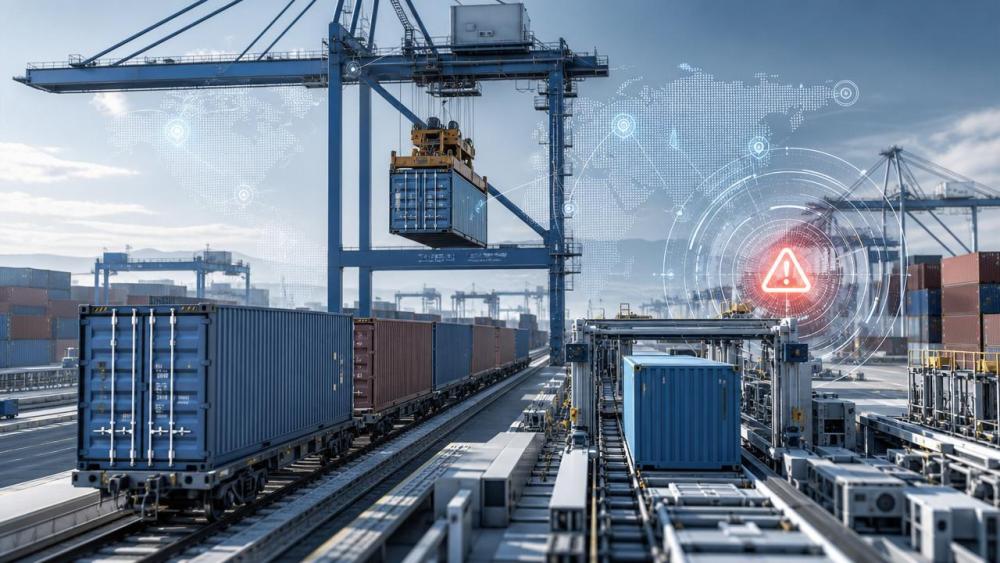
Where are the most common weak points in a global supply chain network?
Weak points are often found at interfaces rather than within a single department. For quality control and safety leaders, that means focusing on transfer zones, outsourced functions, and high-dependency assets. In a global supply chain, the most common vulnerable areas include:
1. Supplier-to-operator handoffs
This includes incomplete certificates, late test records, packaging inconsistencies, or unclear accountability when defects are found after receipt. Weak supplier controls often stay hidden until a high-volume shipment exposes them.
2. Port and terminal transfer points
Container cranes, yard systems, and remote-control workflows can become bottlenecks when maintenance planning, operator training, and software scheduling are not aligned. Small handling errors can cascade into vessel delays, cargo damage, and missed rail connections.
3. Rail and inland transport links
Rolling stock reliability, brake system condition, bogie performance, and route capacity all matter. If inspection cycles are rushed or spare parts visibility is weak, transport reliability can deteriorate before dispatch teams fully recognize it.
4. Bulk handling systems
Conveyors, stackers, reclaimers, and loading systems support continuous flow, so even brief interruptions can create broad disruption. Frequent resets, abnormal vibration, dust-control failures, or inconsistent material flow are often early warnings.
5. Data and coordination layers
A global supply chain may appear physically stable but still be fragile if planning data is outdated, event reporting is delayed, or different systems do not share the same operational truth. Many preventable incidents are rooted in poor information flow rather than equipment failure alone.
How can you judge whether a weak signal is operational noise or a real risk?
A useful test is to ask three questions: Is the signal repeating? Is it spreading? Is it occurring near a critical node? If the answer to two or more is yes, the issue deserves structured review. Quality and safety managers should avoid both extremes: ignoring small anomalies and overreacting to every one-time event.
The best approach is to evaluate weak signals against business impact, safety exposure, and recoverability. A small defect at a low-volume site may be manageable. The same defect in a major rail corridor, automated port terminal, or bulk export facility may be serious because consequences multiply quickly.
What tools and routines help detect weak links earlier?
Early detection is usually the result of disciplined routines rather than one advanced dashboard. Technology helps, but only if the organization knows what to monitor and how to escalate it. In a global supply chain, the most effective routines combine data review with field validation.
Useful methods include trend-based KPI monitoring, supplier scorecards, maintenance exception tracking, route-level variance analysis, safety observation programs, and periodic cross-functional risk reviews. For transport-intensive sectors, this should also include asset-health indicators from locomotives, rolling stock, port machinery, signaling interfaces, and bulk handling equipment.
One strong practice is to create an “early warning layer” separate from standard monthly reporting. Monthly reports often smooth out short-term deviations. Weak links, however, often show up as sudden changes over days or shifts. A weekly or even daily exception view is more useful for operational risk control.
Another effective step is to map critical nodes by dependency. Ask which facilities, suppliers, carriers, or systems would create disproportionate disruption if performance dropped by 10% for two weeks. This helps teams focus on high-impact vulnerabilities instead of monitoring everything with equal intensity.
What mistakes cause companies to miss a weak link in the global supply chain?
A common mistake is relying too much on average performance. Averages can hide instability. A lane that is usually on time but occasionally fails badly may be riskier than one that is consistently slower but predictable. Another mistake is separating quality, safety, and logistics data into different silos. Weak links often sit exactly where those datasets should connect.
Companies also miss early warnings when they focus only on tier-one partners. In a global supply chain, hidden exposure often comes from subcontracted maintenance teams, secondary material sources, inland transfer operators, or software vendors supporting terminal automation. If visibility stops at the first contract layer, risk assessment remains incomplete.
Another frequent error is treating compliance as proof of resilience. A supplier may pass formal audits and still show operational fragility through turnover, delayed CAPA closure, or weak process discipline. Likewise, equipment may meet technical standards while still producing unstable output due to aging components or poor calibration practices.
How should quality and safety managers respond once a weak link is identified?
The first step is to define the exposure clearly: what can fail, how fast, and with what downstream impact? Once that is known, response should match the risk profile. Not every weak link requires a major redesign. Some need tighter inspection frequency, revised loading procedures, backup suppliers, spare-part protection, or better event reporting rules.
In high-dependency environments such as rail logistics hubs, automated terminals, and bulk throughput systems, response plans should include both operational containment and structural correction. Operational containment protects current flow. Structural correction reduces repeat exposure. For example, if a terminal crane shows growing control faults, containment may involve revised dispatch allocation and maintenance standby, while correction may require software review, component replacement, and operator retraining.
It is also important to assign ownership across functions. The global supply chain rarely fails because one team ignores a problem entirely; it fails because each team assumes another team owns it. A clear risk owner, review date, and closure metric make early intervention more effective.
What should you confirm before improving resilience across the network?
Before launching a wider improvement program, confirm five basics. First, identify which nodes are mission-critical to service continuity. Second, verify which indicators provide the earliest practical signal of decline. Third, check whether supplier, transport, equipment, and safety data can be reviewed together. Fourth, test how quickly teams can escalate and decide. Fifth, confirm whether contingency resources are real, current, and reachable.
For organizations working across railways, urban transit-linked assets, ports, and bulk logistics, resilience should not be treated as a generic concept. It should be tied to actual throughput behavior, maintenance maturity, automation reliability, and transfer-node discipline. That is where strategic intelligence becomes useful: not just collecting news, but translating equipment trends and logistics node shifts into decision-ready signals.
Final FAQ takeaway: what is the smartest next step?
The smartest next step is not to wait for a major breakdown to validate concern. In a global supply chain, the earlier you investigate recurring deviations, the cheaper and safer the correction usually is. For quality control and safety managers, the goal is to build a repeatable method: detect signal, verify pattern, rank criticality, contain exposure, and correct the root cause.
If you need to further confirm a specific solution, review direction, evaluation cycle, or cooperation model, start by asking practical questions: Which transport nodes create the highest downstream risk? Which equipment classes show rising instability? Which suppliers or operators have weak corrective-action discipline? Which data gaps prevent early warning? And which fallback plans are tested rather than assumed? Those questions create a stronger basis for resilience across the entire global supply chain.
Related News
Related News
- 00
0000-00
How port machinery systems reduce container handling bottlenecks - 00
0000-00
How smart port logistics systems reduce container dwell time - 00
0000-00
How transport equipment intelligence analysis identifies bottlenecks - 00
0000-00
How rail technology advancements are reshaping signaling standards - 00
0000-00
What is driving growth in the global EMU market size?
Weekly Insights
Stay ahead with our curated technology reports delivered every Monday.