
Evaluating Smart Logistics Automation Platforms: Integration, Data, and Scalability





At a container terminal, a rail freight yard, or a bulk handling facility, automation is rarely a single system waiting to be switched on. It is a living operational layer that must coordinate machines, people, cargo, timetables, safety rules, and commercial commitments—often across assets with service lives measured in decades.
That is why selecting a smart logistics automation platform cannot be reduced to a feature checklist. Technical evaluators need to establish whether a platform can work with the equipment and information landscape already in place, create trustworthy decisions from imperfect operational data, and grow without turning every new terminal, rail node, or warehouse into a separate integration project.
For high-volume transportation networks, the central question is practical: Will this platform improve control where the operation is most exposed to delay, variability, and risk? The answer depends less on a polished dashboard than on integration depth, data discipline, scalability, and the vendor’s understanding of mission-critical logistics environments.
Begin with the operating reality, not the software demonstration
Automation platforms are often evaluated in controlled demonstrations where data is clean, workflows are linear, and equipment behaves exactly as expected. Real operations are less forgiving. A port may experience a vessel delay that compresses yard activity into a few hours. A rail terminal may need to reconcile late-arriving wagons with fixed departure paths. A mine or bulk terminal may face material variability, belt interruptions, weather constraints, and maintenance windows at the same time.
Before comparing suppliers, evaluators should define the operational decisions the platform must support. These are more useful than generic requirements such as “real-time visibility” or “AI-enabled scheduling.” Examples include:
- Optimizing crane, automated guided vehicle, stacker, or locomotive assignments when conditions change mid-shift.
- Sequencing container, wagon, or bulk-material movements to protect throughput while respecting safety and equipment constraints.
- Predicting congestion at transfer points before it affects vessel turnaround, train departure, or downstream inventory.
- Balancing energy consumption, equipment availability, and service-level commitments across a high-demand operating period.
- Giving controllers a clear override path when automated recommendations conflict with local conditions.
This exercise reveals an important distinction. A platform built mainly for reporting may show that congestion occurred. A true automation and orchestration platform should help operators decide what to do next—and should make the reasoning behind that recommendation visible enough to earn their trust.
Integration is the first serious test
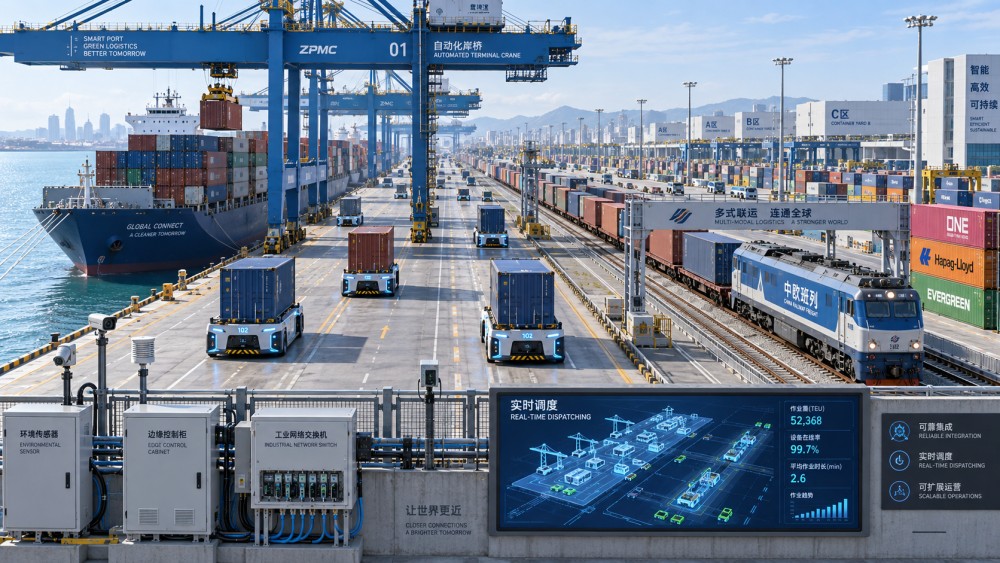
In logistics automation, integration is not a technical appendix. It is the operating foundation. The platform may need to exchange data with terminal operating systems, warehouse management systems, transportation management systems, rail traffic control environments, enterprise resource planning tools, maintenance systems, gate systems, customs interfaces, and customer portals. At the equipment level, it may also need connectivity with programmable logic controllers, crane control systems, conveyor controls, weighbridges, signaling interfaces, sensors, telematics units, and edge devices.
The question is not simply whether the vendor “supports integration.” Nearly every platform claims that. The meaningful questions are more specific.
Assess the integration architecture
Request a clear explanation of how information moves between systems. A mature architecture usually separates operational applications from integration services, uses documented APIs, supports event-driven messaging where rapid changes matter, and avoids forcing all connected systems into a proprietary data model. This matters when a future acquisition, terminal expansion, or equipment modernization introduces technology from another supplier.
For ports and rail-linked logistics sites, event-based integration deserves particular attention. A status update such as “crane unavailable,” “wagon arrived,” “container cleared,” or “conveyor fault detected” should be available quickly enough to influence the next operational decision. Batch updates can be acceptable for finance or long-horizon reporting, but they are often inadequate for dispatching and live resource coordination.
Look beyond the easy interfaces
Most vendors can connect to a modern enterprise application through a standard API. The difficult work often sits at the edge: legacy controllers, mixed equipment fleets, aging serial devices, inconsistent sensor tags, and protocols that were never designed for broad data sharing. Ask how the platform handles industrial connectivity, protocol translation, intermittent network conditions, time synchronization, and data buffering when communications fail.
For railway and urban transit-adjacent environments, evaluators should also understand the boundary between operational technology and information technology. A platform may consume selected status data from signaling, traction, or passenger systems, but it should not create uncontrolled pathways into safety-critical environments. Segmentation, access controls, auditability, and carefully governed interfaces are essential.
Test for integration ownership
Integration projects can stall when responsibilities are vague. One supplier blames the API, another blames source-data quality, and the operator is left coordinating the dispute. During procurement, identify who owns interface design, data mapping, test environments, exception handling, and post-go-live monitoring. A credible implementation plan will include these responsibilities rather than treating them as customer-side details.
Data quality determines whether “intelligence” is useful
A smart logistics automation platform is only as reliable as the operational picture it constructs. Yet logistics data is frequently fragmented: a container may have one identifier in the terminal system, another in a shipping-line message, and a third in a customer portal. Equipment states may be reported differently by different manufacturers. Rail schedules may change faster than planning systems can refresh. In bulk handling, material quality data, stockpile position, and conveyor status may arrive at different intervals and with different confidence levels.
Evaluators should ask the vendor how the platform manages these realities rather than assuming the data will become clean after deployment. The strongest solutions make data lineage visible: users can see where a key status originated, when it was last updated, and whether it is measured, inferred, or manually entered. This is especially important when a platform recommends rescheduling a train, repositioning a crane, or changing a loading sequence.
Establish a practical data model
The platform should accommodate a common view of core operational entities—assets, locations, jobs, shipments, orders, equipment states, constraints, and events—without requiring every source system to be replaced. A common model does not mean erasing local detail. It means ensuring that a “berth,” “rail siding,” “yard block,” “stockpile,” or “maintenance hold” has a consistent meaning wherever it is used in planning and execution.
Pay attention to master-data governance. Who creates and approves location codes? How are equipment changes reflected? What happens when a new crane, rail spur, or warehouse zone is added? Small inconsistencies can create large planning errors when an automation engine is acting across thousands of moves.
Differentiate analytics from operational decisioning
Historical analytics explains trends. Real-time decisioning acts within a moving situation. Both are valuable, but they have different technical requirements. A dashboard showing average truck turnaround time may help management identify a problem. An operational engine that recognizes gate congestion, checks yard capacity, evaluates equipment availability, and proposes a revised appointment sequence has a more direct role in automation.
Ask whether algorithms can incorporate constraints that matter in the field: safe separation rules, equipment capabilities, labor rosters, energy limits, cargo priorities, maintenance restrictions, weather thresholds, and contractual cut-off times. Equally important, ask whether users can inspect and adjust those rules. A black-box recommendation may be mathematically elegant but operationally unusable if supervisors cannot understand why it was made.
Scalability is more than handling more transactions
When technical teams discuss scalability, they often focus on volume: messages per second, number of users, or number of connected devices. Those measures matter, particularly in automated ports and dense intermodal hubs. But logistics scalability has additional dimensions.
A platform must scale across sites, supporting different layouts and local operating practices without becoming a collection of custom code branches. It must scale across asset types, from rubber-tired gantry cranes and automated stacking cranes to conveyors, locomotives, yard tractors, and inspection devices. It must also scale across decision horizons: a controller may need a response in seconds, while a network planner needs to examine capacity several weeks ahead.
Prove multi-site governance without losing local control
Global operators need a shared view of performance, cybersecurity posture, data definitions, and platform releases. Local teams still need the ability to respond to site-specific traffic patterns, labor agreements, regulatory rules, and equipment constraints. A scalable platform provides both: centrally governed templates and interfaces, alongside configuration boundaries that let facilities operate realistically.
During evaluation, ask how new sites are onboarded. Can a proven process model be reused? Which elements are configurable, and which require custom development? How are upgrades tested so that a change requested by one terminal does not interrupt another? These questions expose whether “enterprise-ready” means genuinely repeatable deployment or simply a large installation.
Consider edge resilience and degraded-mode operations
High-volume logistics cannot always wait for cloud connectivity. A remote terminal, rail yard, or bulk site may experience network disruption, and local equipment control must remain safe and coherent. The preferred design depends on the use case, but evaluators should understand what continues at the edge, what is synchronized later, and how conflicts are reconciled after communications return.
Resilience also includes operational fallback. If optimization services are unavailable, can dispatchers continue with a safe manual or rules-based mode? Is there a controlled way to pause automation, validate the situation, and resume? In critical transport environments, graceful degradation is often more valuable than maximum automation on paper.
Security, safety, and accountability belong in the selection scorecard
Connecting cranes, rail assets, yard systems, enterprise data, and remote users creates a broader attack surface. Cybersecurity therefore cannot be assessed only through a corporate IT questionnaire. Technical evaluators should review identity management, role-based permissions, encryption, network segmentation, logging, vulnerability management, patching practices, and third-party access controls.
For operations where automated recommendations affect movement authority, lifting sequences, or interactions between people and machinery, safety governance is equally important. The platform should support clear approval workflows, alarm handling, traceable configuration changes, and audit records. It should be explicit about what it controls directly, what it recommends, and what must remain under human authorization.
A useful procurement test is to walk through a difficult incident: a network outage during peak loading, a sensor reporting contradictory positions, an unexpected equipment lockout, or an operator challenging an algorithmic decision. The supplier’s response will reveal more than a standard security presentation.
A disciplined evaluation path reduces expensive surprises
Rather than selecting a platform based on broad claims, build a scorecard around real operational scenarios. Invite shortlisted vendors to demonstrate how their system manages the same scenario using representative data and constraints. Require them to show exceptions, not only the ideal workflow. Evaluate the quality of integration evidence, configuration tools, audit trails, and operator experience alongside optimization capability.
A phased pilot can be valuable, but it should test a meaningful control loop. For example, connect live equipment and yard events, generate operational recommendations, allow dispatcher review, and measure whether the process can be sustained through shift changes and abnormal conditions. A pilot that only visualizes data may prove connectivity, but not automation value.
Finally, assess the long-term operating model. Determine who will manage rules, data quality, interfaces, algorithm changes, user training, and release testing. Smart logistics automation is not a one-time deployment; it is a capability that must evolve with network demand, asset renewal, decarbonization objectives, and changing service expectations.
The decision: choose a platform that can grow with the network
The best smart logistics automation platform is not necessarily the one with the longest feature list. It is the one that can connect reliably to the systems and equipment that matter, turn operational data into explainable action, and expand from a single use case to a coordinated transport network without compromising safety or control.
For technical evaluators in ports, rail freight, urban transit supply chains, and bulk logistics, this means looking beneath the interface. Integration architecture, data lineage, edge resilience, multi-site governance, and human accountability are the details that determine whether automation becomes a dependable operating layer or another isolated application.
As global transportation systems become more interconnected, the strongest decisions will be made by organizations that evaluate automation with the full movement of goods in mind—from machine signals at the edge to the network-level choices that shape capacity, energy use, and customer reliability.
Related News
Related News
- 00
0000-00
How rail logistics in the Middle East is reshaping freight corridor capacity - 00
0000-00
What railway rolling stock market analysis reveals about fleet demand - 00
0000-00
How axle load limits shape mainline railway freight capacity - 00
0000-00
How to match ship loaders to bulk terminal throughput targets - 00
0000-00
How high speed rail system standards shape CBTC interoperability
Weekly Insights
Stay ahead with our curated technology reports delivered every Monday.