
How Often Should Remote-Control Crane Systems Be Inspected?





Remote-control crane systems should receive visual and functional checks before each shift or use, with detailed inspections scheduled according to the manufacturer’s instructions, applicable regulations, and operating risk. Additional checks are needed after damage, repairs, control-system changes, abnormal behavior, or prolonged storage. There is no single monthly or annual interval that is correct for every crane and remote-control installation.
At a container terminal or bulk-handling facility, a transmitter may look serviceable while a damaged switch, unreliable communication link, or incorrect control assignment creates a serious hazard. The practical answer to “How often should remote control crane systems be inspected?” is therefore a layered schedule: routine operator checks, planned technical inspections, and event-triggered verification. Each layer addresses problems that the others can miss.
What inspection schedule should a site use?
Start with the instructions for the crane and its installed remote-control equipment, then confirm the requirements that apply to the equipment and jurisdiction. A crane’s general inspection schedule does not automatically cover every transmitter, receiver, network connection, or safety-related control function.
The following framework helps organize the work. It is not a substitute for prescribed inspection intervals or an approved maintenance plan.
Do not treat “annual inspection” as permission to ignore the remote system between annual visits. Where a yearly examination is required, it remains separate from checks needed during normal operations. Similarly, a successful morning check does not justify continued use after a fault appears later in the shift.
What belongs in the pre-shift check?
The operator’s check should be short enough to perform consistently but specific enough to reveal meaningful defects. Use a written procedure matched to the actual system rather than a generic “remote works” entry.
- Confirm identity: Verify that the transmitter or workstation is assigned to the intended crane and that identification markings are readable.
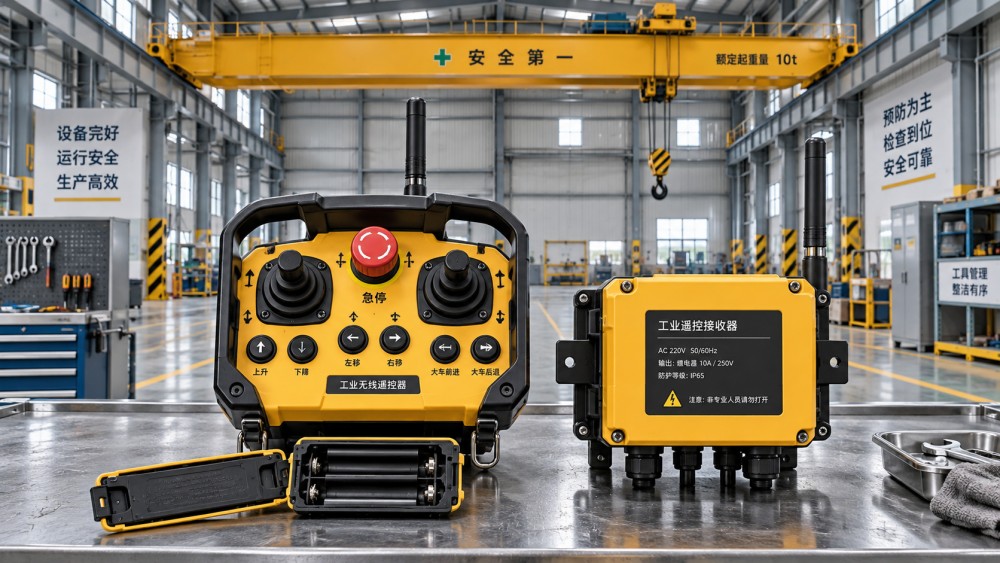
- Inspect accessible hardware: Look for cracked housings, damaged buttons or joysticks, loose external parts, damaged antennas, and signs of water entry.
- Check power condition: Confirm adequate battery charge, secure battery retention, and normal status indications. Remove damaged or swollen batteries from service under the approved procedure.
- Review controls: Check for sticking, loose, or damaged controls and verify that motion controls return to their intended neutral position.
- Observe system status: Investigate communication warnings, unresolved alarms, or inconsistent ready indications before enabling motion.
- Verify prescribed functions: Test control response, emergency-stop operation, and other required safety functions using the manufacturer-approved method.
Functional testing must take place in a controlled area with personnel clear and the crane in the specified safe condition. Never improvise a loss-of-signal test with a suspended load, disconnect safety circuits, or create a hazardous movement merely to see whether protection works. Some tests belong to trained maintenance personnel rather than operators.
A remote command check should confirm the intended motion and direction, not just that something moves. Unexpected direction, continued motion after release, or a command affecting the wrong crane requires immediate withdrawal from operation.
How are detailed inspection intervals determined?
A technical inspection goes beyond the external condition of the handheld controller. Depending on the installation, it may include receiver enclosures, electrical connections, cable entries, power supplies, control interfaces, diagnostic records, and the integrity of safety-related functions. Remote-operated cranes using control rooms may also require checks of operator interfaces, cameras, communication networks, and control-transfer arrangements.
These inspections should be performed by personnel competent for the equipment and the assigned work. Internal examinations require appropriate isolation and electrical safety measures; an operator’s routine check is not authorization to open a live receiver cabinet.
To establish the interval, work through the following decisions:
- Identify mandatory requirements. Determine which inspection and examination rules apply to the crane type, operating location, and installation.
- Review all relevant manuals. Include the crane, remote system, and integrated control equipment. Resolve conflicting instructions through the responsible engineering or maintenance authority.
- Assess exposure and duty. Consider operating hours, control actuations, environmental conditions, and how equipment is handled.
- Use defect history. Recurring switch faults, moisture problems, or communication alarms may justify shorter intervals and corrective work.
- Document the decision. Record the interval, inspection scope, responsible role, acceptance criteria, and conditions that trigger an earlier inspection.
Monthly, quarterly, or other calendar intervals may appear in site maintenance plans, but none should be presented as a universal requirement. Where manufacturer guidance specifies operating-hour or cycle-based maintenance, track those measures alongside calendar time. A heavily used crane can reach a service threshold long before a calendar appointment.
Which operating conditions call for more frequent attention?
Salt spray at a coastal terminal can attack connectors and enclosure hardware. Dust in a bulk-material facility can contaminate controls or obscure indicators. Rain, condensation, vibration, temperature extremes, and rough handling can accelerate deterioration even when the remote system has an enclosure rating suitable for the application.
An enclosure rating is not proof that seals remain intact after a drop or years of service. Check exposure against the manufacturer’s limits, and investigate damaged covers, loose cable glands, or recurring condensation rather than simply increasing inspection frequency.
High-duty operation also changes the maintenance burden. Frequent joystick movements, repeated battery changes, and continuous shift coverage can produce wear that is not obvious during occasional inspections. Shorten the relevant inspection interval when evidence supports it, and address the cause: storage practices, unsuitable charging arrangements, worn controls, or environmental protection may need improvement.
Communication reliability deserves separate attention. Repeated dropouts can relate to interference, damaged antennas, power instability, or network problems. An earlier inspection should investigate the fault; it should not become a routine exercise in resetting the system until production resumes.
Does an incident mean inspecting immediately?
Yes, when the event could affect safe operation. Do not wait for the next planned inspection after a transmitter is dropped, crushed, immersed, or visibly damaged. The same applies to uncontrolled motion, delayed stopping, incorrect crane selection, unexplained command behavior, or failure of an emergency-stop function.
Remove the affected system from service and prevent unintended reuse under the site procedure. Record what happened, including alarms, operating mode, and observed behavior. Preserve diagnostic information where available; repeated resets can make an intermittent fault harder to investigate.
Inspection and verification are also needed after relevant component replacement, wiring changes, software or firmware updates, receiver reconfiguration, and changes to transmitter pairing. The scope should match the change. Replacing a battery does not require the same validation as changing a safety-related controller, but both require the appropriate readiness checks.
Following repairs, verify the affected functions and any related safety functions before release. A replacement transmitter that powers up successfully is not necessarily correctly assigned, configured, or approved for that crane.
What should happen when a check fails?
A failed safety-related check is a stop-work condition, not a reminder for the next service visit. Keep the crane or affected remote-control mode unavailable until the fault is assessed and the required corrective work and verification are complete.
The response to a non-safety defect depends on its effect and the approved acceptance criteria. An unreadable crane identification label, for example, can create a selection risk even though the radio link works. Avoid classifying faults as “cosmetic” without considering their operational consequences.
Do not bypass interlocks, defeat warning functions, or tape a sticking control into position. Switching to local control is not automatically an acceptable workaround: the alternative mode must be permitted, functional, and suitable for the work, with the fault assessed and control transfer managed correctly.
Intermittent defects require particular care. A controller that passes one retest after failing earlier has not necessarily been repaired. Maintenance should identify the cause or apply an approved diagnostic and release procedure rather than treating a temporary disappearance as proof of safety.
What inspection records are useful?
Record enough information to distinguish one device and inspection from another. Include the crane identifier, transmitter or workstation identifier, date, inspector, checks performed, defects, action taken, and release status. For technical work, retain relevant configuration details and test results.
Separate “visual check completed” from “functional test passed.” A single tick box can conceal the fact that a safety function was not tested or that an operator had no safe opportunity to perform the required check.
Review records for patterns: recurring low-battery shutdowns, damaged controls, water entry, or repeated communication faults can reveal that the current inspection interval or maintenance strategy is inadequate. Increasing inspection frequency helps detect deterioration, but it does not replace correcting a known design, installation, or handling problem.
Do spare remotes and stored systems need inspection?
Yes. A spare controller should remain identifiable, protected, and maintained according to its instructions. Before use, confirm compatibility, assignment, battery condition, configuration, and the required functional checks. Do not assume a spare is ready merely because it has been unused.
After a prolonged shutdown, inspect for storage-related deterioration, moisture, corrosion, battery problems, and changes made while the crane was inactive. The return-to-service scope should reflect storage conditions, shutdown duration, and maintenance performed.
A practical schedule therefore states more than a date: it identifies what must be checked before operation, what requires technical examination, and which events cancel the previous clearance to use the system. That distinction keeps inspection frequency connected to the crane’s actual condition rather than the calendar alone.
Have questions about the global trade trends discussed here, or planning your expansion and supply chain strategy? Leave a message below and let the trade experts at TTC-Insight guide you.
We respect your privacy. Your information is strictly confidential.
Related News
Related News
- 00
0000-00
How public funding shapes the urban rail transit market - 00
0000-00
How do terminal operations systems coordinate crane scheduling? - 00
0000-00
Evaluating Skeletal Container Chassis Capacity for Loaded Boxes - 00
0000-00
How much outreach does a container terminal crane need? - 00
0000-00
Which rail safety technology standards apply to CBTC systems?
Weekly Insights
Stay ahead with our curated technology reports delivered every Monday.