
Port Crane Automation and Remote Operations: Planning Safe Control Handover





A container is suspended above the transfer lane when the remote operator’s video feed freezes. The crane controller still has a valid motion command, the terminal operating system expects the move to finish, and a local technician is preparing to take control. At that moment, the important question is not where the controls are located. It is who has authority, what information remains trustworthy, and which movements are still permitted.
For project managers delivering port crane automation and remote operations, control handover must be designed as an operational safety function—not treated as a workstation feature. A dependable plan defines operating modes, operator readiness, communication integrity, interlocks, and responses to interrupted connections. Through TC-Insight’s focus on terminal automation and logistics equipment, this article examines how engineering leads can turn remote-control capability into a controlled, auditable process before commissioning.
Start with authority, not the control-room layout
Moving operators from crane cabins into a remote operations center changes more than ergonomics. It separates the person commanding movement from the machine, the load, and the surrounding work area. Cameras, networks, software, and procedural coordination now carry information previously available through direct observation.
Remote control and automation also mean different things. In remote manual operation, a person issues motion commands from another location. In automated operation, a controller executes a defined task within an approved operating envelope. Many terminals combine both: automation handles routine travel, while an operator manages exceptions or selected positioning tasks.
The handover plan must therefore answer three questions for every transition:
- Who may command motion? Identify the authorized station or automated controller, including any restrictions by axis or operating zone.
- Who may permit operation? Distinguish movement authority from supervisory approval, maintenance access, and terminal dispatch.
- What can override or inhibit motion? Define safety functions and stop paths independently of normal control ownership.
A useful starting principle is that each controllable function has one unambiguous command owner at a time. Safety-related stop functions must remain effective as required by the risk assessment; they should not disappear because another station owns normal movement control. Where authority is divided between functions, document the boundaries and prevent incompatible commands.
Build a mode-and-transition map for the actual crane
A ship-to-shore crane, a rail-mounted gantry, and a rubber-tired gantry do not share identical operating constraints. Vessel movement, stack geometry, truck interaction, travel routes, and personnel access all affect whether a transition is acceptable. Avoid copying a generic “local/remote/auto” selector diagram into the project specification.
Instead, map the operating states against the crane’s tasks and foreseeable interventions.
This map should show prohibited transitions as clearly as permitted ones. Moving directly from automated production into maintenance operation, for example, should not be possible simply because someone selects a different screen. Entry conditions, permissions, and physical access controls require explicit treatment.
For each allowed transition, record the initiating event, acceptance conditions, timeout behavior, cancellation route, and resulting authority state. This becomes a shared reference for the crane supplier, automation integrator, terminal team, and commissioning engineers.
A handover sequence that does not leave an ownership gap
Routine transfers should use a deliberate request-and-accept sequence. Selecting a crane at a remote desk is not, by itself, evidence that the previous controller has released it or that the new operator is ready.
- Request the transfer. Identify the crane, current owner, destination station, requested mode, and reason. Prevent competing requests from creating inconsistent ownership.
- Reach an approved transfer condition. Complete, pause, or terminate the current task according to the transition design. Confirm the required load position and motion state.
- Verify the receiving station. Check operator authorization, station availability, control-device neutral state, required views, alarms, and communication health.
- Release and grant authority. The control system revokes the previous command permission and grants the new permission through a coordinated mechanism.
- Confirm before movement. Display the accepted mode and ownership at relevant interfaces. Require the designed enable or acknowledgement action before accepting new motion commands.
The sequence must prevent both overlapping authority and accidental command replay. Commands queued before transfer, held joystick inputs, or delayed network messages must not become fresh movement instructions after ownership changes.
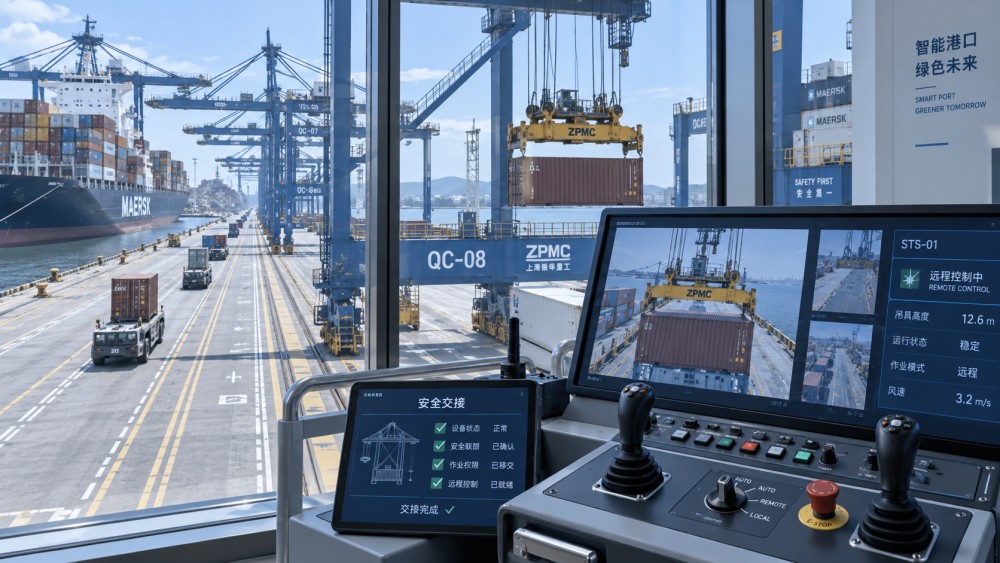
A failed handover should resolve to a defined, non-ambiguous state. If the receiving station cannot accept authority, the system should retain the previous valid state where safe, or enter the specified hold or protective response. It should not silently assign control to an unattended workstation.
Routine handovers at rest are generally easier to validate. Transfers while a load is moving require specific engineering justification, synchronized state information, and additional verification. Schedule pressure is not a sufficient reason to introduce them.
Define degraded operation before choosing network thresholds
“Stop on communication loss” sounds clear until the engineering team asks which connection has failed. Command transport, video, positioning data, safety-related communication, and the terminal operating system can degrade independently. Their failures do not necessarily require identical responses.
Create a fault-response matrix that links each monitored condition to permitted operation, protective action, operator indication, and recovery requirements. Thresholds for latency, jitter, packet loss, and image freshness should follow the task hazards and system design—not a convenient network specification.
Loss or degradation of visual information
A frozen image can look deceptively normal. Provide mechanisms to detect stale frames and make loss of required views unmistakable. Determine which cameras or other sensing functions are necessary for each movement. A missing view may prohibit landing a container while leaving other, separately assessed actions available.
Do not assume that “more cameras” automatically creates redundancy. Shared power, switches, software, or physical mounting can create common failure points.
Loss of commands or state feedback
Define how stale commands expire, how feedback validity is checked, and what happens when the operator can no longer confirm the crane’s state. The selected response may involve controlled deceleration, motion inhibition, or another engineered protective action.
An abrupt stop is not automatically the safest response in every situation. Suspended-load dynamics, brakes, hoist behavior, and nearby obstacles matter. Qualified engineers should establish the appropriate response through the crane’s risk assessment and applicable requirements.
Loss of terminal coordination
If dispatch or vehicle-interface data becomes unavailable, the crane may retain local control capability while losing permission to continue the production task. Distinguish “the crane can move” from “this move remains authorized.” Coordination with truck lanes, automated vehicles, and neighboring equipment must remain valid.
Reconnection must not trigger automatic movement. Recovery should verify the actual machine state, load status, workspace conditions, active task, and command owner before operation resumes.
The remote operator needs context, not just permission
A technically correct transfer can still fail operationally if the receiving operator does not understand the situation. Imagine taking over a crane with a suspended container, an unresolved alarm, and a task that appears complete on one display but remains active on another. The first seconds become guesswork.
The receiving interface should present a concise handover snapshot: crane identity, operating mode, load and spreader status, position, active task, outstanding alarms, movement restrictions, and relevant personnel or vehicle access conditions. Critical uncertainty should block acceptance rather than be buried in a message list.
Station design also needs to address workload. One operator supervising several automated cranes may need exclusive attention when taking manual control of an exception. Allocation rules should prevent simultaneous demands from exceeding the operator’s ability to observe and respond.
Local-to-remote coordination deserves equal attention. Define how personnel announce access, how operating areas are released, and how the remote operator confirms clearance. Radio communication can support coordination, but it should not substitute for engineered protection where the risk assessment requires it.
Put automation and remote operations through exception testing
Factory acceptance testing should exercise the authority logic, not just demonstrate crane movement from a remote desk. Site acceptance testing must then verify that the installed networks, views, interfaces, and operating procedures behave as intended under real terminal conditions.
A practical test program includes:
- Two stations requesting the same crane simultaneously.
- Transfer requests during motion or with a suspended load.
- Frozen video while command communication remains available.
- Command interruption while video continues normally.
- Receiving-station restart during handover.
- Delayed or duplicate messages arriving after ownership changes.
- Active stop conditions, maintenance access, or unresolved interlocks.
- Reconnection after the machine or task state has changed.
- An operator declining or failing to acknowledge a transfer.
Use approved simulation or controlled fault injection where physical testing could create risk. For each scenario, establish the expected state, inhibited commands, indications, recovery steps, and pass/fail criteria before testing begins.
Capture event timestamps, ownership changes, fault detections, and protective responses. Synchronized records help distinguish network problems from controller logic errors and interface misunderstandings. Commissioning teams should also verify behavior after software updates or parameter changes that affect transitions.
Make the delivery boundary visible
Control handover often sits between contracts. The crane supplier owns machine controls, an integrator supplies automation, an IT team manages connectivity, and operations develops procedures. Without a named transition-design owner, each party can deliver its package while the overall behavior remains incomplete.
The project manager should require an agreed responsibility matrix covering authority arbitration, safety functions, communication monitoring, workstation allocation, cybersecurity, operator training, and recovery approval. Authentication and access control must support the operating model; emergency response must not depend on an ordinary login session remaining available.
Before operational release, the project file should contain the approved mode map, transition requirements, risk-assessment outputs, interface definitions, test evidence, recovery procedures, and training records. Applicable crane, machinery, electrical, and functional-safety requirements should be identified with competent specialists and the relevant jurisdiction. A remote interface alone does not establish conformity.
Introduce production gradually, using defined operating envelopes and release criteria. Track aborted handovers, repeated alarms, recovery duration, and operator interventions alongside throughput. These measures reveal whether productivity depends on bypassing an inconvenient process.
For TC-Insight’s broader view of high-volume transportation, the lesson is straightforward: logistics efficiency depends on trustworthy transitions between people, machines, and scheduling systems. A crane is ready for remote operation when authority remains clear during normal work, interruptions, and recovery—not merely when it can be moved from a distant desk.
Related News
Related News
- 00
0000-00
Can digital freight logistics lower costs by reducing empty miles? - 00
0000-00
How bogie condition monitoring can reduce rolling stock downtime - 00
0000-00
How passenger capacity shapes rail equipment selection for metro - 00
0000-00
Port Crane Automation and Remote Operations: Planning Safe Control Handover - 00
0000-00
Traction Converter Core Components: Roles in Locomotive Power Conversion
Weekly Insights
Stay ahead with our curated technology reports delivered every Monday.