
What Container Automation Services Deliver for Busy Port Terminal Operations





Container automation services deliver value when they turn a terminal’s separate operating systems into a coordinated flow: shipside cranes, horizontal transport, yard equipment, gate activity, maintenance, and the terminal operating system (TOS) all work from a shared operational picture. The practical outcome is not simply fewer people in crane cabins. It is more predictable container movement, safer equipment interfaces, better use of constrained yard space, and faster recovery when vessel schedules or landside arrivals change.
For a busy terminal, automation is best understood as an operating model rather than a single technology purchase. Remote-control stations, automated stacking cranes, optical character recognition, positioning systems, equipment-control software, and scheduling algorithms each solve only part of the problem. Container automation services connect those parts, define how exceptions are handled, and keep the operation reliable over years of changing volumes, vessel calls, labor patterns, and equipment conditions.
Automation starts with control over variability
Terminal productivity is often discussed in terms of crane moves per hour, but a port does not perform well merely because one machine moves quickly. A container must be discharged or loaded at the quay, transferred through the terminal, stored in the correct location, released for onward transport, and accurately reflected in the operating system. Delays at any handoff can consume the benefit created elsewhere.
Container automation services address this chain of dependencies. They create rules for equipment movement, exchange real-time status information between systems, and direct work according to priorities that change throughout the shift. A vessel may be waiting for import boxes to clear a work zone; a rail departure may have a cutoff; reefer containers may require immediate placement; a late truck appointment may need reconciliation with gate data. The operating challenge is the ability to make these competing events visible and actionable without relying entirely on manual coordination.
The most important distinction is between automated equipment and automated operations. A terminal can deploy advanced cranes while still depending on manual dispatching, fragmented data, radio-based exception handling, or inaccurate inventory records. In that situation, capital equipment may operate more efficiently in isolation, yet the terminal remains exposed to congestion and rework. Effective automation services focus on the interfaces between machines, systems, and people.
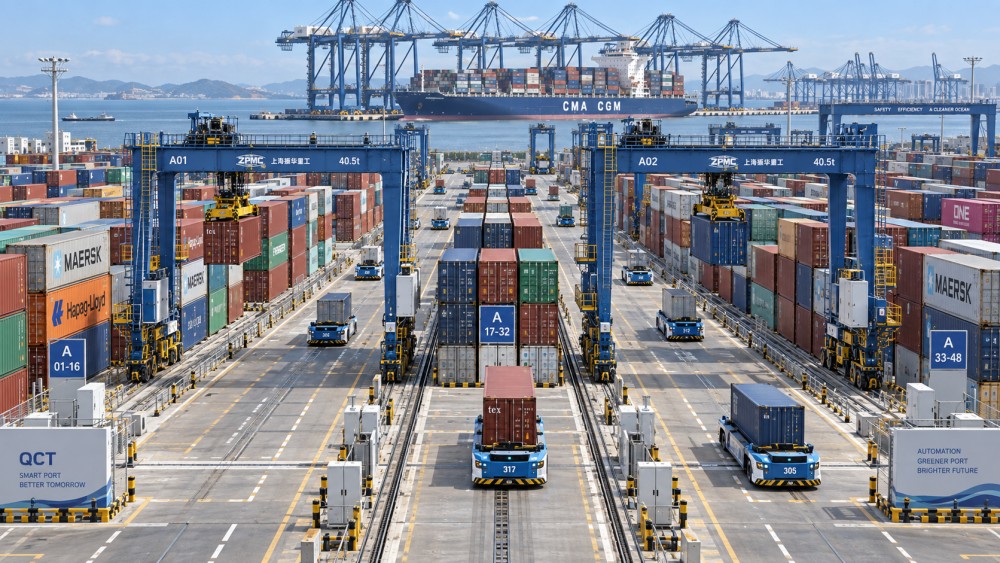
What is typically included in container automation services
The scope varies by terminal, but services usually span the design, integration, commissioning, operational support, and lifecycle optimization of automated processes. The exact technology mix depends on whether the terminal is greenfield, brownfield, partially automated, or already operating with legacy remote-control systems.
Equipment automation and remote operations are among the most visible elements. This can include automated stacking cranes (ASCs), automated rail-mounted gantry cranes, remote-controlled ship-to-shore cranes, and automated or semi-automated horizontal transport. The service requirement extends beyond the equipment itself. It includes control logic, positioning accuracy, collision prevention, work-zone management, communications resilience, and the design of remote operator workstations.
Yard orchestration is equally important. A container yard is not simply a storage area; it is a buffer between vessel, gate, rail, inspection, and inter-terminal flows. Automation platforms use container attributes, dwell status, planned moves, equipment availability, and traffic conditions to determine where boxes should go and which machine should execute the next task. Poorly designed rules can create unnecessary reshuffles, long travel distances, or equipment queues even when the machinery is technically functioning.
TOS integration provides the operational backbone. The TOS holds the intended inventory and work plan, while automated control systems translate instructions into machine tasks and return execution data. This relationship must be carefully engineered. A TOS instruction may say that a container should be moved to a block; the equipment-control layer must determine a safe route, allocate a machine, validate the position, and report task completion. If data definitions, message timing, or exception states are inconsistent, physical and digital inventories can diverge.
Gate and identification automation connects landside activity to the yard plan. OCR portals, truck identification, container-code reading, damage imaging, appointment data, and automated lane controls can reduce manual entry and improve data quality. Yet these systems do not eliminate the need for operational judgment. Incorrect bookings, unreadable markings, seal discrepancies, dangerous-goods restrictions, customs holds, and mismatched chassis or container information still require a defined intervention process.
Condition monitoring and maintenance support help protect availability. Automated terminals depend heavily on a smaller number of highly integrated assets. A sensor fault, communication interruption, drive issue, or software interface failure can affect more than one machine. Monitoring services therefore need to connect alarms to maintenance workflows, distinguish urgent operational faults from routine warnings, and preserve enough historical data to identify recurring causes rather than repeatedly resetting the same issue.
What busy operations gain—and what they do not
The clearest benefit is operational consistency. Automated workflows can apply the same safety zones, routing rules, task priorities, and confirmation steps across shifts. This reduces the variation that arises when decisions depend on individual working styles or incomplete radio communication. Consistency matters particularly in high-density yards, where a small number of poorly sequenced moves can block access to a large amount of inventory.
Automation also improves visibility. When equipment status, container location, task queues, and fault states are captured in near real time, supervisors can distinguish a genuine capacity constraint from a planning issue or a local equipment problem. This makes interventions more targeted. Instead of sending resources toward a general impression of congestion, operations can identify whether the cause is a blocked transfer point, a delayed truck flow, an unavailable crane, a system-message failure, or an unplanned concentration of work in one block.
Safety is another central outcome, especially where automation separates people from repetitive movement zones. Remote operation can remove personnel from crane cabins and reduce exposure within equipment travel areas. Automated access control, anti-collision functions, and geofenced work zones can strengthen discipline around moving machinery. However, automation does not make safety automatic. Risk shifts toward system design, maintenance isolation, remote intervention, cyber access, emergency recovery, and the boundary between automated and manually operated areas.
Labor deployment changes rather than disappears. An automated terminal requires remote operators, control-room coordinators, electrical and software maintenance teams, operations planners, cybersecurity capability, and staff able to resolve exceptions quickly. The organization must decide which tasks should be standardized by systems and which require human discretion. Treating automation as a direct headcount-reduction exercise can weaken the support functions that keep automated assets productive.
Nor does automation guarantee higher throughput under every condition. A terminal with irregular vessel windows, inadequate berth capacity, constrained road access, unreliable power supply, or insufficient landside coordination may not solve its primary bottleneck by automating the yard. The right question is not whether automation is advanced; it is whether it addresses the constraint that most limits the terminal’s service performance.
The critical role of exception management
Normal moves are relatively easy to automate. The operational test is what happens when the normal sequence breaks. A container may be out of position, a twistlock may not release, an OCR portal may fail to read a number, a truck may arrive outside its appointment, a crane may enter a fault state, or a weather restriction may suspend part of the operation. These are not marginal cases. They are part of terminal reality.
Container automation services should therefore be assessed by their exception-management design. This includes clear alarm priorities, authority levels for overrides, safe recovery procedures, manually executable fallback processes, and reliable audit trails. A control room must know not only that a task has failed, but whether it can be retried automatically, needs a remote operator, requires field intervention, or should be removed from the workflow entirely.
The speed of safe recovery often matters more than the speed of an idealized automated cycle. Systems that produce attractive performance in stable demonstrations but require complex human intervention for routine deviations can create hidden operational fragility. Robust services make abnormal conditions visible early and prevent local issues from spreading through the task queue.
Integration quality determines whether the terminal behaves as one system
Many automation projects encounter difficulty not because a crane, sensor, or software product is inherently inadequate, but because the operational interfaces were underestimated. Legacy equipment may use different communication protocols. A TOS may contain years of customized rules. Civil layouts may restrict equipment paths. Existing power and wireless networks may not support the availability required for remote operation. Data ownership can also become unclear when multiple vendors each manage part of the control stack.
Before implementation, the terminal needs a precise view of its current operating logic: who releases a move, what event confirms completion, where manual data corrections occur, which exceptions are most frequent, and which system is the source of truth for each data field. These questions sound administrative, but they determine whether a new control layer can operate safely without generating conflicting instructions.
Brownfield automation deserves particular caution. A live terminal cannot simply pause cargo operations while every process is redesigned. Phased deployment may be necessary, with selected blocks, gate lanes, cranes, or remote stations introduced while conventional operations continue nearby. The transition must account for mixed fleets, temporary operating rules, training demands, and fallback capacity. The implementation plan is therefore part of the automation solution, not a separate project-management detail.
Cybersecurity and resilience are operational requirements
As equipment becomes connected, terminal availability depends on networks, identity controls, software updates, data interfaces, and remote access practices. A cyber incident can disrupt dispatching, prevent equipment communication, compromise operational data, or force a terminal into manual procedures. The exposure is not limited to externally connected corporate systems; industrial control environments and vendor support channels also require protection.
Resilient automation design separates critical operational networks where appropriate, controls privileged access, records system changes, manages patches through tested procedures, and defines how operations continue if a component becomes unavailable. Backup arrangements must be realistic. A nominal manual fallback is of little value if staff have not maintained the skills, physical access is restricted, or the terminal cannot reconcile inventory changes after the system returns.
Decision-makers should look for an explicit operating model covering incident response, vendor responsibilities, spare-parts access, software support periods, interface documentation, and recovery ownership. Automation can increase dependency on specialized suppliers; contractual clarity and internal technical capability reduce the risk of becoming unable to modify or recover critical systems without external intervention.
How to judge whether the service model fits the terminal
A useful assessment begins with the terminal’s actual pain points. If quay cranes are regularly starved of containers because yard delivery is inconsistent, the priority may be automated yard dispatch and transfer coordination. If gate congestion is driven by poor arrival visibility and manual document checks, gate automation and appointment integration may offer more immediate value than fully automated stacking. If labor exposure in crane operations is a major concern, remote operation may be the logical starting point.
The assessment should also examine demand patterns, not only average annual volume. Peaks, call-size variability, reefer handling requirements, rail interfaces, transshipment ratios, container dwell patterns, dangerous-goods segregation, and truck-turn behavior influence the value of each automation function. A system designed around smooth, repetitive flows may struggle in a terminal with frequent plan changes unless it has strong real-time rescheduling and exception handling.
Financial evaluation should extend beyond equipment acquisition. Relevant costs include civil works, power distribution, communications infrastructure, software integration, data cleansing, training, commissioning, maintenance capability, cybersecurity controls, vendor support, and the productivity impact of phased transition. Benefits should likewise be measured broadly: predictable service levels, safer working conditions, inventory accuracy, reduced rehandles, better equipment utilization, and reduced disruption recovery time can be as important as direct labor savings.
The most durable result is a terminal that can make its operational state legible: what is moving, what is waiting, what is unavailable, what has changed, and who must act. Container automation services deliver their real value when that visibility is converted into disciplined, recoverable execution across the quay, yard, and gate—not when automation is treated as a collection of machines operating on their own.
Related News
Related News
- 00
0000-00
How rail logistics in the Middle East is reshaping freight corridor capacity - 00
0000-00
What railway rolling stock market analysis reveals about fleet demand - 00
0000-00
How axle load limits shape mainline railway freight capacity - 00
0000-00
How to match ship loaders to bulk terminal throughput targets - 00
0000-00
How high speed rail system standards shape CBTC interoperability
Weekly Insights
Stay ahead with our curated technology reports delivered every Monday.