
Rail Engineering Choices That Raise Lifecycle Costs





In rail transport, early rail engineering decisions can quietly lock operators into decades of higher maintenance, energy, and retrofit costs. For enterprise decision-makers, understanding how design trade-offs affect asset lifecycle performance is essential to protecting long-term value. This article examines the choices that raise total ownership costs and what smarter planning can do to avoid them.
Why rail engineering decisions matter beyond the construction phase
For many infrastructure owners, the most expensive rail asset is not the one with the highest purchase price, but the one that performs inefficiently for 30 to 50 years. This is why rail engineering should be assessed as a lifecycle value discipline rather than a design-only task. Track form, drainage strategy, axle load assumptions, signaling architecture, power supply design, depot accessibility, and maintainability standards all influence the full cost of ownership.
In today’s environment of tighter capital controls, decarbonization targets, and pressure for higher network availability, enterprise leaders can no longer separate engineering choices from commercial outcomes. A line that appears cost-efficient at commissioning may later suffer from excessive rail wear, poor energy performance, difficult component replacement, or disruptive retrofit programs. For operators, freight corridors, urban rail systems, and high-speed networks alike, these hidden cost drivers shape competitiveness.
This is especially relevant to intelligence-led sectors such as those observed by TC-Insight, where the performance of rolling stock, transit systems, traction power, and logistics interfaces depends on how well design assumptions match long-term operating reality. In other words, good rail engineering is not simply about making infrastructure work; it is about ensuring that networks remain efficient, adaptable, and resilient as demand changes.
What lifecycle cost means in practical rail engineering terms
Lifecycle cost includes far more than construction. It covers inspection labor, maintenance interventions, spare parts, energy use, service disruptions, renewal cycles, retrofit difficulty, safety risk exposure, and end-of-life replacement. A technically acceptable design may still be financially weak if it requires frequent possessions, complex diagnostics, or expensive specialist components.
In rail engineering, the challenge is that many cost consequences are delayed. A drainage shortcut may not cause visible problems in year one, but it can accelerate ballast fouling, track geometry degradation, and subgrade instability over time. Likewise, a signaling platform selected without open integration principles can become costly when operators later need automation upgrades, capacity enhancements, or cybersecurity improvements.
Decision-makers should therefore ask a different question at project stage: not “What is the cheapest compliant option?” but “Which option minimizes total cost while sustaining reliability, maintainability, and future adaptability?” That framing changes investment priorities significantly.
Common rail engineering choices that increase long-term costs
Several recurring design choices tend to raise lifecycle costs when they are optimized too narrowly for upfront capital savings.
- Underdesigned drainage and earthworks, leading to faster degradation of track structure and more frequent corrective maintenance.
- Tight curvature or poor alignment choices that increase wheel-rail wear, noise, energy consumption, and speed restrictions.
- Insufficient allowance for axle loads, thermal behavior, or traffic density growth, forcing earlier reinforcement or renewal.
- Closed or proprietary subsystems that make signaling, traction, communications, or monitoring upgrades expensive.
- Difficult asset access for inspection and replacement, raising labor time, downtime, and safety risk.
- Weak integration between civil works, rolling stock interfaces, and maintenance strategy.
These are not abstract engineering errors. They directly affect service reliability, asset utilization, and operating margin. On busy mixed-traffic networks, poor early rail engineering decisions can multiply possession costs because interventions must be scheduled around passenger slots, freight windows, and logistics commitments.
Industry context: why the issue is becoming more urgent
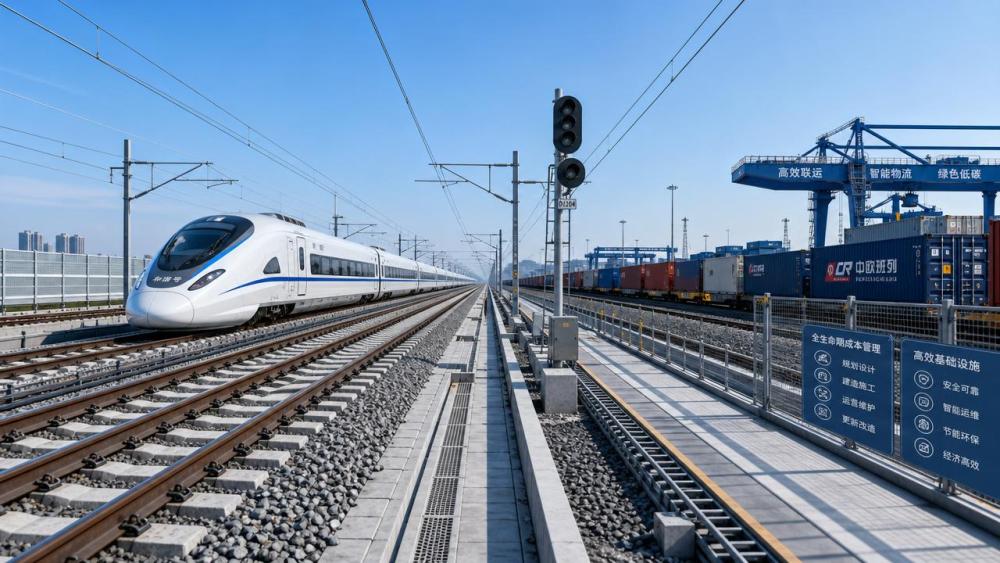
The global transport equipment sector is entering a period in which network efficiency and asset intelligence matter as much as physical expansion. Mainline railways are carrying heavier and more complex freight flows. Urban transit systems face higher frequency expectations and tighter punctuality standards. High-speed corridors demand precision in infrastructure condition, power quality, and passenger comfort. At the same time, ports and inland logistics hubs increasingly rely on synchronized rail interfaces to keep cargo moving without delay.
This creates a broader systems challenge. When rail infrastructure performs poorly, the effect extends beyond the track itself. It can reduce terminal throughput, limit rolling stock productivity, increase traction energy demand, and weaken supply chain reliability. That is why enterprise decision-makers in integrated transport and logistics should treat rail engineering as a strategic cost-control function, not just a technical specialty.
Another factor is digitalization. Modern operators increasingly expect condition monitoring, predictive maintenance, automated traffic control, and data-led asset management. Designs that do not support sensor deployment, secure communications, or interoperable control architecture may become operational bottlenecks long before the infrastructure itself reaches physical end of life.
Where lifecycle cost risks usually appear
The table below highlights where lifecycle cost pressure often emerges and what executives should watch in project reviews.
Business value of stronger rail engineering discipline
Better rail engineering decisions create value in four ways. First, they improve asset availability. Reliable infrastructure supports timetable stability, freight slot certainty, and more productive fleet deployment. Second, they lower operating expenditure by reducing intervention frequency, energy waste, and unplanned failures. Third, they extend asset usefulness by enabling modular upgrades instead of disruptive full replacement. Fourth, they strengthen strategic flexibility, allowing a railway to respond to traffic growth, automation needs, and environmental regulation with less friction.
For enterprise leaders, this matters because rail systems are long-cycle assets embedded in broader economic networks. A design that reduces annual maintenance pressure by even a modest percentage can unlock major value over decades, especially on high-volume corridors and urban systems where every hour of disruption has downstream commercial consequences.
Typical scenarios where design trade-offs become costly
Lifecycle risks show up differently depending on the operating context.
- Heavy-haul freight lines: underestimating axle load growth or traction demand can accelerate fatigue, increase power supply constraints, and force expensive reinforcement.
- Urban rail transit: station, depot, and systems interfaces that are hard to maintain can drive recurring nighttime access costs and reduce service recovery speed.
- High-speed networks: tolerances, aerodynamics, and power quality decisions have outsized impact on ride comfort, wear patterns, and energy performance.
- Port and logistics rail links: limited signaling flexibility or yard geometry can restrict throughput and undermine automated cargo coordination.
Across these scenarios, the pattern is consistent: a narrow project-stage optimization often becomes a network-stage cost burden. Strong rail engineering avoids this by connecting design with operational reality from the start.
How decision-makers should evaluate engineering options
A practical evaluation framework should combine technical, operational, and financial views. Boards and investment committees do not need to review every engineering detail, but they should insist on visibility into the assumptions that shape future cost exposure.
- Request lifecycle cost models, not only capital expenditure summaries.
- Test design assumptions against future traffic growth, automation needs, and decarbonization requirements.
- Review maintainability, access safety, spare parts strategy, and intervention duration early.
- Favor interoperable and upgrade-ready systems where technology evolution is likely.
- Use digital asset management requirements as part of engineering scope, not as an afterthought.
- Compare options by net present value of ownership, including disruption and renewal effects.
This approach is particularly useful for organizations managing mixed portfolios of rail, transit, and logistics infrastructure. It aligns with the intelligence-led perspective advanced by TC-Insight, where engineering choices are evaluated in relation to system efficiency, resilience, and long-term operational value.
Practical recommendations for reducing lifecycle cost exposure
Enterprises can improve outcomes by embedding several practices into project governance. First, involve operations and maintenance teams during concept development, not only during handover. Second, define performance targets around reliability, energy, and maintainability alongside delivery milestones. Third, prioritize design simplicity where possible, because complexity often raises fault sensitivity and specialist dependency. Fourth, create upgrade pathways for signaling, power, communications, and data systems so that modernization can occur in stages.
It is also wise to treat condition monitoring infrastructure as part of core rail engineering. Sensors, diagnostic access, and structured asset data can significantly reduce uncertainty in maintenance planning. Finally, organizations should review whether procurement models encourage the wrong behavior. Contracts focused only on lowest initial price may discourage lifecycle optimization, while performance-based frameworks often produce stronger long-term outcomes.
A strategic view for enterprise leaders
The central lesson is simple: early engineering decisions shape decades of economic performance. In a world of dense urban mobility, transcontinental freight pressure, digital traffic management, and synchronized logistics hubs, weak design choices do not stay local. They spread through maintenance budgets, operating plans, energy bills, service quality, and competitiveness.
For enterprise decision-makers, the most effective response is to treat rail engineering as a strategic investment discipline grounded in lifecycle thinking. When design, operations, and commercial planning are stitched together from the beginning, networks become more resilient, more efficient, and better positioned for future demand. That is the difference between building infrastructure that merely functions and building assets that sustain value over time.
Organizations seeking stronger insight should build internal review frameworks that connect engineering assumptions to long-cycle asset performance, technology evolution, and logistics system outcomes. That is where better decisions start, and where lifecycle costs can be controlled before they become unavoidable.
Related News
Related News
- 00
0000-00
How port machinery systems reduce container handling bottlenecks - 00
0000-00
How smart port logistics systems reduce container dwell time - 00
0000-00
How transport equipment intelligence analysis identifies bottlenecks - 00
0000-00
How rail technology advancements are reshaping signaling standards - 00
0000-00
What is driving growth in the global EMU market size?
Weekly Insights
Stay ahead with our curated technology reports delivered every Monday.