
Can Digital Intelligence Increase Terminal Throughput Without New Equipment?





Digital intelligence can increase terminal throughput without replacing cranes, conveyors, stackers, reclaimers, or yard vehicles—but only when the terminal’s current constraint is poor coordination rather than a hard physical limit. The distinction matters. A terminal with idle equipment, uneven shift performance, excessive rehandles, avoidable truck queues, and weak maintenance visibility may unlock meaningful capacity through better decisions. A terminal already constrained by berth length, crane lifting capability, conveyor belt capacity, rail discharge rate, or yard footprint will not solve that problem with software alone.
The practical question is not whether digital tools are “better” than new equipment. It is whether the next tonne, container move, or vessel call is being lost to a physical bottleneck or an information bottleneck. In many operations, both exist. The value of digital intelligence lies in identifying which constraint is active at a given time and directing existing assets accordingly.
Throughput is a flow problem, not an equipment-count problem
Terminal capacity is often described through asset specifications: crane moves per hour, conveyor tonnes per hour, stacker travel speed, rail unloading time, or nominal yard capacity. These figures are necessary, but they are not the same as delivered throughput. A ship-to-shore crane may have available lifting capacity while containers are unavailable in the correct sequence. A bulk conveyor may be rated for a higher flow than the upstream reclaiming system can sustain. A yard may contain enough slots in aggregate while the usable slots near the active work zone are unavailable.
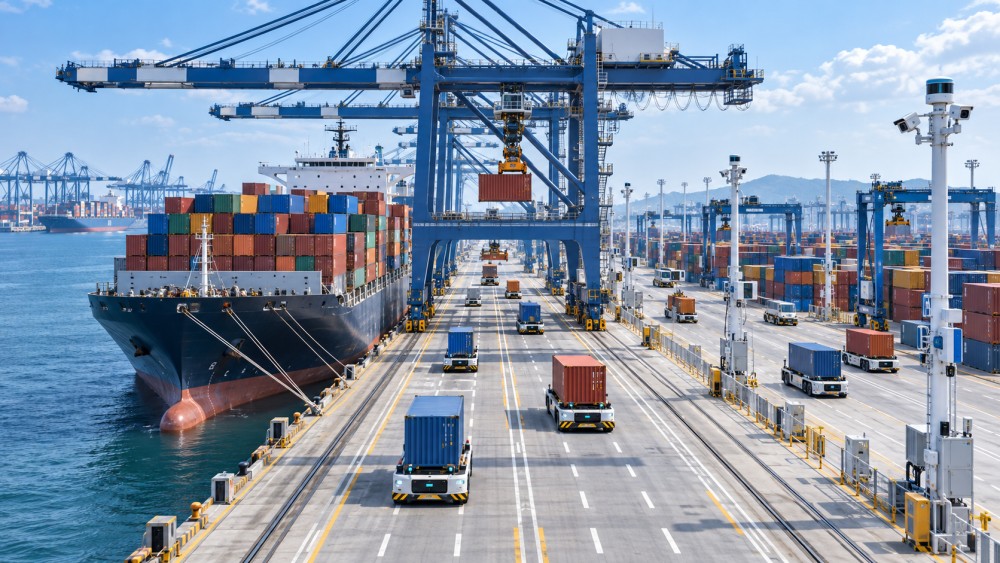
Actual output depends on the continuity of the whole operating chain. For a container terminal, that chain may include berth planning, crane allocation, vessel stowage sequence, horizontal transport, yard block availability, gate activity, rail interface, and customs or release status. In a bulk terminal, it can include vessel arrival, berth assignment, stockpile quality, reclaiming sequence, conveyor routing, transfer-point availability, loading rate, dust-control constraints, and downstream transport readiness.
When one link operates without timely awareness of the others, productive equipment waits. Digital intelligence is most useful when it reduces this waiting: waiting for instructions, for cargo release, for a vehicle, for an available stockpile route, for an operator decision, or for a maintenance response.
This is why the answer to “Can digital intelligence improve terminal throughput without replacing equipment?” is qualified but substantial: it can improve the use of installed capacity; it cannot repeal mechanical, spatial, environmental, or regulatory limits.
Where digital intelligence differs from conventional terminal control
Most terminals already use some combination of terminal operating systems, SCADA platforms, maintenance software, spreadsheets, radio communication, and manual dispatching. The difference is not simply the presence of software. It is the ability to combine operational data, predict conflicts, test alternatives, and turn recommendations into executable work instructions before disruption becomes visible on the quay or in the stockyard.
Conventional control is often retrospective or rule-based. It records moves, displays alarms, assigns work through fixed rules, and leaves exceptions to supervisors. Digital intelligence adds a more dynamic layer: it can use current equipment status, location data, queue conditions, work priorities, cargo attributes, and predicted task durations to recommend the next best sequence.
The comparison should not be framed as software versus machinery. Equipment creates the physical envelope within which a terminal can operate. Digital intelligence determines how much of that envelope is accessible on an ordinary day, under a disrupted schedule, or during a high-volume operating window.
The areas where existing equipment usually has recoverable capacity
Yard and stockpile planning is often the first area to examine because it affects almost every downstream move. In container yards, weak planning can produce unnecessary reshuffles, long travel distances, block congestion, and late discovery that export boxes or import deliveries are buried beneath less urgent cargo. In bulk yards, an inefficient stockpile sequence can create avoidable reclaiming travel, contamination risk, imbalance between grades, or conveyor route conflicts.
An intelligent planning layer can evaluate more variables than a manual planner can reasonably hold in mind during a live shift: cargo priority, vessel cut-off, dwell time, reefer requirements, hazardous-cargo segregation, rail departure windows, stack height restrictions, anticipated truck arrivals, reclaiming quality requirements, and equipment availability. Its value is not that it produces a mathematically elegant plan. Its value is that it reduces the number of moves that add no cargo-flow value.
Crane, vehicle, and conveyor sequencing is another source of latent capacity. A crane’s headline cycle time says little about the gaps between cycles. Those gaps may come from vehicle imbalance, poor job sequencing, incomplete work instructions, downstream congestion, or a delayed handover between systems. Dispatch optimization can reduce empty travel and prevent several vehicles from converging on the same work area while another crane or loading point waits.
For bulk operations, route selection is equally important. Where multiple conveyors, transfer towers, ship loaders, reclaimers, or storage routes exist, the operationally obvious route is not always the highest-throughput route. A decision engine can account for current belt loading, equipment condition, maintenance isolations, stockpile access, blend requirements, and the expected duration of a task. This does not increase the rated capacity of a conveyor; it can reduce the time spent using the network in a suboptimal configuration.
Exception management may generate more value than routine optimization. Terminals rarely operate under perfect schedules. A late vessel, rain event, mechanical fault, customs hold, labour changeover, power interruption, or delayed train can invalidate a carefully prepared plan. If replanning depends on telephone calls, disconnected spreadsheets, and repeated manual checks, recovery consumes time that cannot be regained.
Digital intelligence can support faster recovery by showing the operational consequence of each alternative: moving labour to a different workfront, shifting cargo to another block, changing a loading sequence, protecting a rail cut-off, or rerouting bulk material through an available line. The system need not make every decision autonomously. In many safety-critical or commercially sensitive situations, its most appropriate role is to present feasible options and make trade-offs visible to the duty manager.
What software cannot fix
There is a risk in treating “digital” as a universal capacity answer. It is not. A terminal should distinguish operational losses from structural constraints before approving an optimization program.
If vessels routinely wait because berth occupancy is physically high and no alternative berth exists, better scheduling may improve predictability but cannot create waterfront. If crane productivity is limited by lifting height, outreach, rail gauge, hoist condition, or a required safe operating envelope, the solution may involve refurbishment or replacement. If the rail siding cannot accept longer trains, the gate has insufficient lanes, or the conveyor has a fixed low-capacity section, the limiting asset remains physical.
Likewise, digital systems cannot safely compress mandatory inspections, statutory rest requirements, cargo segregation rules, environmental restrictions, or safe separation distances. A plan that maximizes moves while ignoring operational safeguards is not intelligent optimization; it is an unsafe instruction set.
The most difficult situations are mixed constraints. A bulk loader may be physically capable of a higher loading rate, but only when material is available at the right quality and the reclaiming route is clear. A container terminal may have sufficient cranes, but yard density makes landside retrieval slow. In such cases, digital intelligence can reveal whether a modest targeted investment—such as a transfer-point upgrade, additional sensors, improved communications coverage, or a yard-layout change—would release more capacity than major equipment procurement.
Data quality determines whether optimization is operationally credible
Digital decision-making is only as useful as the operating picture behind it. The basic requirement is not an elaborate data architecture; it is trustworthy status information for the decisions being automated or supported.
For container operations, relevant inputs may include container identity, location, status, booking or delivery constraints, dangerous-goods attributes, reefer status, planned vessel sequence, equipment position, job progress, and gate or rail events. For bulk terminals, the critical data set may focus on inventory location, material quality, moisture or blending constraints where relevant, equipment availability, conveyor status, route configuration, loading target, and maintenance isolations.
Data latency matters as much as data completeness. A system that knows a vehicle was available ten minutes ago may dispatch work poorly in a rapidly changing yard. Location data that is accurate only at the zone level may be adequate for tactical planning but insufficient for close-proximity automation. Equipment condition data may support maintenance prioritization, but it should not be confused with a diagnosis unless the sensing, failure logic, and validation process are appropriate for that conclusion.
Integration is another practical dividing line. A terminal operating system, SCADA environment, crane control layer, maintenance platform, gate system, and enterprise planning system may each hold a valid part of the truth. If their timestamps, asset identifiers, and status definitions conflict, an optimization model can generate recommendations that look plausible but cannot be executed reliably.
The comparison that matters: capital avoidance versus constraint displacement
Digital intelligence is often attractive because it appears to avoid the cost and disruption of new equipment. That can be true, but capital avoidance should not become the only business case. The stronger comparison is between removing avoidable operational loss and displacing a real constraint elsewhere in the system.
For example, faster quay crane cycles may increase yard workload. Better gate appointment management may shift congestion to inspection areas. More aggressive reclaiming schedules may increase wear on transfer points or reduce maintenance windows. A local productivity improvement is valuable only if the next process can absorb it without causing a more expensive failure mode.
This requires measurement at the flow level. Useful indicators include time lost between planned and actual task start, non-productive travel, rehandle rate, queue duration, unplanned route changes, equipment idle time with work waiting, completion reliability against vessel or train schedules, and the frequency of manual plan overrides. These metrics reveal why throughput is being lost. A single average productivity number can conceal severe variability between shifts, locations, cargo types, or weather conditions.
It is also important to separate capacity from resilience. A terminal may achieve an impressive peak rate during a short, controlled window yet perform poorly when a vessel sequence changes or a key machine becomes unavailable. Digital intelligence can be valuable even where average output changes modestly if it improves the terminal’s ability to recover from disturbance without creating cascading delay.
Implementation should begin with a bounded operating decision
Large transformation programs frequently fail to show early operational value because they attempt to model every process at once. A more credible starting point is a bounded decision with a measurable consequence: assigning internal transport jobs, selecting a bulk-material route, prioritizing maintenance response for production-critical assets, sequencing export stacks, or managing truck arrivals against available yard capacity.
The selected decision should have four characteristics. It must recur frequently enough to matter, involve trade-offs that are currently difficult to manage manually, have data that can be made sufficiently reliable, and remain within clear human and safety authority. A recommendation engine for vessel-work sequencing may be useful, for example, while direct autonomous control of safety-sensitive machinery requires a much higher level of assurance and integration.
Operational adoption is as important as algorithm quality. Supervisors need to understand why a recommendation is being made, what assumptions it uses, and when it should be overridden. If dispatchers view the system as a black box that ignores local constraints, they will create parallel manual processes. The result is not human oversight; it is fragmented control.
Cybersecurity and continuity planning also belong in the throughput discussion. A terminal that becomes more digitally connected may improve coordination, but it also increases dependence on networks, interfaces, identity management, backup procedures, and recovery discipline. The operating model should define how work continues when a feed is delayed, a sensor fails, an optimization service is unavailable, or a system is placed into a safe degraded mode.
When an equipment investment remains the better answer
New equipment is justified when analysis shows that the bottleneck is persistent, measurable, and physical. That might mean a loading line that is saturated during normal operating conditions, a crane fleet with insufficient availability despite disciplined maintenance, a yard whose geometry no longer supports required volumes, or a berth interface that prevents efficient vessel handling.
Even then, digital intelligence remains relevant. It can establish the baseline that supports the investment decision, test whether an additional machine will actually receive enough work, determine where to place it, and verify whether expected gains materialize after commissioning. Without this operational visibility, terminals risk buying capacity that remains underused because the original loss was caused by poor synchronization rather than inadequate machinery.
The most defensible conclusion is therefore not that terminals should digitize instead of investing in assets. It is that they should understand the flow before choosing the asset. Where coordination failures consume productive time, digital intelligence can release capacity from the installed base. Where the physical envelope is genuinely exhausted, software can clarify the case for equipment—but it cannot substitute for it.
Related News
Related News
- 00
0000-00
What determines port crane intelligence pricing for terminal upgrades? - 00
0000-00
Rail equipment intelligence in Southeast Asia is reshaping fleet investment - 00
0000-00
Selecting Abrasion Control Systems for High-Wear Mining Transfer Points - 00
0000-00
Which rail engineering standards govern a new freight line design? - 00
0000-00
Can Digital Intelligence Increase Terminal Throughput Without New Equipment?
Weekly Insights
Stay ahead with our curated technology reports delivered every Monday.