
Why Cutter Suction Dredgers Lose Production in Variable Soil Conditions





Why Cutter Suction Dredgers Lose Production in Variable Soil Conditions
A dredging operation can appear stable for hours and then lose output abruptly when the cutterhead reaches a different layer of material. Operators may see lower slurry concentration, rising discharge pressure, cutter overload alarms, pipe vibration, repeated blockage, or a drop in advance rate. In many cases, the pump and engine are still running, but the dredger is no longer removing and transporting material efficiently.
Variable soil conditions are a common reason. A borrow area, river channel, pond, harbor basin, or reclamation site rarely contains one uniform material from surface to design depth. Loose sand may sit above compacted sand, clay lenses, silt pockets, gravel seams, shells, organic deposits, or weathered rock. Each material responds differently to cutting, suction, mixing, and pipeline transport. A production figure achieved in one layer should not automatically be used as the expected output for the next.
For operators, the practical issue is not simply whether the dredger can cut the soil. It is whether the complete dredging system can maintain a stable balance between excavation, slurry formation, pump capacity, and discharge transport as conditions change.
Production loss usually begins with a mismatch
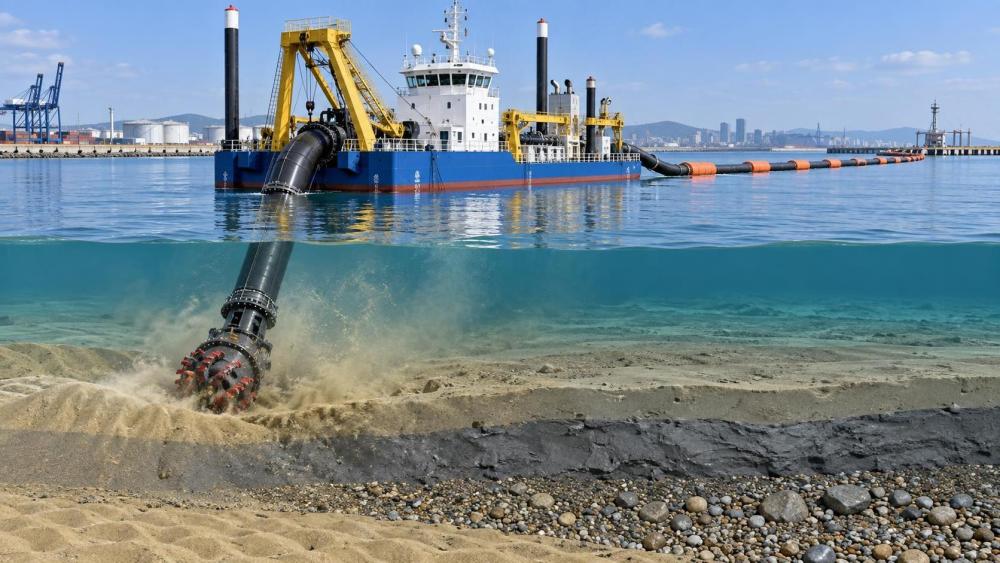
A cutter suction dredger works as a connected system. The cutterhead loosens material, the suction inlet captures it, the dredge pump moves the slurry, and the discharge line carries it to the placement area. Production falls when one part of that chain cannot match the others.
In loose, uniform sand, the cutter may excavate easily and the suction flow can carry a relatively consistent mixture. When the soil suddenly becomes denser or more cohesive, the cutter may require more torque while producing less pumpable material. If the operator keeps advancing at the same rate, the cutter can stall, the suction mouth may become poorly fed, or oversized pieces may enter the system. If the operator slows too much without adjusting other settings, the slurry can become too diluted, reducing useful solids output despite acceptable flow readings.
The key point is that “running” is not the same as “producing.” A dredger may consume fuel, crew time, and wear parts while moving mostly water or repeatedly recovering from unstable operating conditions.
Different materials create different operating problems
These conditions can occur within a short distance. A dredging plan based only on broad soil descriptions may not capture thin hard layers, clay pockets, buried debris, or abrupt changes in moisture and compaction. Operators need to treat changing behavior at the cutterhead and pipeline as useful field information, not just as equipment trouble.
Why cutter settings alone cannot solve the problem
When output drops, crews often focus immediately on cutter speed. Cutterhead revolutions do matter, but increasing speed is not a universal answer. A higher speed can improve cutting in some loose or moderately compact materials, yet it may also accelerate tooth wear, create excessive turbulence, or break material into a slurry that contains too much water. In cohesive soil, more rotation may polish or smear the clay rather than feed it effectively into the suction inlet.
Advance rate is equally important. If the ladder advances too quickly into dense material, cutter torque rises while the suction system may receive irregular chunks instead of a controlled mixture. If the advance rate is too low in loose material, the cutter can churn the face without maintaining a productive solids feed. Swing speed, side-step distance, ladder depth, and cutterhead positioning all influence how consistently material enters the suction zone.
Operators should look for a stable relationship among cutter load, pump vacuum, discharge pressure, slurry flow, and visible solids delivery. Any single indicator can be misleading. A high discharge pressure, for example, may indicate a dense slurry, but it can also suggest growing resistance in a long pipeline or the early stage of a blockage. Low vacuum may reflect easy excavation, air leakage, insufficient submergence, or poor material capture. The operating context matters.
The pipeline often reveals the real constraint
Variable soils affect the pipeline as much as the cutterhead. A slurry that moves well through a discharge line in fine sand may become unstable when clay lumps, gravel, fibrous material, or coarse particles enter the mixture. If velocity falls below the level needed to keep heavier solids moving, material can settle in low sections, bends, joints, or floating pipeline transitions. Repeated flushing may restore flow, but it also adds nonproductive time and can make daily output look better than the actual solids delivered.
Longer discharge distances amplify this issue. More pipeline adds friction loss, and elevation changes add further resistance. A dredger that performs acceptably near the placement area may lose considerable output when the line is extended. Operators should not assume that a pump’s nominal capacity will translate directly into usable production at the end of a changing pipeline route.
Air ingress is another frequent source of instability. Worn suction-side seals, loose connections, inadequate submergence, vortex formation, or poor priming can introduce air into the system. The result may resemble a soil problem: fluctuating pressure, reduced suction, surging flow, and erratic output. Before changing the entire cutting strategy, crews should verify that the hydraulic circuit is sound.
A practical field check when output falls
A disciplined troubleshooting sequence can prevent unnecessary adjustments and reduce the chance of damaging equipment. The following order is useful because it separates excavation problems from transport problems:
- Compare current readings with the last stable operating period. Record cutter load, pump speed, suction condition, discharge pressure, flow behavior, ladder angle, and advance rate. A single reading has limited value; changes from normal conditions are more informative.
- Inspect the material being excavated. Observe spoil, sample the material where practical, and note whether the dredger has entered a harder, stickier, coarser, or debris-containing layer.
- Check cutterhead and suction intake condition. Missing teeth, worn adapters, damaged liners, clogged openings, and accumulated clay can sharply reduce cutting and intake performance.
- Confirm pipeline condition. Look for leaks, air entry, soft hoses, damaged couplings, sharp bends, settlement areas, and signs of partial blockage.
- Adjust one operating variable at a time. Change advance rate, swing speed, ladder position, cutter speed, or pump setting in controlled steps. Multiple simultaneous changes make it difficult to identify the cause of improvement or deterioration.
- Document the layer transition. A brief log of location, depth, soil behavior, and successful settings helps crews anticipate the same material elsewhere on site.
Machine configuration matters before the project starts
Production losses in mixed soils are not always caused by poor operation. They can result from selecting a dredger around an optimistic production target without examining the material range, discharge distance, and expected interruptions. A machine suited to loose sand may not have the cutter power, cutterhead geometry, pump margin, wear protection, or pipeline arrangement needed for dense sand and clay layers.
When evaluating a cutter suction dredger, buyers should consider the entire duty profile rather than focusing only on headline capacity. Useful questions include whether the expected soil description is based on actual investigation, how often hard or cohesive layers are likely to occur, how far material must be transported, whether the discharge route changes during the project, and what access is available for maintenance. The correct configuration depends on the combination of these conditions.
Cutter power and pump power should be assessed together. A powerful cutter with insufficient pumping capability may produce material that cannot be transported efficiently. Conversely, a large pump cannot compensate for a cutterhead that cannot penetrate or effectively break the material. Wear-resistant components also deserve attention in abrasive sands and gravel-bearing deposits, because loss of cutter teeth, liners, or pump efficiency can gradually reduce production long before a visible failure occurs.
What buyers should question when considering a cheap YLCSD 550
The label “cheap” can obscure the operating questions that determine actual project cost. For a YLCSD 550 or any similarly described dredger, the purchase price should be separated from the cost of lost production, replacement parts, mobilization delays, pipeline modifications, and downtime in difficult material. A lower initial price may be appropriate for a straightforward, shallow, low-abrasion job, but it should not be treated as proof that the unit will perform equally across variable soils.
Buyers should request a clear scope of supply and compare it against the job requirements. The review should cover the cutterhead arrangement, tooth and adapter system, dredge pump construction, available spare wear parts, pipeline compatibility, control instrumentation, electrical or engine configuration, and the practical limits of maintenance access. If hard inclusions, abrasive sand, or long discharge distances are expected, those conditions should be stated in the technical discussion rather than left as assumptions.
Acceptance planning is also important. Instead of relying on a broad claim about output, purchasers can define how the machine will be inspected, what operating documents will be supplied, what components are included, and which site conditions affect achievable production. Soil variability should be recognized explicitly: performance in free-flowing sand is not a reliable proxy for performance in dense clay, mixed gravel, or a long discharge line.
Operator habits that protect sustained production
Stable output usually comes from deliberate control rather than maximum settings. Crews benefit from maintaining a shift log, monitoring wear before it becomes severe, and communicating soil changes between operators. A change in cutter sound, ladder vibration, pressure pattern, or spoil appearance can provide an earlier warning than a full production collapse.
Planned flushing and pipeline inspection should be based on material behavior, not only on a fixed schedule. Where coarse solids or cohesive material are expected, operators may need to reduce the risk of settling by managing slurry velocity and avoiding prolonged low-load operation with solids in the line. In loose material, the priority may be preventing excessive dilution and keeping the cutterhead properly engaged with the face.
Variable soils cannot be eliminated, but their impact can be managed. The most reliable approach is to connect field observation with controlled adjustments, pipeline checks, realistic equipment selection, and maintenance discipline. When operators understand which part of the system is limiting production, they can respond to changing ground conditions without turning every slowdown into a costly interruption.
Related News
Related News
- 00
0000-00
How port machinery systems reduce container handling bottlenecks - 00
0000-00
How smart port logistics systems reduce container dwell time - 00
0000-00
How transport equipment intelligence analysis identifies bottlenecks - 00
0000-00
How rail technology advancements are reshaping signaling standards - 00
0000-00
What is driving growth in the global EMU market size?
Weekly Insights
Stay ahead with our curated technology reports delivered every Monday.