
Where Rail Transport Still Beats Road on Total Cost





For business evaluators comparing freight modes under real operating constraints, rail transport still outperforms road in specific high-volume, long-distance, and corridor-based scenarios. When total cost includes fuel volatility, labor intensity, asset utilization, emissions pressure, and network efficiency, the advantage becomes clearer. This article explores where rail transport continues to deliver stronger economic value and why that matters for strategic logistics decisions.
Why a checklist works better than a generic mode comparison
For commercial reviewers, the biggest mistake is to compare freight modes only by quoted rate per ton or per truckload. That approach hides the real economics. A corridor may look cheaper by road in a spot quote, yet become more expensive once recurring delays, driver shortages, damage rates, carbon costs, and terminal congestion are included. A checklist method is more practical because it forces teams to verify the operating conditions that decide whether rail transport creates total cost advantage.
This matters across integrated supply chains, from bulk materials and industrial components to containers linked with ports, inland terminals, and manufacturing clusters. For organizations evaluating long-cycle logistics structures, the right question is not whether rail is always cheaper than trucks. The right question is where rail transport still beats road on total cost after all operational variables are tested.
Start with these five decision triggers
Before building a detailed model, evaluators should confirm whether the shipment profile fits the classic conditions where rail transport has structural cost strength.
- Is the shipment volume large enough to support regular train loading, block train service, or repeatable wagon utilization rather than occasional ad hoc moves?
- Is the route long enough that line-haul efficiency can outweigh first-mile and last-mile handling costs?
- Does the corridor have stable infrastructure, terminal access, and reliable scheduling instead of fragmented interchange risk?
- Are the goods heavy, dense, or standardized enough that truck flexibility adds less value than rail scale efficiency?
- Will emissions targets, fuel exposure, or labor constraints materially affect the total cost comparison over the contract term?
If the answer to at least three of these questions is yes, rail transport deserves deeper analysis rather than being screened out early.
Core checklist: where rail transport usually wins on total cost
1. High-volume bulk flows
Rail transport remains especially strong in coal, ore, aggregates, grain, cement inputs, chemicals, and other bulk flows where payload density is high and delivery patterns are continuous. In these cases, truck fleets require more drivers, more equipment cycles, and more fuel per ton moved. Rail lowers line-haul cost by concentrating large tonnage into fewer movements, often with better predictability on major corridors.
Business evaluators should verify not just freight rate, but loading efficiency, wagon turnaround, unloading dwell, and storage synchronization. When origins and destinations are both equipped for rail handling, the total delivered cost often favors rail by a meaningful margin.
2. Long-distance inland freight lanes
The longer the lane, the more likely rail transport can offset its terminal interfaces. This is particularly true where road haulage faces toll accumulation, driver hour limits, maintenance wear, and rising diesel exposure. In cross-regional or transcontinental lanes, rail can stabilize cost over time because one locomotive crew and one train path can replace a large number of truck trips.
The break-even distance varies by region, network design, and cargo type, but evaluators should treat distance as a trigger for analysis, not a conclusion by itself. A long lane with poor terminal access may still disappoint, while a well-served intermodal corridor can make rail transport highly competitive.
3. Port-hinterland and corridor-based container movements
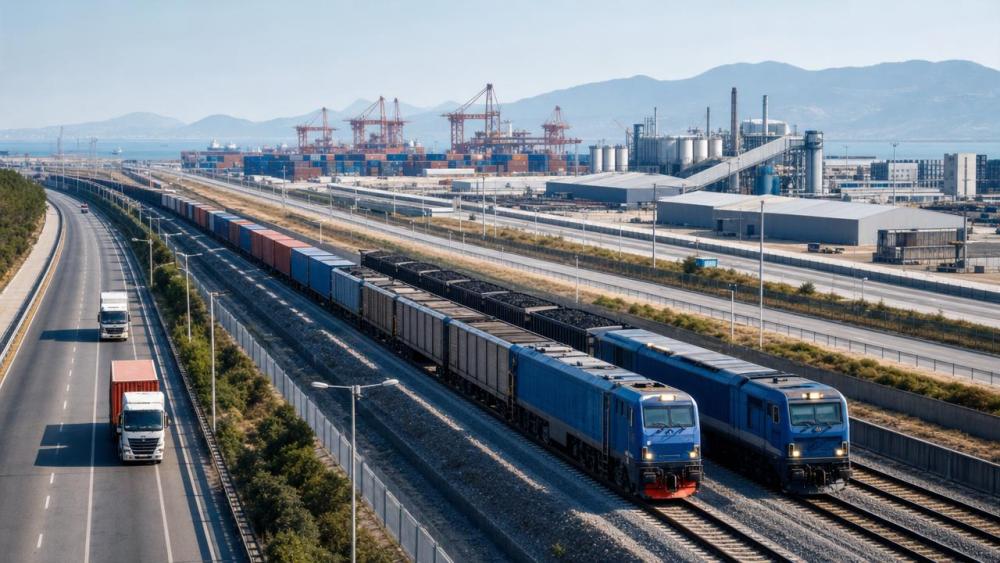
Where port cranes, inland terminals, and scheduled rail services are well integrated, rail transport can outperform road on both cost and network resilience. Container drayage by truck remains necessary, but the expensive middle section of the journey can often be shifted to rail. This is especially valuable in congested trade gateways where truck queues, chassis shortages, and labor peaks drive hidden costs.
For evaluators in broader logistics or industrial sectors, this is not only a transportation question. It is also a node-efficiency question. The economics improve when rail reduces gate pressure, shortens yard congestion, and improves equipment cycle planning across the supply chain.
4. Repetitive industrial supply chains
Factories, steel plants, power assets, and large processing sites often benefit from rail transport when inputs and outputs move in stable, forecastable patterns. Repetition improves asset utilization. Once loading windows, siding capacity, and shipment rhythm are aligned, rail can reduce the per-unit cost of moving large volumes compared with dispatching trucks daily under variable market conditions.
This is where strategic planning matters. A rail-linked supply chain may require more up-front coordination, but the long-run economics can be superior if the business has consistent throughput and limited tolerance for fuel or driver market volatility.
5. Carbon-sensitive procurement environments
More tenders now weigh emissions alongside price. When customers, regulators, or investors apply carbon accounting to transport decisions, rail transport gains relevance because it generally offers lower emissions per ton-kilometer than road freight. That advantage may not appear in today’s invoice, but it can become a cost factor through reporting obligations, green procurement scoring, future carbon pricing, or customer retention.
For business evaluators, the practical point is simple: if sustainability metrics influence contract awards or compliance costs, total cost cannot be measured on freight spend alone.
A practical comparison table for screening rail transport opportunities
Use the following quick screen before launching a full commercial study.
Scenario differences evaluators should not overlook
For bulk logistics
Focus on throughput continuity, axle load capability, loading automation, unloading speed, and stockyard integration. Rail transport is strongest when stoppages are expensive and inventories are sized around reliable train cycles.
For containerized trade
Review port dwell time, crane productivity, drayage cost, and terminal slot reliability. The more synchronized the corridor, the more rail transport can cut the total inland movement cost.
For manufacturing supply chains
Check whether production schedules can absorb rail’s fixed departure logic. Rail works best when the plant values stable replenishment and can consolidate shipments rather than depending on last-minute road dispatch.
Common hidden costs that distort the comparison
Many internal reviews underestimate road cost because some items sit outside the transport budget. Business evaluators should actively test the following risk areas:
- Fuel volatility over the full contract period rather than the current quarter.
- Driver shortage exposure, overtime, and compliance constraints.
- Congestion delays at ports, city approaches, and border crossings.
- Damage, pilferage, or cargo handling losses across many truck touchpoints.
- Asset underutilization caused by empty repositioning and poor backhaul balance.
- Future carbon reporting or low-emission procurement penalties.
When these items are priced correctly, rail transport often looks stronger than the first-rate sheet suggests.
Execution checklist: what to gather before making a mode-shift decision
If a company wants to test rail transport seriously, the first step is disciplined data collection. Evaluators should prepare:
- Annual and monthly shipment volumes by lane, including seasonality peaks.
- Cargo density, packaging form, damage sensitivity, and loading constraints.
- Origin and destination infrastructure details, including siding or terminal access.
- Required transit time, acceptable variability, and service recovery expectations.
- Current road cost structure broken into line haul, waiting time, tolls, fuel, and exceptions.
- Sustainability targets, reporting obligations, or customer procurement criteria.
With that information, teams can model not just nominal freight rates but total landed logistics cost, inventory effects, and risk-adjusted performance.
Final decision guide for business evaluators
Rail transport still beats road on total cost when freight is heavy, volumes are repeatable, distances are meaningful, and corridor conditions are supportive. It becomes even more compelling when labor intensity, fuel exposure, terminal congestion, and emissions accountability are added to the model. Road freight remains essential for flexibility and distribution reach, but flexibility is not always the lowest-cost answer.
For companies assessing the next step, the most useful discussions are practical ones: confirm lane volumes, terminal compatibility, service frequency, handling interfaces, expected transit stability, carbon reporting needs, and contract horizon. If those parameters are clear, the comparison between road and rail transport becomes less theoretical and far more actionable for strategic logistics planning.
Related News
Related News
- 00
0000-00
How port machinery systems reduce container handling bottlenecks - 00
0000-00
How smart port logistics systems reduce container dwell time - 00
0000-00
How transport equipment intelligence analysis identifies bottlenecks - 00
0000-00
How rail technology advancements are reshaping signaling standards - 00
0000-00
What is driving growth in the global EMU market size?
Weekly Insights
Stay ahead with our curated technology reports delivered every Monday.