
What Makes Smart Logistics Worth the Investment?





For finance decision-makers, smart logistics is no longer a speculative upgrade but a measurable investment in resilience, asset utilization, and long-term cost control. As transport networks grow more complex, the real value lies in better visibility, faster decisions, and stronger returns across rail, port, and bulk handling operations. Understanding what makes smart logistics worth the investment starts with linking operational intelligence to financial performance.
Why scenario differences matter before approving smart logistics spending
The biggest mistake in evaluating smart logistics is treating it as a single technology purchase. In reality, smart logistics creates value differently in each operating environment. A port terminal may justify investment through crane automation and yard throughput. A rail freight operator may gain more from predictive maintenance, timetable optimization, and wagon visibility. A bulk handling site may prioritize uptime, safety, and energy efficiency over pure speed.
For financial approvers, this means the right question is not simply, “Is smart logistics valuable?” but rather, “In which business scenario does it create measurable returns first?” This scenario-based view reduces approval risk because it connects capital expenditure to operational bottlenecks, margin pressure, and asset performance. It also helps separate strategic investments from fashionable but low-impact digital projects.
In sectors linked to railways, urban transit, port machinery, and bulk material handling, organizations increasingly rely on intelligence platforms such as TC-Insight to interpret how equipment automation, control systems, and network-level visibility influence financial outcomes. When capital assets are expensive and service lives are long, smarter logistics decisions have a compounding impact.
Where smart logistics delivers the strongest return
Smart logistics is most valuable in operations where delays, idle assets, manual coordination, and fragmented data directly affect cost and revenue. Finance teams should look first at scenarios with high transaction volume, tight scheduling, expensive equipment, and rising service expectations. These conditions make inefficiency visible and improvement quantifiable.
1) Mainline rail freight networks
In mainline railways, smart logistics supports locomotive utilization, wagon tracing, route planning, and maintenance timing. The financial upside comes from fewer unplanned outages, better load balancing, and improved network reliability. For operators managing long-haul freight, even small reductions in dwell time can translate into significant annual savings.
2) Container ports and intermodal terminals
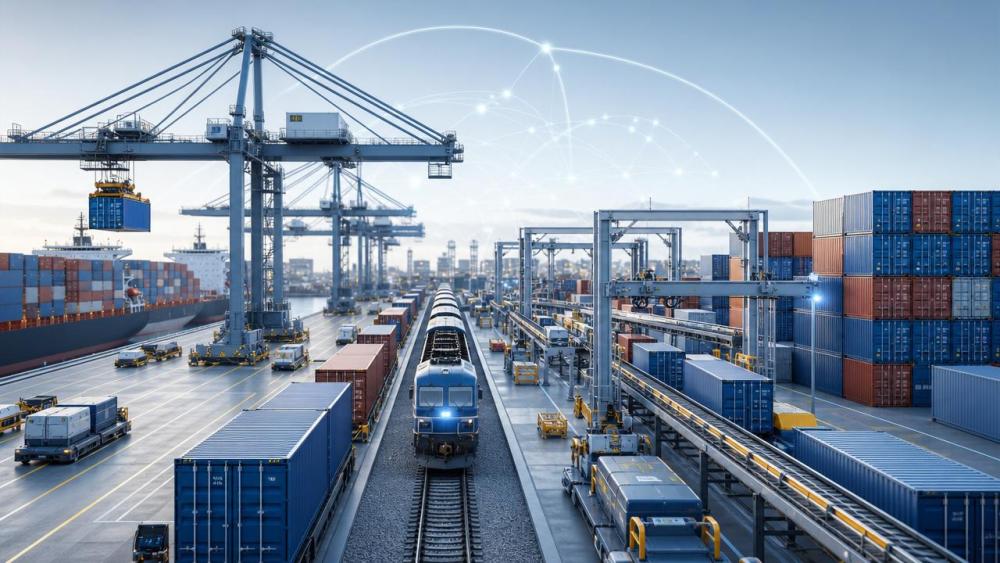
At ports, the investment case often centers on automated cranes, gate scheduling, yard management, and remote operations. Smart logistics improves vessel turnaround, reduces rehandling, and enables stronger labor productivity. For finance leaders, this is one of the clearest cases because throughput gains and congestion costs are easier to model.
3) Bulk material handling operations
For mines, coal terminals, and continuous conveyor-based systems, smart logistics is less about package-level tracking and more about flow stability. Sensors, predictive diagnostics, and automated dispatching help avoid stoppages that can trigger severe downstream losses. In this scenario, return on investment often depends on reducing unplanned downtime and protecting safety compliance.
4) Urban rail and high-frequency transit support
Although urban rail is often discussed from a passenger perspective, smart logistics also matters in spare parts flow, fleet readiness, signaling maintenance support, and depot efficiency. For cities and operators under budget pressure, the value lies in extending asset life, preventing service disruptions, and improving workforce deployment.
Scenario comparison: what finance teams should evaluate first
A practical way to assess smart logistics is to compare operating scenarios by bottleneck, value driver, and expected payback logic. The table below helps financial approvers quickly identify where an investment may deserve priority.
How value priorities change by operating scenario
Not all smart logistics projects should be judged by the same metrics. A common approval failure occurs when companies demand a uniform payback model across very different assets and workflows. Scenario fit matters.
When speed matters most
Ports, intermodal hubs, and high-volume transfer points benefit most when smart logistics shortens cycle times. Here, finance teams should track moves per hour, queue reduction, berth productivity, and labor leverage. Revenue capture may improve because capacity is effectively expanded without immediate physical expansion.
When reliability matters most
In rail freight and bulk material systems, reliability often creates more value than raw speed. Smart logistics helps coordinate traction assets, monitor component health, and reduce service interruption. In these cases, the strongest business case may come from avoided losses rather than visible volume growth.
When compliance and safety drive the decision
For hazardous, high-load, or heavily regulated environments, smart logistics can reduce incident exposure and strengthen auditability. The financial return includes avoided penalties, lower insurance pressure, and a lower probability of catastrophic interruption. This logic is especially relevant where manual control creates hidden risk.
What finance approvers should verify before saying yes
A high-quality smart logistics proposal should present more than technical ambition. It should show how digital capability links to operating economics. Before approval, finance leaders should verify five conditions.
- There is a clearly defined bottleneck, such as asset idling, congestion, downtime, or energy overuse.
- The project has measurable baseline data, allowing before-and-after comparison.
- The implementation scope matches operational maturity; over-complex deployments often delay returns.
- Integration risk with legacy equipment, signaling, or terminal systems has been priced in.
- The benefits include both direct savings and strategic gains such as resilience, continuity, and customer service quality.
This is where intelligence-led evaluation becomes useful. Insight into rail equipment trends, automation logic, and supply chain behavior can improve capital timing and help avoid technology choices that are impressive on paper but weak in practical return.
Common misjudgments in smart logistics investment
Even strong organizations can misread where smart logistics works best. One common error is investing in top-layer dashboards without fixing data capture at the equipment or process level. If wagon location data is delayed, or if crane operating signals are inconsistent, the analytics layer will not deliver dependable results.
Another mistake is assuming labor reduction is the only justification. In many transport and industrial scenarios, the bigger gain comes from stabilized output, fewer disruptions, and stronger asset utilization. Especially in rail and bulk logistics, the cost of interruption can exceed the cost of staffing inefficiency.
A third misjudgment is copying another operator’s architecture without matching it to local traffic, equipment age, energy costs, and maintenance capability. Smart logistics is highly context-dependent. What performs well in a large automated port may not fit a regional rail node or a mixed-manual bulk terminal.
How to match smart logistics investment to enterprise scale
Large networks and asset-heavy operators can often justify end-to-end smart logistics programs because small efficiency improvements multiply across fleets, terminals, and corridors. Mid-sized enterprises may benefit more from phased adoption: start with visibility, then add predictive maintenance, then automate planning. Smaller operators should focus on the one or two process points where poor coordination causes the greatest financial drag.
For finance decision-makers, phased rollout usually lowers risk. It creates a cleaner audit trail for returns and helps management distinguish between foundational digital infrastructure and later-stage optimization tools. In capital-intensive sectors, this sequencing can protect cash flow while still building long-term capability.
FAQ: scenario-based questions about smart logistics
Is smart logistics only worth it for very large operators?
No. Large operators may see bigger absolute gains, but smaller organizations can also benefit if they target a high-cost constraint such as asset downtime, dispatch inefficiency, or poor inventory visibility. The key is selecting the right scenario, not the biggest technology stack.
Which scenario usually shows the fastest payback?
Container terminals and high-throughput transfer points often show faster payback because throughput, queue time, and equipment productivity are easier to monetize. However, in bulk handling or rail freight, avoided disruption may deliver equally strong long-term value even if the return appears less immediate.
What should be included in a smart logistics business case?
A credible case should include baseline operating data, implementation scope, integration cost, expected process improvements, risk reduction value, and a clear timeline for measurable outcomes. It should also specify which operating scenario is being addressed and why that scenario is the best starting point.
A practical next step for finance-led evaluation
Smart logistics becomes worth the investment when the scenario is right, the bottleneck is real, and the return path is measurable. For finance approvers in rail, port, urban transit, and bulk logistics environments, the most effective approach is to start with one question: where does operational friction produce the most expensive inefficiency today?
From there, align the investment with a specific use case, define the operating and financial metrics, and validate whether the organization has the data discipline to support execution. Intelligence platforms like TC-Insight can strengthen this assessment by connecting equipment trends, automation developments, and supply chain shifts to investment timing. In a world shaped by transcontinental networks and digital operations, smart logistics is not valuable because it is advanced. It is valuable because, in the right scenario, it turns complexity into control and control into return.
Related News
Related News
- 00
0000-00
How port machinery systems reduce container handling bottlenecks - 00
0000-00
How smart port logistics systems reduce container dwell time - 00
0000-00
How transport equipment intelligence analysis identifies bottlenecks - 00
0000-00
How rail technology advancements are reshaping signaling standards - 00
0000-00
What is driving growth in the global EMU market size?
Weekly Insights
Stay ahead with our curated technology reports delivered every Monday.